





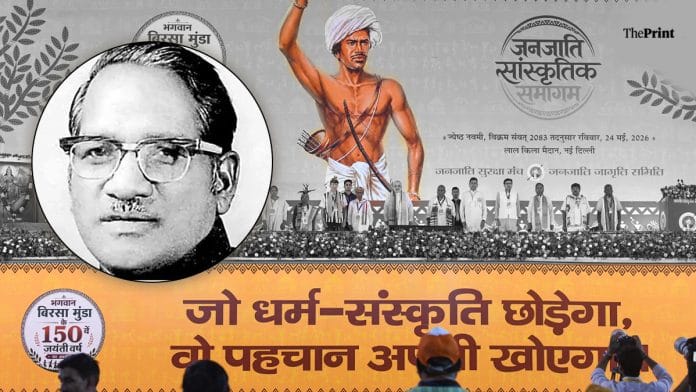

New Delhi: Nearly two lakh tribals attended the Sangh Parivar-organised Janjati Sanskritik Samagam at New Delhi’s Red Fort on 24 May with one major demand— that ‘converted’ tribals should be denied benefits that come along with the Scheduled Tribe (ST) status. A Congress Member of Parliament’s assertions from the 1960s and 1970s are now the basis of arguments being made by these tribal groups.
Kartik Oraon’s name features in the latest demand by the Janjatiya Suraksha Manch (JSM), an organisation backed by the Vanvasi Kalyan Ashram (VKA), the tribal welfare wing of the Rashtriya Swayamsewak Sangh (RSS). The organisation has urged Prime Minister Narendra Modi to bar from seeking reservation benefits all those who abandon tribal faith, customs and culture after conversion.
The JSM submitted a memorandum to the Prime Minister and President Droupadi Murmu on 28 May, apprising them of the ills of such conversions. “As the late Dr Kartik Oraon had noted in Parliament in 1970, at that time merely 10 per cent of converted tribals were cornering nearly 70 per cent of ST reservation benefits, while 90 per cent of the genuine tribal population received only 30 per cent. This imbalance has only widened since,” the Manch said in a press release.
Oraon was a prominent tribal leader, and a three-time member of the Lok Sabha from Lohardaga constituency, in erstwhile Bihar. He went on to become a Union Minister in Indira Gandhi’s Cabinet as well. His speeches in the Parliament often raised several issues pertaining to the tribes— from the funds being spent on their welfare, to the concerns over tribals converted to Christianity receiving benefits of ST status. He passed away in 1981, following a heart attack while attending Parliament.
Kartik Oraon’s daughter, Geetashree Oraon, a Congress leader and former Jharkhand minister, asserts that her father’s name is being “misused and misappropriated”.
“Presently, the intention behind invoking his name again is to fit tribals into the idea of a Hindu nation by the BJP and RSS,” she told ThePrint, adding, “They say that my father said Sarna-Sanatan is one. Where has he said it? He just said, ‘stay in your original faith’. They are misleading people.”
Also Read: How a 1994 case led to landmark SC ruling upholding inheritance rights of tribal women
Poll apart
One of the most well-documented arguments made by Oraon is in a court document from 1963. Contesting on a Congress ticket, Oraon had lost his Lohardaga seat, reserved for the Scheduled Tribes. Swatantra Party candidate David Munzni won the seat, after which Oraon filed an election petition challenging the validity of the election.
Among other things, Oraon had alleged that the two other candidates fighting for the seat, including Munzni, were both Indian Christians and were, therefore, not entitled to contest the seat. The ancestors of the two candidates were from the Oraon tribe— a listed Scheduled Tribe in Bihar— but the candidates had since embraced Christianity. Oraon asserted that the two candidates had nothing to do with the animistic faith and tribal way of life, that they did not follow the manners and customs of the tribes, and that they had no affinity nor any common interest, defence or aspirations for the tribal people.
After Oraon’s election petition was rejected by the Election Tribunal, he approached the Patna High Court. In its verdict of November 1963, the court ruled that from the evidence produced, it appeared that even if a non-Christian Oraon omitted to celebrate certain festivals and celebrated some other festivals differently, he or she did not cease to be one. It even laid emphasis on the fact that non-Christian Oraons treat the converted Oraons as tribals calling them ‘Christian Oraons’.
“The very fact that the converted Oraons are called ‘Christian Oraons’ shows that they are Oraons first and Christians next,” the court had observed in rejecting Oraon’s petition.
10 percent anomaly
Oraon had also taken the issue of converted tribals to Parliament. In May 1968, he had asked the Minister of Home Affairs if the government was aware that 90 percent of the posts reserved for members of Scheduled Tribes both in the state and central government, including Class I posts, were filled up by those who had converted to Christianity. He had also asked whether the government was aware that those who had converted to Christianity formed only a tenth of the tribal population.
In response, Deputy Minister in the Ministry of Home Affairs K.S. Ramaswamy had responded that the “Scheduled Tribes may belong to any religion” and that information regarding Scheduled Tribes belonging to Christian and other religions recruited to Central Services was not available.
In July 1967, Oraon pointed out in Parliament that the Orissa government had, right after Independence, issued a notification to say that the criterion for becoming a member of the Scheduled Tribes was to hold that only those people who “profess tribal religion” should be recognised as members, and that those who convert to Christianity would be recognised as Other Backward Classes instead.
In May 1968, he reiterated, “I would like to know from the government whether it is in their active knowledge that the tribes are 90 percent and the tribal converts will not be more than 10 percent of the total tribal population and that these tribal Christians are taking government privileges guaranteed under the Constitution in inverse proportion to their population— privileges like matriculation scholarships, government service, foreign scholarships, etc.”
Oraon also seems to have led the signing of a memorandum submitted by 322 MPs to then Prime Minister Indira Gandhi. As per Parliamentary debates from the time, the memo “brought out how the ignorant and backward tribals are exploited by the converted Christians or Christian tribals”.
Also Read: If there’s any group who has the right to rule over India, it’s Adivasis: Jaipal Singh Munda
Joint Committee report
The suggestion to exclude those who had given up their tribal faith and converted to Christianity or Islam also came in the form of a Parliamentary Joint Committee report.
The Scheduled Castes and Scheduled Tribes Orders (Amendment) Bill 1967, which aimed to provide for the inclusion and the exclusion from the lists of Scheduled Castes and Scheduled Tribes of certain castes and tribes, was introduced in Parliament in August 1967.
This Bill was sent to a Joint Parliamentary Committee that submitted its report in 1969. It had considered the question whether a member of the Scheduled Tribes should continue to be treated as such after conversion to another religion other than a tribal religion.
“The committee is of the opinion that no person who has given up the tribal faith or faiths and has embraced Christianity or Islam should be deemed to be a member of a Scheduled Tribe,” it said.
However, the government expressed its reservations over this specific amendment, with the Minister of Law and Social Welfare K. Hanumanthaiya calling it a “controversial matter”. Speaking about the Bill in November 1970, he said that after examination, the government has found that “constitutionally such an amendment is not sustainable because it discriminates between converts to Christianity and Islam on the one hand and converts to other religions on the other”.
“If conversion from a tribal to individual religion is made a disqualification, then most of the Scheduled Tribes would be de-Scheduled,” he had asserted.
Supporting the Bill are approved by the Joint Committee, Oraon told Parliament in November 1970 that if the Bill was defeated, “there will be large-scale conversions; the Christian missionaries will think that they have got a licence for conversion and that the government is behind them and no attempt afterwards, whatsoever, will be able to detract them from conversions”.
While the members debated the Bill for a few days during the Winter Session of Parliament in 1970, the government on 25 November moved a motion to adjourn the debate on the Bill. The Lok Sabha was dissolved prematurely in December 1970 and the Bill lapsed.
Sarna-Sanatan debate
Geetashree distinguishes between the Sarna community, which does not identify as Hindu or Christian, and the Hindu religion.
“When they say Sarna-Sanatani ek hain (are one), how are they one? They don’t know what Sarna is. They are people who are completely steeped in the Hindu faith. Our customs, birth and death, everything is very different,” she told ThePrint. “You’re saying that Christians should be delisted. If it is about tribal people leaving their religion and adopting another religion, then let’s talk about Sanatan also. Then they (tribals who follow Sanatan Dharma) should also be delisted.”
She refuses to accept the similarity between tribes and those following Sanatan Dharma merely on the basis of them being nature worshippers.
“The conversation does not stop there. Our day-to-day rituals are extremely different. No worship at a Sarna site is considered complete without a sacrificial offering. Does that happen at temples?” she asked.
Prakash Kumar, former district judge and now President of Bharatiya Adimjati Sevak Sangh, however says that the faith of tribals is connected to Sanatan. “Sarna pooja is basically nature worship, like worshipping Tulsi or Peepal. This is a part of Sanatan already. So Sarna is not different from Sanatan,” he says.
Kumar also rejects the idea of a demand for a separate Sarna religious code, pointing out that over 900 tribes are currently listed as Scheduled tribes. “All tribes are separate communities and all of them have their own rituals and customs. Why would all communities accept one Sarna code?” he asked.
“It (tribal living) is a panth (way of life), not religion. The concept of religion has come from Christianity and Islam. In Sanatan also, we just believe in nature and worship it,” he added.
During a press conference last week, Akhil Bharatiya Vanvasi Kalyan Ashram president Satyendra Singh had asserted that the word ‘Sarna’ originates from Jharkhand. The place of worship of the tribal society is called ‘Sarna sthal’. This is Nagpuri language, he said, referring to the Chhota Nagpur Plateau in Jharkhand.
He claimed that it was Archbishop Telesphore Placidus Cardinal Toppo who spread the word for the demand for a ‘Sarna Dharma Code’. Toppo was the country’s first tribal cardinal.
‘20 years of darkness’
Oraon’s arguments for the welfare of the tribes seems a little more layered, talking about acceptance of the tribes as a standalone religion.
For instance, during a Parliamentary debate in August 1967, Oraon asserted that “we must first accept the tribes as a religion of their own— the tribal religion which is called animism”.
In his book, Bees Varsh ki Kaali Raat (Twenty years of darkness), as shared by Geetashree, Oraon had written, “If Adivasis are to survive, then their culture, civilisation, traditions, and Adi Dharma must be kept alive.” The book goes on to assert that if the government wishes, it can “provide full support to our Christian brothers as backward classes, but they should not receive the benefits we deserve”.
“Just as Scheduled Castes have a provision to preserve their culture, civilisation, tradition, and religion, such that anyone who leaves Hinduism and Sikhism and embraces another religion is not considered a member of a Scheduled Caste, a similar amendment for tribal people could save their lives,” it adds.
Geetashree asserts that the concerns raised by her father pertained to a different era, and at the time, the concerns were not baseless. “His concern was that people of the tribes should be proud of their rich heritage, and the fact that they never bowed down before anybody. Even the Britishers understood that tribals would never come into our fold, which is why they identified scheduled areas separately,” she told ThePrint. “The situation now is very different.”
(Edited by Nardeep Singh Dahiya)
Also Read: Karnataka’s Koraga tribe to urban renters—UN report highlights India’s housing inequality
सुप्रीम कोर्ट के आदेश दिनांक 05 जनवरी 2011 के अनुसार आदिवासी इस देश का मालिक है, बाकी सब नागरिकता धारी है,
जिनके रितिरिवाज adiआदिवासीयों से मेल नहीं खाते वे, सब विदेशी है,
जय जोहार.