



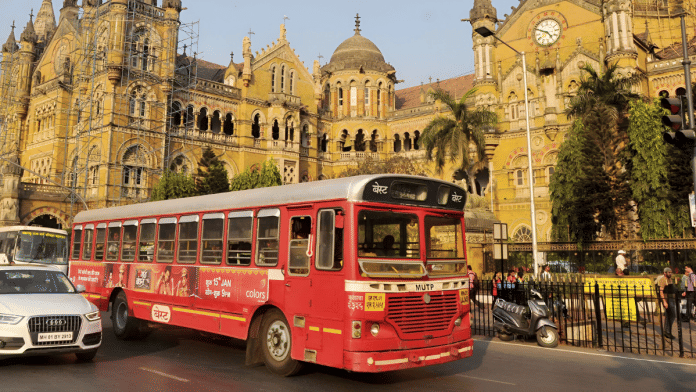
Mumbai: The iconic red buses, especially the beloved double-deckers, have long been a defining feature of Mumbai. From featuring in multiple Bollywood movies and songs like ‘Jaanu Meri Jaan’ in the 1970s and 80s, Mumbaikars have fond memories of the red bus criss-crossing across the metropolis.
For the city, it was the obvious commuting choice after the suburban railway network. However, 40 years later, Mumbaikars’ romance with these buses has seemingly run its course.
In a city that has millions of commuters, there are only around 2,700 buses. A host of challenges, from operational hurdles and financial losses to accidents and a shrinking fleet, the Brihanmumbai Electric Supply & Transport (BEST) undertaking, responsible for Mumbai’s public bus transport system, is looking for ways to again become passengers’ go to choice. And, one of the plans was the Rs 28,000 crore ‘Kayapalat plan’.
On Thursday, the Brihanmumbai Municipal Corporation’s general body approved BEST’s ‘Kayapalat’ plan and cleared the proposal to redevelop 22 out of its 27 bus depots under a public private partnership (PPP) model.
With this new plan, the BEST hopes to pay off its liabilities, help arrest financial losses, and add buses to its fleet.
The 22 depots will be converted into urban mixed-use urban centres to generate revenue for the loss-making entity. The first phase will focus on modernising the ageing bus depots and staff quarters, followed by the development of designated public parking and social infrastructure like schools, hospitals, among others.
The redevelopment will be carried out through the Design, Build, Finance, Operate, and Transfer (DBFOT) model, with BEST retaining ownership of the land.
“We are leasing these depots and not selling or giving them away. No need to worry,” BEST Committee chairperson Trushna Vishwasrao told the media.
Over the past decade, funding crunch, mounting losses, and a shrinking fleet have all contributed to the decline of this once-proud symbol of the city.
“The budget sanctioned by the BMC (Brihanmumbai Municipal Corporation) is only about Rs 1,000 crore, which is very low,” a BEST official told ThePrint. “We have to find other ways to fund the undertaking. This new project will help us take care of our liabilities and also purchase new buses.”
Since 2013, the BMC has been providing budgetary support to the BEST. That came to end six years on, when the BEST budget was merged with the BMC’s to help bail out the cash-strapped undertaking.
However, it has not been enough, BEST officials said. Since the merger of the budgets, BEST has received only 2-5 percent of overall BMC’s budget, which runs in thousands of crores annually, according to them.
The dwindling bus fleet is one of the main issues that the undertaking is facing. As of 18 August, there are 2,789 BEST buses, out of this BEST owns only 249 of them. Based on the city’s population, Mumbai should have nearly 12,000 buses.
It comes as no surprise that the daily ridership has come down from 45 lakh to around 20 lakh commuters, which means there are 1.45 buses for every 1,000 passengers.
Since 2022, the BEST has given orders for electric buses and new mini and midi buses. However, the official quoted above said that the contractor has not yet fulfilled the orders.
BEST requires at least 7,000-8,000 buses to operate efficiently, according to Vishwasrao.
Also Read: Mumbai’s iconic BEST bus crippled by chronic ailments. Age, mounting bills & a shoestring budget
Past its prime?
BEST introduced the single-decker bus in 1926, followed by the double-decker bus in 1937. The double-deckers gained immense popularity over the decades. By the 1990s, BEST had nearly 900 of them.
However, as Mumbai grew and infrastructure developed, the old models weren’t practical, and the ageing ones were decommissioned without any replacements.
The growing app-based taxis, private vehicles, shared taxis and rickshaws all dented BEST’s prospective ridership, resulting in huge losses to the undertaking.
It was impractical to maintain double-deckers and larger buses. Because of this, the BEST started using midi and mini buses but the balances continued to bleed. To arrest these losses, during Municipal Commissioner Ajoy Mehta’s tenure, the wet-lease model was introduced in 2019, shifting bus operations to private contractors.
However, some officials believe this was also one of the reasons for BEST’s downfall. “Since the drivers and buses are not owned by BEST, it doesn’t inculcate discipline in them. That is why there are so many accidents as there is no accountability,” the official quoted above said.
In 2022, BEST had a fleet of 3,400 buses, with an additional 3,000 e-buses to be added by the end of 2023. By the end of next year, BEST wants to convert all its fleet-around 10,000 buses-to electric-powered.
But, BEST owns only 249 buses of its own while the rest are on wet lease. So far, 938 buses (including 154 double-deckers) have been received and the delivery is staggered across 2026-2027. Currently, it has only 1,324 electric buses, out of which 50 are double-decker.
Another problem plaguing the BEST buses is the frequency at which they get into accidents. In 2026, the BEST buses were involved in multiple accidents with 3 major accidents in July alone.
BEST officials blame it on wet lease drivers who are less trained. The public utility plans to conduct a special refresher training course for the wet lease/on contract drivers on maintaining discipline while on road, BEST PRO Sunil Vaidya told the media.
Given these circumstances, the BEST administration hopes that redeveloping and monetising the depots will generate revenue to restore the former glory of Mumbai’s red buses.
(Edited by Tony Rai)
Also Read: No longer the ‘BEST’, Mumbai’s iconic bus service plagued by leadership void, financial troubles