





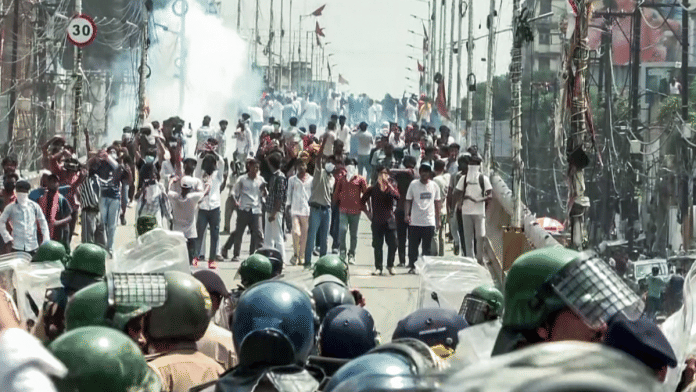


New Delhi: Released from jail after the Supreme Court barred coercive action against student protesters without criminal antecedents, students and activists arrested across Bihar, West Bengal and Maharashtra say the fear has not ended. They allege brutal lathicharge, detention without due process, threats, and uncertainty over whether the FIRs against them will ultimately be quashed.
“On 25 July we were sitting near Gandhi Maidan gate 10 when the Bihar police rushed towards us and began lathicharging. The male officers did not care if the protesters were male or female,” said Ashish Kumar, a second year Sociology student at Patna University. Kumar was one of the several students who were allegedly lathicharged, and then arrested by the Bihar Police following their protest against the brutalities against students in Delhi on 20 July.
“The Bihar police in a press conference had allowed students to hold a peaceful protest but as soon as two-three students gathered, they began lathicharging. Tired of this treatment, some of us sat down near Gandhi Maidan and refused to leave. That is when they lathicharged and detained us,” said Kumar. According to the student, at least 22 people were detained alongside him—many of whom minors. “Bohot nasha hai protest karne ka, career barbad kar denge (you want to hold protests, we will destroy your careers), the officers said,” Kumar told ThePrint.
He further alleged that his phone was snatched away and not until 26 July night was he able to speak to a friend or family. “We were not given food or allowed to contact anyone. We were first not told the grounds for arrest and then we were coerced into signing a blank arrest memo,” Kumar said. He was then moved to Beur jail where he was kept till late 29 July night.
Now, out of jail, Kumar worries the police will still persecute him. “We have been assured that there will be no FIRs but have not received any communication from the police,” said Kumar. Kumar has not been given a copy of the FIR, and does not know if he has been named specifically or as a member of a group.
Kumar was released in Bihar and several like him were released in Maharashtra, West Bengal and Assam after the Supreme Court said that no coercive action should be taken against student protesters without criminal antecedents.
Speaking to ThePrint, Kassey Suhita Anupam ADG (law and order) said that the Bihar Police was extremely sensitive with the handling of minors. “We sent all the minors to observation homes and did not keep them with the adults who were detained. Following the orders of the Honourable Supreme Court we have almost completed the process of releasing all the adults who were arrested and have released all the minors,” said the officer. She added that the police have submitted all details related to the accused to the learned counsel of the state and the matter related to the quashing of FIRs will be overseen by the judiciary.
Several kilometres away in West Bengal, Arshad Ali, one of the 16 people arrested in the state, was also worried about the FIR against him.
He was identified by facial recognition technology, arrested and later paraded on the road for the “sake of recreation of crime scene”.
“I had spent less than 30 minutes at the protest and a day later there were several charges against me and I was behind bars. Is peacefully protesting a crime?” asked Ali. A resident of Amherst Street in Kolkata, and a parent of a student, he had joined the protest rally from Metro Cinemas.
“I walked a bit alongside the protesters and then came back home. The next morning a few local BJP leaders came to my house and threatened me for participating in the protest,” said Ali. He went to his local police station where he was told that the matter needed to be addressed at Lal Bazaar, the police headquarters. “When I reached there, they made me wait in the office and soon detained me. Next thing I know I was arrested, but for what?” asked Ali.
In West Bengal, there were 7 FIRs related to the CJP protest, 4 filed by the state, 2 filed on suo motu cognisance and 1 filed by a journalist for being harassed and heckled by anti-social elements who were part of the protest. The 16 people who were subsequently arrested were not initially named in the FIRs, ThePrint has learnt. “The FIRs were registered against unknown persons and the names were later added as and when the police identified them through facial recognition technology,” said a source.
Ali and 15 others were released on 28 July, after senior Advocate Sayed Nafirul Islam took the lead to represent the 16 people arrested following the protest in Kolkata. “Arshad Ali and many like him were falsely framed by the state police. The police did not submit anything to substantiate their claims in the forwarding report before the court,” said Islam. Taking cognisance of both the forwarding report and the Supreme Court’s order the court granted Ali and 15 others bail.
“Prima facie no material before the court shows that any of the accused persons has any criminal antecedent. In view of the order passed by the honourable Supreme Court and the forwarding report of the investigating officer this court is inclined to grant bail to all accused persons,” the court observed.
Speaking to ThePrint, a senior Kolkata Police officer said that the accused had been identified through CCTV footages. “We have submitted all relevant evidence before the court, and the judiciary will decide if the FIRs are to be pursued or quashed. Nobody who has been associated with violence will be spared,” he said.
In Mumbai, Tabrez Ali Syyed is awaiting the confirmation regarding the quashing of the FIR against him. “The Mumbai Police has filed four separate FIRs against me,” exclaimed Syyed. The FIRs were registered in police stations in Mahim, Shivaji Park and Azad Maidan.
“We had first protested on 10 July outside Mumbai University, from where I was first detained. Then after Sonam Wangchuk was forcibly removed from Jantar Mantar, we protested again, following which the police registered an FIR against five people which included me,” said Syyed. He added that amongst the five was the name of Sudhir Dhawala who was named in the Bhima Koregaon and Elgar Parishad case, even though he was not even part of the protest.
On 19 July when the UBT called for a protest on the students’ issues, while agreeing in principle, Syyed did not reach the protest site. “Despite that I was named in an FIR for that that day as well,” he added.
He told ThePrint that following the 20 July protest, a police van monitored the movements of his family members and threatened his wife and mother. “Soon after I gave a call for a hunger strike in Powai. Then they detained me, called me tadipar, used cuss words for my mother and wife,” he added.
Syyed was released on 22 July around 11.30 pm after sustained pressure from protesters, he says. He has received four notices informing him the sections under which he has been booked but no confirmation on the status the FIRs.
“No protester has been named without proper evidence against them. In any case all details related to protesters named in the FIRs have been submitted to state counsel,” a senior Mumbai Police officer said. At present there are at least 20 FIRs that have been filed in Mumbai against more than 1,000 people.
(Edited by Viny Mishra)
Also read: Students’ battle over paper leaks is becoming a caste war