



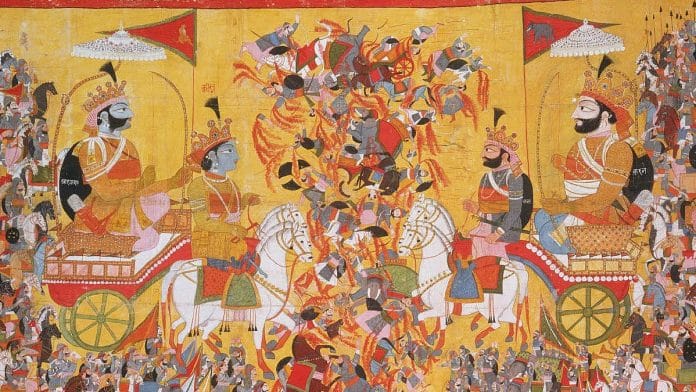
New Delhi: A full-fledged postgraduate degree programme devoted entirely to the epic Mahabharata will soon be taught in India. The Central Sanskrit University (CSU) in Delhi is developing a two-year interdisciplinary MA course in Mahabharata Studies.
The “pioneering” programme, as described by the central university, will focus on close textual reading, philosophical inquiry and the wider Vedic intellectual tradition.
Titled MA in Mahabharata Studies (MA-MBH), it is being developed in collaboration with Indica, a non-profit organisation focused on Indian philosophical and cultural traditions.
While universities in India and abroad teach the epic as part of broader courses in Hindu Studies, Sanskrit and religious studies, the proposed degree seeks to establish Mahabharata Studies as a distinct field of postgraduate education.
Dr K. Manogna, Assistant Professor at the Department of Vedanta at Central Sanskrit University, told ThePrint that the programme is intended for candidates who have completed either a four-year or a three-year undergraduate degree, followed by a two-year postgraduate qualification.
“The idea is to bring in students who have already worked in a particular field, and help them understand how the Mahabharata’s teachings can be applied in their respective areas,” she said. “This will be the first full-time course in India dedicated to Mahabharata Studies.”
The course is expected to begin in the next academic year, with admissions to follow the university’s application process that will be announced soon.
A new field of academic inquiry
According to the concept note, for over centuries, the Mahabharata has shaped India’s intellectual, cultural and social traditions, finding expression in commentaries, regional retellings, performing arts, religious practices, sacred geographies and living traditions across India and beyond.
“Despite its extraordinary breadth and continuing relevance, the Mahabharata has rarely been approached within a dedicated, comprehensive postgraduate framework that brings together its textual, philosophical, social and civilisational dimensions,” the note reads.
The proposed MA course seeks to address this gap by establishing Mahabharata Studies as a distinct interdisciplinary field of advanced inquiry, combining textual study with research into the epic’s continuing relevance to society and culture.
CSU and Indica are also envisaging a wider academic ecosystem around the programme, including visiting scholars, research collaborations, fellowships, specialised lectures, publications and engagement with traditional knowledge holders. The initiative is part of their stated effort to advance Indian Knowledge Systems (IKS) within higher education through structured postgraduate study and research.
Sanskrit texts, ethics and governance
The proposed curriculum is organised around three pillars—text, research and immersion—spanning four domains: text, thought, society and civilisation.
Students will study Sanskrit sources, narrative structures and interpretive traditions, alongside themes, such as the Bhagavad Gita, dharma, ethics, statecraft, diplomacy, social institutions and ecology. The course will also examine regional retellings, sacred geography, cultural memory and the epic’s continuing influence on society.
The programme is designed to take learning beyond the classroom. Students will engage with scholars, traditional practitioners, cultural institutions, archives and living Mahabharata traditions.
The concept note says the course will draw on the Bhāratīya pedagogical principles of Śravaṇam, Mananam and Nididhyāsanam—attentive learning, critical reflection and deeper assimilation—alongside contemporary postgraduate study.
Students will also undertake independent research through a 20-credit capstone project. A public scholarship component and comprehensive viva voce will assess their ability to communicate their research beyond conventional academic settings.
“The curriculum is being finalised and will be announced soon. The candidates will be asked to submit the statement of purpose to pursue the course, based on which interviews will be conducted,” Manogna said.
(Edited by Mannat Chugh)
Also Read: PM to CM, everyone wants Karnataka kids to learn AI. But state’s tech push skips govt schools