


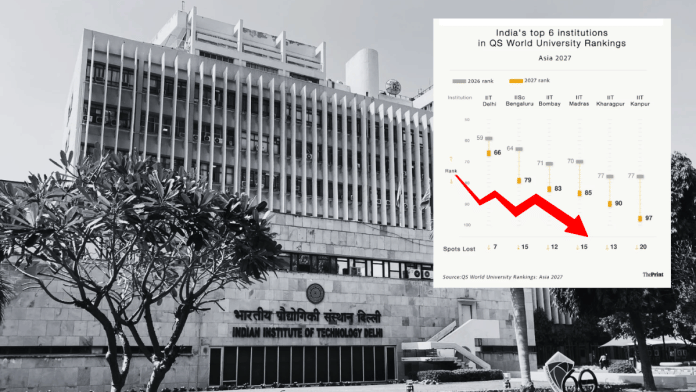
New Delhi: India’s leading higher education institutions have continued to lose ground in the QS World University Rankings: Asia 2027, with none making it to the top 50 for the second consecutive year. The decline comes amid intensifying competition across the region as new entrants were considered for the rankings.
All six of India’s highest-ranked institutions have slipped from their previous positions, with weaknesses in academic and employer reputation, internationalisation and research impact weighing on their performance.
This comes even as India expands its presence in the rankings, adding 34 institutions this year to take its total to 325.
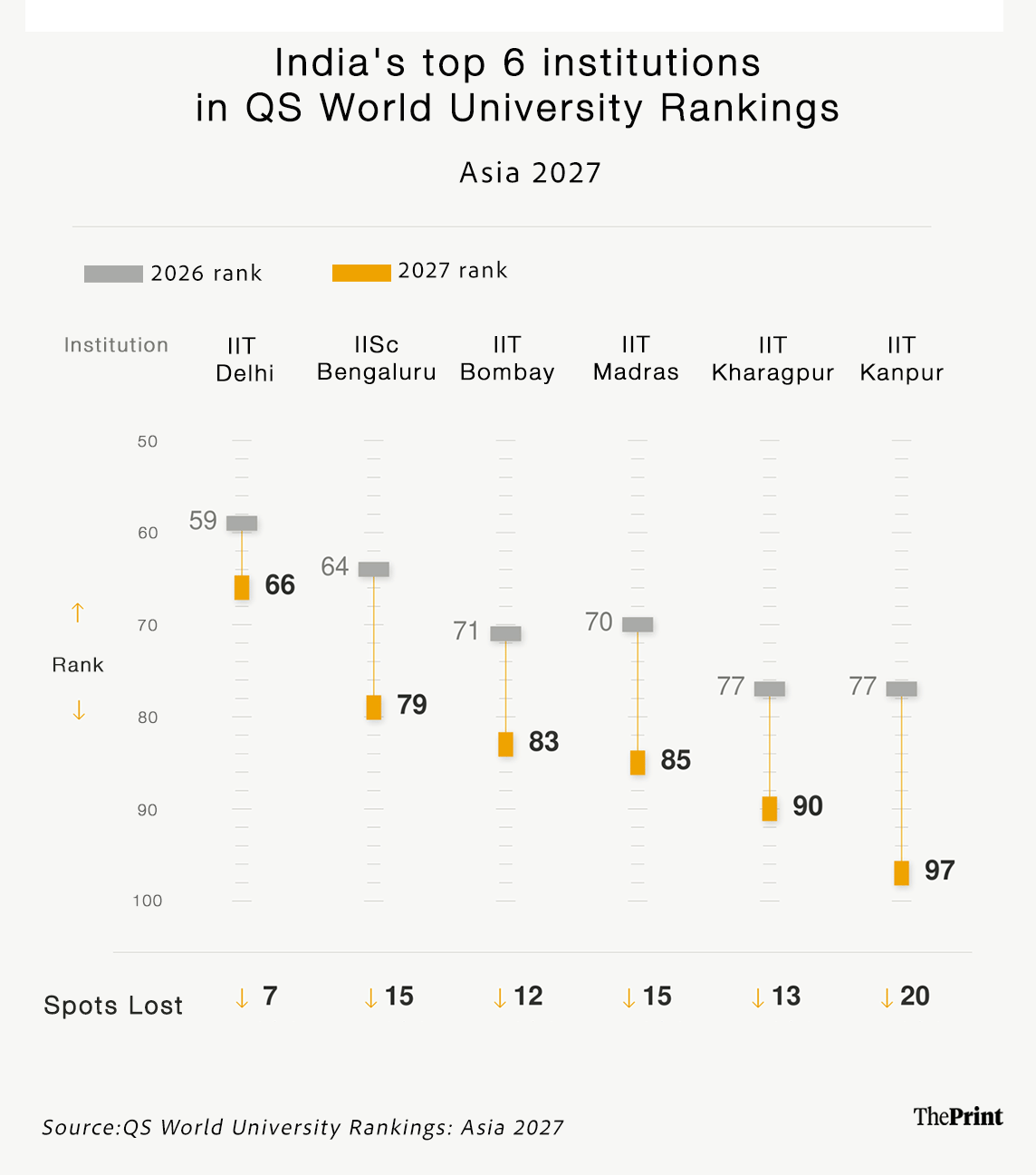
IIT Delhi remains India’s highest-ranked institution but has fallen seven places, from 59th last year to 66th this year. The Indian Institute of Science (IISc), Bengaluru, has dropped 15 places, from 64th to 79th, while IIT Bombay has slipped from 71st to 83rd. IIT Madras has fallen from 70th to 85th, IIT Kharagpur from 77th to 90th, and IIT Kanpur from 77th to 97th.
The last time an Indian institution featured in the top 50 was in 2024, when IIT Delhi ranked 44th and IIT Bombay 48th.
India now has the second-highest number of universities in the rankings, after Mainland China.
The QS office told ThePrint that rankings are relative, meaning an institution can fall even when its overall score improves if its peers make faster progress.
“Two-thirds of the Indian universities that dropped in rank improved their overall scores, while leading institutions such as IIT Bombay, IIT Delhi and IISc broadly maintained them. In 2027, seven Indian institutions scored above 90 in the Academic Reputation indicator, compared with six last year. Three years ago, in 2024, no Indian institution scored above 90,” the QS office said.
It added that India was not alone in facing increased competition. A total of 195 new entrants took the number of universities in the QS Asia rankings to 1,722 this year, across 26 countries and territories, intensifying competition.
“Japan saw 85 per cent of its ranked universities fall, while Taiwan and Indonesia recorded declines among 70 per cent of their institutions each,” the QS office said.
Academic reputation, employer recognition remain weak spots
The QS rankings point to declining academic and employer reputation scores across Indian institutions, alongside weaknesses in internationalisation and research impact.
Academic Reputation carries a 30 per cent weight in the QS Asia rankings and is based on a global survey in which academics identify institutions they consider strongest in research and teaching in their fields. Employer Reputation accounts for 20 per cent and measures employers’ views on which institutions produce the best graduates.
Among Indian universities with comparable rankings, 76 per cent recorded a decline in Academic Reputation scores, while 83 per cent saw their Employer Reputation scores fall.
Employer Reputation remains a relative strength for some leading institutions. IIT Bombay ranks seventh in Asia on this indicator, while IIT Delhi is placed 10th. However, QS said this recognition remains concentrated among a relatively small group of Indian institutions.
The QS office attributed the declines in both indicators to growing competition—Mainland China has 22 universities in the top 100 for Academic Reputation, followed by Japan with 14 and South Korea with 11. Malaysia and Indonesia have eight each, matching India’s eight.
For Employer Reputation, Mainland China and Japan have 18 and 14 institutions, respectively, in the top 100, compared with 10 from India.
Internationalisation and research impact
QS measures internationalisation through indicators including the proportions of international faculty and students, international research networks and student exchange.
India performs below the regional average across these indicators. Only 15 per cent of Indian universities improved their International Students scores, while 85 per cent recorded a decline.
The picture is similar for student exchange. In inbound exchange, which measures the number of students coming to Indian universities from abroad, 91 per cent of institutions recorded a decline. In outbound exchange, which tracks Indian students participating in overseas exchange programmes, 89 per cent saw their scores fall.
Research impact is measured through the Citations per Paper indicator, which assesses how frequently a university’s research papers are cited by other researchers. Only three Indian universities feature in Asia’s top 50 on this measure. The QS analysis found that 77 per cent of Indian universities with comparable rankings recorded a decline in their Citations per Paper scores.
National expenditure on research and development remains around 0.64 per cent of GDP, according to the QS report.
QS Senior Vice President Ben Sowter said India had built considerable research capacity, with its universities leading Asia in the number of institutions in the top 10 for Papers per Faculty. Fifteen Indian universities also share first place for Staff with PhD.
“The challenge now is to translate this strength more consistently into research impact and international recognition. Although several leading institutions have fallen in this year’s rankings as competition grows across Asia, India has a strong foundation on which to build,” he said. Investment in research quality, international partnerships and global visibility would be crucial to sustaining progress, he added.
Competition intensifies across Asia; India’s representation grows
The regional picture is mixed, with universities in some countries improving their positions while others lose ground. Mainland China and Hong Kong SAR have strengthened their standing among academics and employers. For the first time, universities from these two occupy all five top positions in the overall rankings.
Bangladesh and Pakistan have improved their performance in Citations per Paper, while Malaysia has 16 universities achieving their highest-ever positions in the 2027 edition. South Korea is home to the region’s most improved university among institutions with a numerical rank—Inje University climbed 337 places to 366th.
“Competition is growing across the region among both new entries as well as peers that have featured in previous editions of the rankings,” the QS office said.
However, QS also highlighted India’s longer-term expansion. Its representation in the rankings has grown from 24 universities in 2016 to 325 in 2027. India now accounts for almost one in five universities ranked in Asia, compared with around one in 12 in 2018. “It is also important to note that the long-term trend for Indian institutions is a very positive picture,” the QS office told ThePrint.
(Edited by Chingkheinganbi Mayengbam)
Also Read: Talent shift: What’s driving faculty from top public institutions to private universities
Apart from much else that ails Indian higher education, the intrusion of ideological compatibility.