



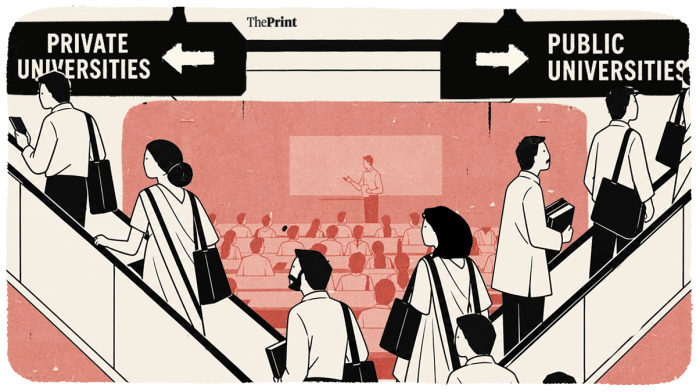
New Delhi: For decades, India’s top central universities and IITs have been sought-after destinations for academics. But in recent years, as more and more quality private universities have come up, quite a lot of faculty has moved out. The reasons for the shift vary from professor to professor: from greater academic freedom to more flexible working conditions and, in some cases, better pay. For many, private universities offer a way out of the central university limbo, where a faculty member can spend years in an ad hoc capacity with no permanence in sight.
It’s a worrying development for central universities and premier government institutions, especially for those already battling a significant faculty shortage, including the Indian Institutes of Technology (IITs).
There is no consolidated data on how many academics have moved from publicly funded institutions to private universities, or when the trend caught on. But ThePrint’s analysis of faculty profiles at six prominent private institutions—Shiv Nadar University, O.P. Jindal Global University, Ashoka University, Krea University, BITS Pilani and Amity University, Noida—identified around 100 professors at various levels with previous affiliations to public universities. All of these people moved to these private institutions over the past decade.
Examples include Rishikesha T. Krishnan, a management scholar and former director of IIM Bangalore, who joined Ashoka University as vice-chancellor in August this year. Computer scientist Subhashis Banerjee joined Ashoka in 2023 after leaving IIT Delhi. V. Ramgopal Rao, an electrical engineering scholar and former director of IIT Delhi, joined BITS Pilani as group vice-chancellor in March 2023.
Other examples include Sumedha Chauhan, a management information systems scholar, who moved from IIM Rohtak to O.P. Jindal Global University in 2019, and Anand Sharma, an economist, who had joined Jindal by 2021 after teaching at IIM Rohtak and IIM Sirmaur. At Krea University, Krishna Kumar Balaraman, a management scholar, joined from IIT Jodhpur, where he headed the School of Management and Entrepreneurship and remained on the faculty at least until 2022–23.
These examples show that faculty movements span almost all major academic disciplines, including humanities and social sciences, sciences, engineering, management, law, finance and accounting.
The trend may also extend to state universities, but this analysis is limited to faculty movements from central universities, IITs and IIMs to private institutions.
A director at one of the first-generation IITs, who spoke on the condition that he not be named, described the movement as a gradual transition rather than an “exodus”, driven by individual circumstances and the opportunities available at a small group of private institutions.
He said that at senior levels, salaries at leading private universities are almost on a par with those at IITs and top central universities. “Not all private universities are attracting talent from IITs and central universities. There are only a handful of them,” he said. “The faculty who are moving are looking for a similar academic atmosphere and salaries comparable to those at top public institutions, but with more flexibility.”
The demand for faculty positions is not limited to newer private universities. The Birla Institute of Technology and Science (BITS) Pilani, one of India’s leading private engineering institutions, established over six decades ago, continues to receive applications from faculty at IITs and other centrally funded institutions, an institute official said.
“Every time we advertise, we receive close to 10,000 applications for about 70-80 positions. So many people want to join, both senior and junior faculty… We don’t even know how to handle such a rush,” the official told ThePrint.
A former IIT director, who did not want to be named, said that while academics have traditionally moved from public to private institutions after retirement, an increasing number are now making the switch before retirement.
“People leaving in their 40s and 50s is something very new,” he said.
Also Read: Adani Group’s healthcare ambitions find foothold in deemed-to-be university in Maharashtra
Greater autonomy, curricular flexibility
For some academics, the attraction of private universities lies in the greater flexibility on offer—the freedom to design courses, pursue interdisciplinary research and organise academic events with fewer institutional constraints.
A former DU professor, who is now at Krea University in Andhra Pradesh, said he decided to shift as the move offered greater freedom to design courses, conduct research and organise academic events.
“There is tremendous intellectual freedom of the kind that has been systematically dismantled in the public universities,” the professor said.
For instance, the professor said, Krea University’s curriculum committee had so far not mandated changes to course content to align with UGC guidelines or the National Education Policy (NEP) 2020.
Greater curricular freedom at private universities contrasts with concerns among some former public university faculty about changes to the curriculum under NEP 2020.
A former DU professor said the introduction of more non-core courses under the NEP 2020 had diluted the depth of the curriculum, which they described as previously rigorous. The restructuring has also constrained the scope for research, the professor said.
“Earlier, the syllabus structure allowed faculty members to pursue research in relation to their teaching. Now, there is little time or scope for that. The lack of depth in the curriculum is also discouraging,” the professor said.
Subhashis Banerjee, who spent over three decades at IIT Delhi before moving permanently to Ashoka University in 2023, said he wanted to explore computer science beyond conventional engineering applications, using computational methods to study healthcare, society, elections, politics and economics.
“Ashoka’s strength in the humanities, social sciences and biology appealed to me. I was also drawn by the opportunity to build the university’s computer science department from scratch… When I joined in 2021, the department had only three people, and the then vice-chancellor, Malavika Sarkar, asked me to develop the department and define its curriculum. It was an exciting institution-building role,” he told ThePrint.
A former DU professor now at Shiv Nadar University told ThePrint that research-related travel also involves fewer bureaucratic hurdles at private institutes.
“We don’t have to go through the kind of bureaucratic approvals that are required at places like JNU and DU to travel for research,” the professor said.
Under Delhi University’s guidelines, faculty members must submit their application for travel at least two months before a conference. The application for travel support must include the full paper, conference programme or brochure, and a detailed invitation letter.
Some of the professors also say private universities offer better research funding, but this argument splits opinion—especially when it comes to institutes like IITs.
A former IIT professor now at a private university said some academics have been attracted by the prospect of accessing research funds “beyond government sources”.
“Private institutions are increasingly able to raise money through alumni and other sources, allowing them to support research through internal funding schemes and seed grants. This gives faculty the prospect of building laboratories and research facilities without relying solely on government funding,” the professor said.
However, the former IIT professor quoted earlier who moved to a private university in the NCR, said IITs had significantly greater research resources and infrastructure support. “Private universities’ reliance on philanthropy could be a limitation, the professor said, as donors often found ‘education outcomes more tangible than research’,” the professor said.
Also Read: Amid protests, Jamia shuts campus until mid-January; classes, exams shifted online
Concerns over leadership, faculty appointments, admin work
Dissatisfaction with institutional leadership, concerns over departmental autonomy and questions about the transparency of faculty appointments also emerged as factors shaping academics’ experiences at public institutions.
A former IIT professor said dissatisfaction with leadership was another reason some faculty members considered moving to private institutions.
“Almost all central universities and centrally funded institutions are now headed by people who accept all orders and regulations coming from the UGC and the ministry without questioning or reasoning, even if these are not suited to the institution,” the professor said. “This has become another issue that has left several professors dissatisfied with their leadership and the way institutions are governed.”
The former Delhi University professor now at Shiv Nadar University said departments in public universities had gradually lost their say in institutional decision-making, including faculty recruitment.
“There have been instances when vice-chancellors overruled departmental recommendations on the selection of external experts for faculty recruitment committees. There’s no head or tail to appointments. There’s no logic about how an appointment happens,” the professor said.
Faculty at public universities also face administrative workloads that can eat into time available for research. A faculty member at Krea University said the work involved in National Assessment and Accreditation Council (NAAC) accreditation and National Institutional Ranking Framework (NIRF) rankings is assigned to faculty members in public universities, whereas at private universities, dedicated teams handle these tasks.
“There is so much data work assigned to faculty members for NAAC accreditation and NIRF, with no formal credit for it. It takes up time that faculty should be using for research,” the faculty member said.
Driven by ‘ad-hoc-ism’: pvt universities ‘not our first choice’
For some academics who shifted, moving to private universities was not a choice they wanted to make. They said their decision was driven by the prolonged delay in changing their ad hoc positions to permanent. They say many academics continue in ad hoc positions for close to a decade.
Unlike permanent faculty, ad hoc teachers are appointed on a temporary basis, often with less job security, lower or less predictable pay, fewer paid-leave entitlements and uncertainty over access to maternity and medical benefits. Their appointments are also subject to periodic renewal.
A former Delhi University professor said he spent six years teaching on an ad hoc basis. “In the early 2000s, there was rampant adhoc-ism. I attended some 20-odd interviews, but I did not get a permanent position despite having cleared the National Eligibility Test (NET),” the professor said. “There was no support for research if you were an ad hoc teacher at Delhi University at that time. The teaching hours were also quite formidable and simply did not leave enough time for research. So I decided to go abroad and pursue a PhD.”
Returning to India after completing the PhD did not make it easier to secure a permanent position, the professor said. Age limits mandated in some central university recruitment advertisements became a big obstacle.The professor said his decision to move to a private university was “by default”.
He described this as a “double bind”, where years spent in temporary employment can leave academics without a permanent position and eventually make them ineligible to apply for some posts because of age restrictions.
DU’s ad hoc system expanded amid prolonged delays in permanent recruitment. By 2022, DU had more than 4,200 ad hoc teachers, accounting for around 40 per cent of its teaching workforce. In October 2023, the university directed colleges to stop making ad hoc appointments and prioritise regular recruitment.
Abha Dev Habib, an associate professor at DU, said that many professors got fed up around 2013-14 because they were not getting promotions.
“For several years, permanent appointments also became difficult, leaving many academics working with uncertainty. People who were doing well academically wanted a certain kind of stability and peace of mind. When they got opportunities elsewhere, they moved,” she told ThePrint.
Former UGC chairman Sukhadeo Thorat said the shift of experienced faculty from public to private universities could further weaken publicly funded institutions, which are already struggling with vacancies and delays in career progression. He said the lack of recruitment and stalled promotions had made the environment increasingly discouraging for academics.
“The government has already created problems for state and central universities by not recruiting teachers. There are too many vacancies against sanctioned posts. There are also hundreds of teachers in central universities who have acquired the qualifications for promotion from assistant professor to associate professor and from associate professor to professor, but universities are not taking any interest in promoting them,” he added. “Many have been waiting for five, six, seven or even eight years. This is also one of the reasons why people are moving out. The overall situation has become very discouraging for teachers. If you are not getting good teachers, then obviously the quality of teaching will go down,” he said.
Be that as it may, joining private institutions comes with its own challenges. Moving to a private university, some academics said, has meant giving up aspects of the public university experience. Some professors who have moved said they missed the diversity of public university classrooms.
“The class, caste and religious diversity at IIT is something I definitely miss. Private universities tend to draw students from more similar socioeconomic backgrounds, who are broadly English-speaking. When students come from diverse backgrounds, they bring different perspectives to the classroom, and that enriches the learning experience. That is a huge part of education,” said one of the IIT professors quoted above.
Is salary driving the shift?
There is a general perception that private universities offer higher salaries than centrally funded and state universities. However, pay varies across institutions and individual appointments. While public universities generally follow defined pay scales linked to academic designations, private universities do not always have publicly available, standardised salary structures, making direct comparisons difficult.
A former Delhi University professor now at a private university said salaries were largely determined through individual negotiations, leaving room for disparities.
“There is no clear pay grade allocation. People are just negotiating salaries based on how well they can bargain,” the professor said, adding that he found that a colleague who joined two years after him was earning more.
Despite these concerns, several academics said they earn more at private universities or receive benefits that help make up for any difference in pay.
“If not more, there is accommodation and other free services on campus like (home) cleaning, which make up for that. Besides, the central government is no longer giving pensions, so that attraction is also not there anymore,” said a former faculty member of the Central University of Gujarat who now teaches at a private university in the National Capital Region.
The Centre replaced the Old Pension Scheme with the contributory National Pension System (NPS) in 2004 for new central university faculty, who no longer receive the guaranteed pension available to earlier recruits.
Central universities have limited accommodation, so not all faculty members are allotted university housing within the campus. However, they receive House Rent Allowance (HRA) instead. The HRA ranges from 10 to 30 percent of their basic pay, depending on the city’s classification.
Habib warned that the shift of experienced academics to private institutions could affect the future leadership of publicly funded universities. “If this continues, the future academic leadership will not remain with public-funded universities,” she said.
(Edited by Sunanda Ranjan)
Also Read: University townships—India’s chance to build its own version of what America got right