



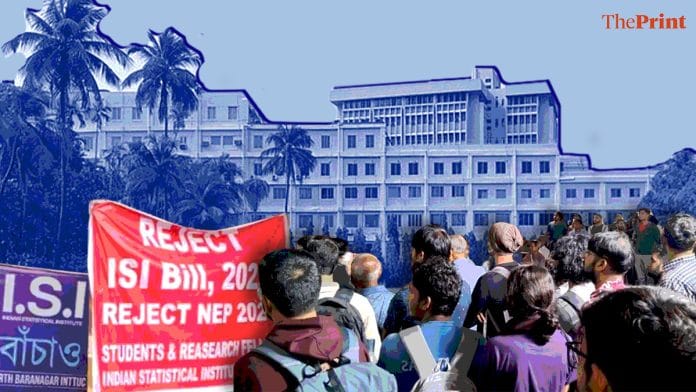
New Delhi: Introduced in the Lok Sabha Monday, the Indian Statistical Institute (ISI) Bill 2026 has run into stringent criticism, both from the Opposition and the institute’s faculty because, they say, it will dilute the autonomy of one of India’s most reputed organisations and lead to interference by the Centre in its day-to-day functioning.
Critics of the Bill say it tinkers with the basic structure that governs the 95-year-old institute by concentrating all powers in the proposed Board of Governors to be set up by the Central government.
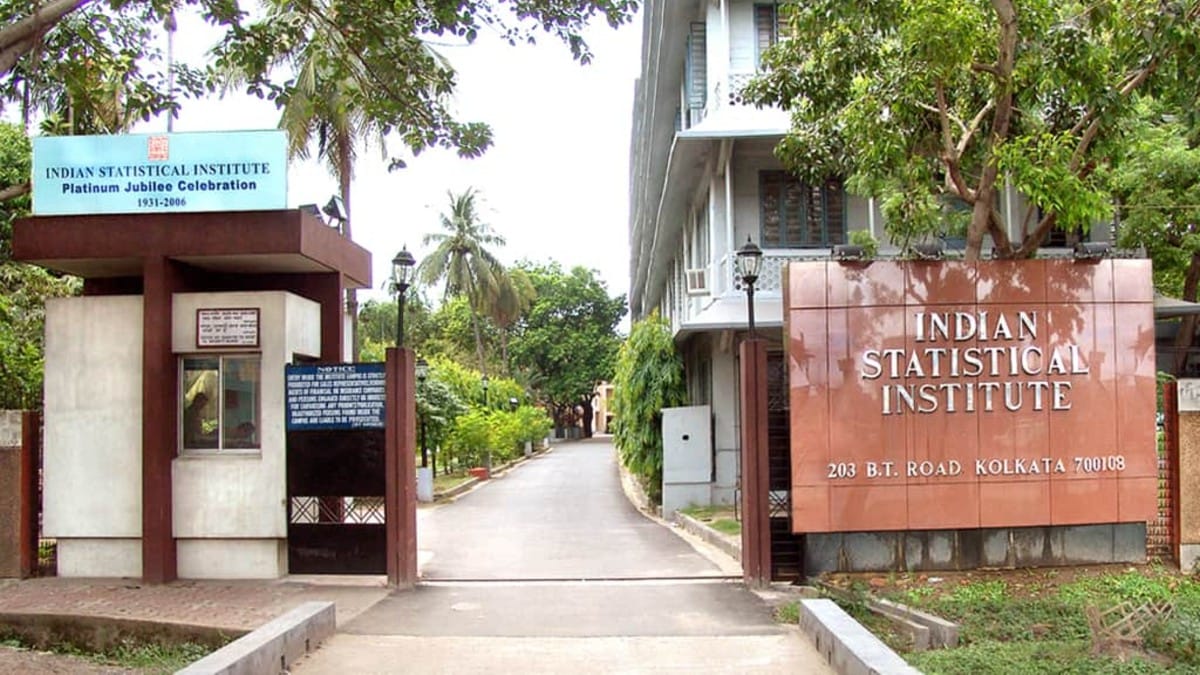
Founded in 1931 by P.C. Mahalanobis, also called the father of Indian statistics, the ISI has contributed in shaping some of India’s key economic policies; the National Sample Survey Organisation was also born within ISI. Headquartered in Kolkata, with regional centres in New Delhi, Bengaluru, Chennai and Tezpur, some of India’s legendary statisticians and mathematicians, including C.R. Rao, S.R. Srinivasa Varadhan and Raj Chandra Bose are among ISI alumni.
Piloted by the Ministry of Statistics and Programme Implementation (MoSPI), the Bill seeks to repeal the ISI Act 1959 that declared the institute to be of “national importance” and empowered it to grant degrees and diplomas in statistics.
The new Bill proposes that the President of India shall be the Visitor of the Institute, and may appoint one or more persons to review the work and the progress of the Institute as well as to hold inquiries into its affairs.
Concentration of power
The main bone of contention, however, is the dismantling of the Council of ISI, the highest decision-making body of the institute which has 33 members, including 10 elected ones. The council is headed by a chairperson, who can be a distinguished person from academics or a politician or a bureaucrat, and is appointed by the members of the council. Though it is an elected position, such exercises are rare in practice. The person is chosen by the members unanimously. The current chairperson of the ISI Council is K. Radhakrishnan, former chairman of the Space Commission, who also headed the Indian Space Research Organisation.
The new bill replaces the 33-member Council with a Board of Governors (BoG) headed by a chairperson and 11 members, all of whom will be nominated, not elected. The chairperson will be nominated by the President of India on the recommendation of the Central government from among eminent persons in the field of academia, industry, education, public policy, statistical sciences and allied sciences, or other fields.
Among the 11 members, three are to be Central government bureaucrats—not below the rank of joint secretary—nominated by the chairperson, four eminent persons in the field of statistical sciences and allied fields, including one woman, who are not from the ISI, and four representatives from the institute. The ISI representatives will include the director, a centre director and two members of the academic council.
The ISI’s registrar will be the member-secretary of the BoG. The BoG will be responsible for the “general superintendence, direction and control of the affairs of the Institute and shall have the power to frame, amend or rescind the regulations governing the affairs of the Institute to achieve its objects”.
The BoG will appoint the ISI director, who will be the chief executive officer of the institute, with the prior approval of the President of India. Besides, the board will also appoint the dean, centre-directors and the registrar.
Prof. Arijit Chakrabarty, who teaches at ISI, Kolkata told ThePrint that the Bill will basically alter the structure of the oldest statistical institute of the country, which will end up diluting the institute’s autonomy. “Where earlier the ISI Council, comprising elected as well as nominated members from the institute, was the highest decision-making body of the institute, the government has proposed to replace it with a Board of Governors where all the members will be nominated by the Central government,” he said.
He added that there will be total control of the Central government, which will nominate the chairman, who in turn will select the director. The professor also said that the ISI is a society registered under the West Bengal Societies Registration Act 1961, even though it is funded by the MoSPI. “It is not very clear what will happen to the ISI society now,” he added.
The society has a Memorandum of Understanding and ISI is governed by that, he said, adding: “Our powers, regulations come from the society.” The society is headed by a president. The current president is Dr Shankar Kumar Pal, noted computer scientist.
Curbed council
It’s not just the Council of ISI that will be dismantled once the ISI Bill becomes an Act. The existing academic council’s power has been curbed. Its role will be more of a recommendatory nature now; it will be the BoG that will have a final say in all matters unlike now where the academic council has the final say in all academic matters such as introduction of new courses in the institute.
The new bill proposes that the academic council will be the principal academic body of the institute and will be headed by the director of the Institute, who will be the chairperson. The centre-directors and all full time professors and such number of other full-time faculty members as may be determined by the BoG will be its members.
The dean of academic affairs will be the academic council’s member-secretary. The meeting of the academic council will be held at least once a year and periodical meetings may be held at the centres of the institute with members of that centre.
While the academic council currently has the final say in all academic matters, under the draft Bill it will only make recommendations to the BoG. Besides the academic council, there will also be a management council and ISI director be appointed by the BoG.
An ISI Kolkata professor, who did not wish to be named, said that the way ISI will be governed under the new law will be starkly different from how it is governed now. “With so much direct interference from the Central government, academic institutions like the ISI can’t thrive. It is very difficult,” the professor said.
The professor added that there is a lot of similarity in the proposed structure of ISI with that of IIMs. “But the thing is we are two very different kinds of institutes. It is evident that this kind of structure has not worked well in IIMs. Look at IIM Kolkata. They have not been able to retain directors.”
The professor said that the Bill will result in bureaucracy running the institute. “This is not desirable. This is what we are opposing.”
The Bill does not say what will happen to the society but it seems this society will be converted into a body corporate, the professor said. “This is not legally tenable. Also it is this structure that made ISI famous… This has helped us flourish. The ISI is a small specialised institute and has made the nation really proud. We are the best in the country in terms of mathematics and statistics. The statistical systems of India which is envied by even the world, they took lessons from us. The NSSO was born within ISI.”
Why a new law?
The statement of objects and reasons of the ISI bill 2026 says that the fourth review committee of the Institute, constituted by the Ministry of Statistics and Programme Implementation under the chairmanship of Dr. R.A. Mashelkar, in its report submitted in July, 2021, observed that the institute “can rise to its true potential and effect a turnaround, if it can bring in certain fundamental changes, some of which are not just incremental, but truly radical in its structure, systems and processes backed up by much higher aspirational levels, from top leadership, down to every worker.”
The committee had recommended that the ISI must “reimagine, reinvent and reposition itself to regain its leadership position and remain relevant in changing times and as ISI reaches its centenary year in 2031, it should aim to create a new ISI@100 vision, transitioning from the current good to the very best, one of the foremost institutes globally.”
However, a third ISI professor argued that the Mashelkar Committee, while pointing out shortcomings and recommending modernisation, did not bat for a new law. “The Mashelkar committee nowhere says that you need new legislation. They have talked about some changes that can be brought through small amendments. They have recommended trimming the size of the council. That is possible, can happen within the ambit of the existing legislation. For that you don’t need to dismantle a healthy functional institute,” the professor, who did not want to be named, said.
The professor added, “We fear that statistics can be misused. If the control is with a malicious person, it can be misused.”
Professors from ISI are demanding that the government have a discussion with them on the ISI Bill. “There has been no structured discussion so far. In fact, all statutory bodies of ISI have essentially rejected the bill. No one asked for our views. The Centre said there was a brainstorming meeting where it was decided but we want to know which meeting was this decided,” one of the professors told ThePrint.
The 1959 Act was amended in 1995 to empower the institute to grant degrees and diplomas in statistics, mathematics, quantitative economics, computer science and such other subjects related to statistics as may be determined by the it from time to time.
Opposition up in arms
The Opposition has stringently criticised the introduction of the ISI Bill. Jairam Ramesh of the Congress on Tuesday posted on social media platform X that Opposition parties want the Indian Statistical Institute Bill 2026 be referred for detailed examination and wider consultations by the Parliamentary Standing Committee concerned (finance in this case).
Trinamool Congress’ Sagarika Ghosh posted that the bill requires much wider consultation with all stakeholders before it is brought before Parliament. “Given its far-reaching implications for one of India’s most premier institutions, it deserves careful scrutiny and deliberation. We are hopeful that the government will agree to this reasonable demand.”
Senior faculty members of ISI Kolkata and its regional centres were scheduled to hold a press conference in the Capital on Wednesday to highlight their concerns on the ISI Bill.
(Edited by Nardeep Singh Dahiya)
Also Read: Govt’s Delimitation Bills ‘dangerous proposition’, says Rohit Pawar; rules out alliance with BJP