








New Delhi: Setting up a high-stakes showdown featuring the Left, the Right, and the Centre of Indian politics in the scorching summer, the Election Commission (EC) Sunday announced the schedule for assembly elections in West Bengal, Assam, Tamil Nadu, Kerala, and Puducherry.
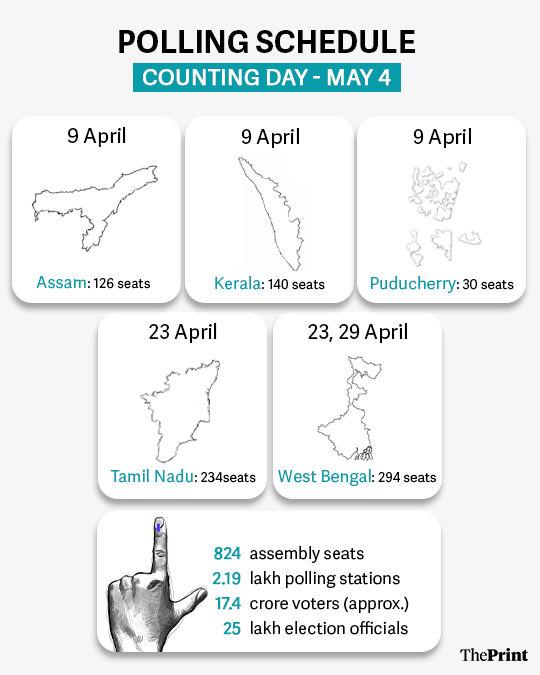
West Bengal will vote in two phases on 23 and 29 April. In the first phase, 152 assemblies will go to the polls, while the remaining 142 will feature in the second phase. Polling in Assam, Kerala and Puducherry will occur in a single phase on 9 April. Tamil Nadu elections will take place on 23 April. The results will be announced on 4 May.
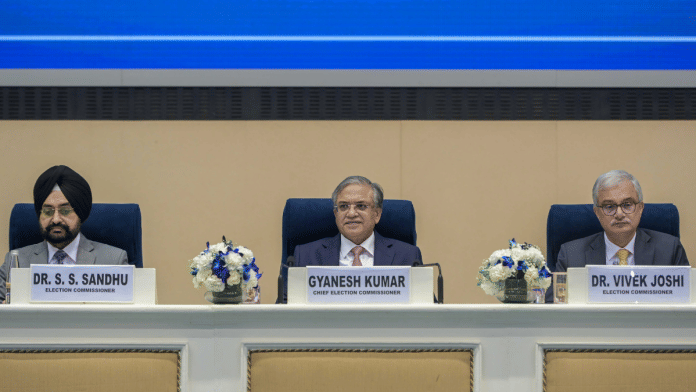
“During the past few days, the Commission visited all the poll-bound states to review preparedness for the elections. Roughly 17.4 crore electors across 824 assembly constituencies are part of the electoral rolls of these States and UT (of Puducherry),” Chief Election Commissioner (CEC) Gyanesh Kumar told a press conference in the national capital.
“These five states represent distinct geography and cultural representation of India,” the CEC said at Vigyan Bhavan, as he went to hail the “massive democratic exercise”.
The Model Code of Conduct came into force with the latest announcement.
“With regard to the West Bengal elections to be held in two phases instead of eight earlier, the Commission has had detailed deliberations and in its considered opinion, it was found necessary to reduce the number of phases and bring it down to an extent where it is convenient for everybody,” Kumar said.
The CEC, however, did not address questions about the notice submitted by Opposition MPs in Parliament seeking his removal.
Hours before the press conference on Sunday, West Bengal Chief Minister Mamata Banerjee announced a Rs 500 increase in the monthly honorarium for priests and muezzins in West Bengal. She also announced Dearness Allowance for thousands of state government employees. Later, Kumar clarified that the MCC is applicable “from now onwards so actions taken prior to the Model Code of Conduct is a prerogative of the concerned government”.
The EC also announced that bypolls in the assembly constituencies of Goa, Karnataka, Nagaland and Tripura will take place on 9 April, while those in constituencies of Gujarat and Maharashtra will take place on 23 April. Bye-elections for 8 assembly constituencies in these States are necessary due to the death of the elected candidates. Votes will be counted on 4 May as well.
What makes this round of state polls particularly consequential is that West Bengal, Tamil Nadu, and Kerala represent frontiers where the Bharatiya Janata Party (BJP) has struggled to grow, even as it won consecutive Lok Sabha elections and expanded its footprint across the length and breadth of the country over the last decade.
In West Bengal and Tamil Nadu, the BJP and its alliance partners face the ruling Trinamool Congress (TMC) and the Dravida Munnetra Kazhagam (DMK), which in 2021 leveraged regional cultural pride and welfare schemes to counter the fusion of Hindutva and hyper-nationalism in elections held amid a deadly wave of the COVID-19 pandemic.
In Kerala, the Congress has a real shot at returning to power in the sole state currently governed by the Left coalition of the Communist Party of India (Marxist), the Communist Party of India, and smaller allies.
Meanwhile, in Assam, the party finds itself in a highly polarised battlefield shaped by Chief Minister Himanta Biswa Sarma of the BJP, who has stoked religious, cultural, and demographic identities on a scale never witnessed before.
In Puducherry, the ruling alliance of the NR Congress and the BJP is facing a challenge from the Congress-DMK combine.
For the Opposition, gaining an upper hand against the BJP is crucial to healing the scars inflicted by a string of losses since the 2024 Lok Sabha elections, when an unexpected surge in its numbers had briefly revitalised it.
However, having won four of the six states—Haryana, Maharashtra, Bihar, and Delhi—where elections have been held since then, the BJP has largely undone that Lok Sabha blip, in which it lost its absolute majority, forcing it to rely on the support of the Telugu Desam Party (TDP) and the Janata Dal (United) to remain in office.
A fresh success in this round of elections would not only brighten the aura of the BJP’s invincibility but also cement its pan-Indian appeal, the kind the Congress enjoyed in the years following Independence.
The elections are also being held at a time the credibility of the EC, in the eyes of the Opposition, has hit a rock bottom, especially in light of the contentious Special Intensive Revision (SIR) of voter rolls by the poll watchdog.
While the SIR, and the parallel special revision in Assam, segues into the BJP’s key themes of drives against infiltrators and correcting demographic imbalances to consolidate Hindu votes, the Opposition hopes to capitalise on the bureaucratic botches that have marked the exercise, causing harassment to many genuine voters across communities.
The SIR was especially contentious in West Bengal, with the Supreme Court passing directives unique to the state for completion of the exercise in time. West Bengal CM and TMC supremo Mamata Banerjee led from the front, appearing and arguing in person even in the Supreme Court as a petitioner in the case.
In West Bengal, the exercise saw deletion of 61.78 lakh voters, amounting to an 8.06 percent decrease in voter roll. Before the publication of draft rolls, the state had a total of 7.6 crore voters, while 7.04 crore electors remained on the roll after the SIR.
However, in addition to the deletions, 60.06 lakh electors were placed in the “under adjudication” category, and their eligibility was to be subject to judicial scrutiny. The apex court last month decided to involve the judiciary in the exercise, noting that the “trust deficit” between the TMC government and the EC had led to a “stalemate”, with time running out.
It permitted the Calcutta High Court chief justice to deploy civil judges and also requisition judicial officers from neighbouring Jharkhand and Odisha to deal with 80 lakh claims and objections. The top court allowed the poll panel to publish the final voter list with decided claims on 28 February, followed by supplementary lists. So far, no supplementary lists have been published.
On 10 March, the court also directed the constitution of special tribunals to decide on appeals against exclusions from the electoral roll during the SIR process in Bengal.
Meanwhile, post the special revision exercise, Assam has 2,49,58,139 voters in its electoral roll—a 0.13 percent increase from the roll published in January 2025. Tamil Nadu saw deletion of 97.37 lakh names, while Kerala saw deletion of 8.57 lakh voters. In Puducherry, the electorate shrunk from 10.21 lakh to 9.44 lakh voters.
(Edited by Tony Rai)
Also Read: SIR notice to Amartya Sen reveals how burdensome India’s overseas vote really is