



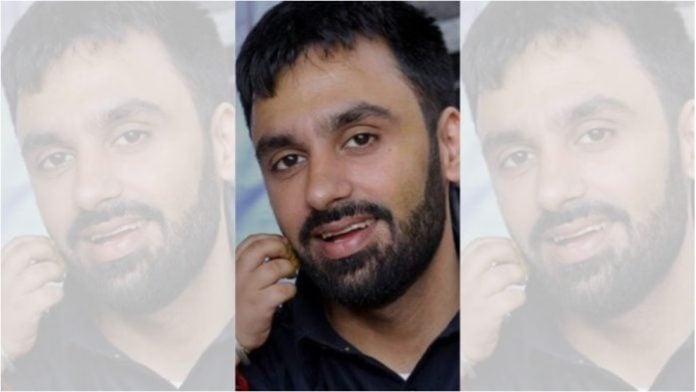
New Delhi: Nearly nine years after his arrest by the Punjab Police, British national Jagtar Singh Johal, released on bail by the Delhi High Court, emerged from a small exit gate of Delhi’s Tihar jail Thursday.
Johal was arrested in 2017 in a terror conspiracy case related to the funding and propagation of the banned Khalistan Liberation Force (KLF) and a series of targeted killings in Punjab between 2016 and 2017. A lot has happened in the years since: not only have more details emerged about the Indian-origin UK national, who allegedly first found his voice as a propagandist in blogging, the police team that arrested him in Moga has come under the scanner for allegedly being in cahoots with drug operators.
Just last week, dismissed Punjab Police Assistant Inspector General Raj Jit Singh, who led the Moga district police as senior superintendent of police (SSP) at the time of Johal’s arrest, was caught by Punjab’s Anti-Narcotics Task Force (ANTF) after being on the run for more than three years.
Overall, it’s a story involving several characters—one that transcends any one strand to cover several of Punjab’s most sensitive pain points.
‘Moving funds for Khalistan Liberation Force’
Johal is currently under investigation by the National Investigation Agency (NIA) in eight cases centred on the targeted killings of Hindu leaders in Punjab in 2016-17, including those of senior RSS leaders Jagdish Gagneja and Ravinder Gosain.
The NIA was assigned these cases a month after his arrest.
There were two other cases against Johal in connection with the killings, filed by police in Faridkot and Moga, but they have since resulted in a discharge and acquittal.
When Johal was arrested in 2017, it had been a fairly quiet affair. It was only when the Moga district police team produced him before a local court that the details of the cases against him came into public view.
Johal traces his paternal roots to Jalandhar’s Jandiala village, where he also got married in November 2017. However, he was born in the UK in 1987 to the family of Jasbir Singh, an immigrant who ran a takeaway joint until a decade ago. Johal, also known as Jaggi, is believed to have studied up to high school before going into digital marketing, where he earned a salary of nearly £3,000 per month. By a strange coincidence, the terror conspiracy case against him is also centred on an equivalent figure, if in a whole other context.
Johal, police files state, ran a website neverforget84.com—a reference to the year that saw Operation Blue Star as well as the anti-Sikh riots in Delhi—which became a popular hub for radical Sikh voices. Johal is also believed to have developed other similar online forums, including 1984tribute.com. Quoting his interrogation, the police case files reveal that Johal translated news from Punjabi dailies into English, as well as designed T-shirts and other merchandise and materials used for events organised by radicals among the Sikh diaspora.
Both the Punjab Police and the NIA have accused Johal of working as a cash courier to transfer GBP 3,000 on behalf of Gursharanbir Singh, a senior member of the KLF, to Harminder Singh Mintoo, the late former chief of the terrorist group.
The agencies have alleged that Mintoo, who died in 2018, used these funds to influence one Hardeep Singh to join the KLF and carry out terrorist activities. The NIA has identified Hardeep Singh and one Ramandeep Singh alias “Raman Canadian” as the shooters in all the targeted killings.
According to the NIA, Hardeep’s alleged indoctrination began in June 2013 when he was staying with an uncle in Italy, where Mintoo was accommodated as a “guest” by another KLF operative, identified as Gurjinder Singh alias Shastri. “It has been established during the investigation that Harminder Singh @ Mintoo convinced the impressionable Hardeep Singh of the need to commit violence in the name of ‘Khalistan’,” the agency alleges in the chargesheet.
The agency further alleges that, during their Italy trip, Shastri, Mintoo and Hardeep took a road trip to France and Germany. In France, they allegedly received Johal at the airport when he arrived for a visit in 2013.
“When they were in Paris, France, Harminder Singh @ Mintoo and Gurjinder Singh @ Shastri went to the Paris airport and received Jagtar Singh Johal, who had arrived from the UK. Jagtar Singh Johal, a UK national, had been sent to France from the UK by Gursharanbir Singh to deliver £3,000 to Harminder Singh Mintoo; a part of this money was given by Harminder Singh @ Mintoo to Hardeep Singh to motivate him to join the KLF and recruit him for executing the conspiracy,” the NIA alleges in the chargesheet for RSS leader Ravinder Gosain’s murder.
According to Indian intelligence agencies, Johal was also close to the Pakistan-based chief of KLF, Harmeet Singh alias Happy PHD, who succeeded Mintoo and was killed in January 2020, and UK-based Amritbir Wahiwal, alleged to be a top member of radical Sikh operations along with his brother Gursharanbir.
However, speaking to ThePrint, Johal’s longtime counsel Jaspal Singh Manjhpur dismissed the allegations against him, and said the NIA’s case has “not gone beyond these two paragraphs” in nearly a decade of investigation and incarceration.
“All the eight chargesheets by the NIA and one by the Punjab Police had the same allegations written in the same form and structure,” Manjhpur said after Johal’s release. “It all started with the Punjab Police’s chargesheet. It was first written in Gurmukhi, and the same text has been merely translated and reproduced by the NIA in all the eight cases against Johal. The NIA’s probe is not an inch beyond what was alleged in the first chargesheet,” he added.
Also Read: The hot trail of Musa, last of Lashkar’s 4-member ‘Pir Panjal’ module that terrorised Kashmir
Outrage in UK over Johal’s arrest
The then Punjab chief minister Captain Amarinder Singh had called Johal’s arrest in 2017 a breakthrough in investigations into the targeted killings in Ludhiana, Khanna, and Jalandhar at the behest of Pakistan’s Inter-Services Intelligence (ISI).
The development, however, drew sharp criticism from British lawmakers, with the then Scottish MP Martin Docherty-Hughes, who represents the constituency where Johal lives, raising the issue in British parliament. He urged the then Conservative government to act on concerns about Johal’s alleged torture in Indian custody.
The concerns among British lawmakers continued to grow over the years. In 2023, over 70 British MPs signed a letter urging the then British Prime Minister Rishi Sunak to call on his Indian counterpart, Prime Minister Narendra Modi, to release Johal.
The UK government, from time to time, has expressed concerns about the allegations of torture, saying they were being investigated.
In the interim, two terror-related cases against Johal in Punjab fell apart, with the Faridkot court discharging him in one case in 2019 and the Moga court acquitting him in a similar case last year. The Faridkot court discharged him and the other accused on the ground that the police had lodged a fresh FIR and chargesheet on the very allegations that Johal faced in the case registered by the Moga police, observing that there could not be two separate cases with the same allegations. The court observed that even the case property and witnesses were the same in both cases, and hence the offences did not stand separately.
The Moga court acquitted him after a full trial last year. The other eight cases probed and charged by the NIA have reached the stage of trial proceedings and witness examination.
Last month, the Delhi High Court relied on Johal’s acquittal in the Moga case to hold that he was at least entitled to bail on the same grounds, ordering his release on stringent conditions, including the submission of his passport to ensure he does not leave the country.
Johal’s counsel Manjhpur alleged that the Tihar administration subsequently tried to block his release, saying they had approached the Ministry of Home Affairs to ask whether Johal was eligible for release from jail. The NIA, on its part, also moved court, seeking an order to prevent Johal from travelling outside the national capital.
The high court, however, rejected the plea, stating that it had already imposed strict conditions to ensure Johal faced trial.
“On September 30, Jaggi Johal filed a habeas corpus writ in the Delhi High Court challenging his illegal detention… Justice Navin Chawla ordered at 11 am to release Jaggi Johal or else the court would pass its order,” Manjhpur said, adding that his client was only released after a “stern order” from the court.
As Johal walked out of Tihar jail on Thursday, he met subdued chants from a handful of supporters and his lawyer. He then paid obeisance at Gurdwara Bangla Sahib in the national capital and told the media assembled there that he hoped for the release of all Sikh prisoners.
(Edited by Sunanda Ranjan)
Also Read: American VanDyke, arrested by NIA in Myanmar training camp case, flies home day after Tihar release