


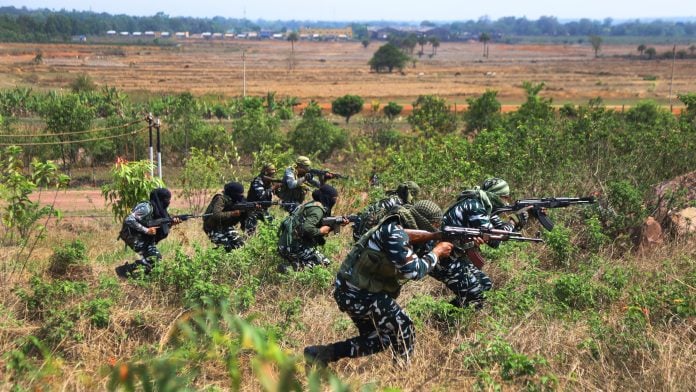
New Delhi: Over the past 12 months, the Central Reserve Police Force (CRPF) attained a massive feat: zero operational fatalities. The figure means something for a force tasked with sensitive operations in India’s insurgency hotspots. Even so, the force—and its sister forces in the Central Armed Police Forces (CAPFs)—has failed to curb a grave threat stalking its personnel: suicide.
Suicides among CAPF personnel have been a concern for decades, with the trend worsening in recent years. Since 2019, over 100 CAPF personnel have killed themselves every year, at a rate of roughly one suicide every three days. The latest incident saw a CRPF trooper posted at the Mizoram Raj Bhavan turn his AK-47 on himself Thursday morning.
The trend is largely blamed on the personnel’s tough working conditions, which involve strenuous deployments and long periods away from family, and little scope for rest. Officials in these forces cite several challenges they say are unique to CAPF personnel as compared to other security personnel.
“A police constable or other personnel at any rank are mostly at a commuting distance from where their family members are based,” an officer in one of these CAPFs told ThePrint. “They don’t have to follow a longer procedure to go back home, and when you combine these issues with problems including those at home as well as related to land and other disputes which they are unable to personally intervene in, purely because of their work, it demotivates them,” the officer said.
It doesn’t help that conditions have been getting tougher, insiders add, pointing to the increased deployment of CAPFs for law-and-order duties that ought to be the remit of state police.
“The mandate of these forces is such that the personnel don’t get even adequate time to rest and recuperate. The mandate of the CAPFs is across the country, and it can be called a no-breather mandate,” a senior CRPF officer said. “This week they are in West Bengal helping the state police hold the ground to conduct elections, the next week they are in Manipur trying to take control of the streets in the face of a hostile crowd,” the officer added.
While the government has attempted steps to resolve the problem, the persistently high numbers raise serious questions about the effectiveness of measures to address mental health concerns, improve working conditions and ensure adequate institutional support within the forces.
Also Read: From Nehru to Modi, Parliament has often rewritten what the Supreme Court decided
Worrying data
There are a total of seven CAPFs: the CRPF, the Border Security Force (BSF), the Sashastra Seema Bal (SSB), the Indo-Tibetan Border Police (ITBP), the Central Industrial Security Force (CISF), the Assam Rifles, and the National Security Guard (NSG).
So far this year, 95 CAPF personnel have died by suicide, an analysis by ThePrint has revealed. This figure doesn’t include the CISF, for which the latest data wasn’t available, and the NSG, which recorded zero suicides.
The BSF recorded the highest number of suicides at 38, followed by the CRPF, the largest of the six forces, with at least 26. The figure is 14 for the SSB, and 12 for Assam Rifles. The figure is five for the ITBP.
Since 2023, the CRPF has recorded more than 185 suicides, with 2025 emerging as the deadliest year in this period, accounting for 59 deaths.
The rate of suicide—number of suicides per 100,000 people in a given population—among CAPFs (13) has been inordinately higher than the average for other men (8.9) in a similar demographic, as reported by ThePrint in 2023.
Retired IPS officer Prakash Singh said the CRPF should be appreciated for achieving what once appeared to be a mountainous task of no casualty over a year. “Over the last few years, they have upgraded their overall strategy, field tactics as well as use of technology to better prepare themselves in the operations; that was all on display in the left-wing extremism theatre,” Singh told ThePrint.
However, he added that the figure of zero casualties does not paper over the underlying crisis that the force, as well as other CAPFs, faces.
“Zero operational casualty is a huge achievement but does not mean everything is hunky dory in these forces. The alarming number of suicides in these forces are a reflection of nothing but a state of perpetual strain and stress that the personnel are under,” he said. “We need some large reforms to solve it.”
Discussing the pressures within the CAPFs, Singh said conditions are getting tougher. State governments, he added, are overly reliant on the CAPFs. States pass the buck to the Centre for law-and-order management, and the Ministry of Home Affairs (MHA) has been succumbing to such pressure, he said. “Earlier, there was a designated company in each battalion that was demarcated for training, and the practice meant that each company used to get at least two months of training in which they were not on full-fledged deployment,” Singh explained.
“The situation has become such that states are sending beefed-up requirements for deployment to maintain law and order, and the MHA is succumbing to such pressure, meaning that all companies are nowadays deployed on the ground, leaving no personnel with time to rest and recuperate,” Singh added.
Another officer pointed towards poor living conditions during deployment, low morale and overall health issues.
“There are thousands of forces living in makeshift tents and battling mosquitoes and bad water during their deployment, and they are shuffled in the matter of an email or communication from the top even before proper arrangements are made,” the officer said.
Another facet flowing from these factors is death due to illness: more than 500 personnel died due to various illnesses and heart attacks in areas affected by left-wing extremism (LWE) between 2019 and 2023—more than twice the deaths caused during operations (207) in the same time period in the same theatre.
Also Read: 654 suicides & 50,000 resignations in 5 years — the crisis stalking India’s CAPFs
‘Poor working conditions, extended deployments’
The government is well aware of the issue at hand.
In 2021, the Ministry of Home Affairs created a task force to investigate CAPF suicides and tasked it with finding out the risk and precipitating factors at the individual level. The task force was also asked to suggest a prevention strategy.
The task force went on to identify three broad risk areas: poor working conditions, service conditions, and personal/individual issues.
Regarding working conditions, the task force highlighted extended deployments in high-risk areas, particularly for personnel from the CRPF, ITBP, BSF, SSB, and Assam Rifles.
These troops, the report said, grappled with extended separations from their families as well as fatigue and depression due to long duty hours in adverse climatic conditions.
Among service conditions, the task force highlighted leave-related problems in the ITBP, CRPF, BSF, SSB, and Assam Rifles. Additionally, the report said, CRPF, CISF and Assam Rifles personnel get insufficient time for rest and recreation. Lack of job satisfaction, especially when compared to counterparts in other sectors, also plays a role in suicides among CISF, CRPF and Assam Rifles personnel, it added. Furthermore, the task force said, frequent transfers of company commanders in the ITBP and SSB disrupt communications with troops, serving as another challenge for these forces.
On the personal front, mental health disorders emerged as significant factors affecting CRPF, BSF, SSB, and Assam Rifles personnel. Domestic issues and land-related disputes, the report said, are notable stressors for personnel in the four forces.
The issue of suicides among CAPF personnel has even been raised before the parliamentary standing committee on home affairs, which observed in 2023 that leaves at proper intervals are a “necessity” for CAPF personnel, given the challenging nature of their duty.
“CAPFs function under much duress, given the nature of their duty which requires their postings in harsh climatic conditions. So, to ease their mental state and reduce stress, leaves at appropriate intervals are a necessity, so that they can spend time with their families,” the committee had said in a report.
The committee also noted that the MHA was deliberating on the possibility of increasing leave for CAPF personnel and recommended that this be “finalised at the earliest” to “boost the morale of the CAPFs”.
On paper, the MHA has a 100-day leave policy for CAPF personnel. In practice, however, the situation is far from the policy guidelines and grim. Only about 42,000 personnel from the CAPFs availed their 100-day leave between 2020 and October 2024, according to government data.
(Edited by Sunanda Ranjan)
Also Read: After 17 yrs of struggle, court battles, CAPF officers still fighting for their rightful dues