



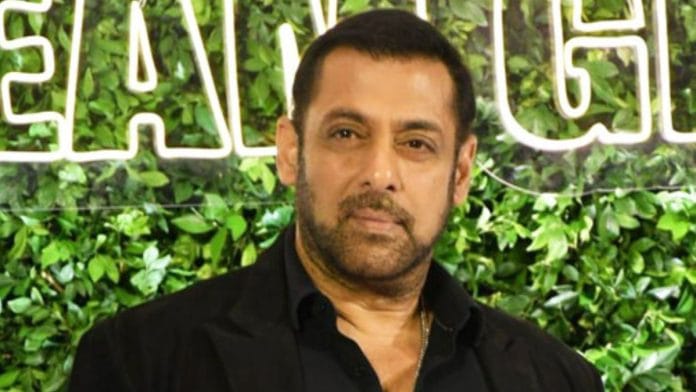
Chandigarh: Days after the shooting attempt on actor Tiger Shroff, the All-India Bishnoi Mahasabha has asked Salman Khan to go to Mukam, the community’s holiest shrine in Rajasthan’s Bikaner district, and apologise for the killing of a blackbuck 28 years ago.
The Mahasabha chief Devendra Budhiya said this in a statement issued Wednesday after a meeting of the office-bearers held Tuesday.
Speaking to ThePrint over the phone, the Mahasabha’s national president Devendra Budhiya said the community is ready to consider forgiveness if the actor does so.
“There is still time. Salman Khan can go to Mukam and apologise. If he does, the community can think of forgiving him, in keeping with our religious belief of protecting life,” Budhiya said. “Violence like firing is wrong. Mistakes have been made on both sides. If the actor had given up his arrogance, this dispute could have been avoided.”
His statement comes days after shots were fired at Shroff, an incident that has revived talk of the long-running feud between the Bishnoi gang and the Bollywood star.
Mukam shrine
Mukam is a small village in Nokha tehsil of Bikaner district. For the Bishnoi community, it is what Amritsar is for the Sikhs, or Haridwar for many Hindus.
The samadhi of Guru Jambheshwar, also called Jambhoji, the 15th-century saint who founded the community, is here. A temple stands over it, and Bishnoi families from Rajasthan, Haryana, Punjab and Madhya Pradesh travel to it throughout the year.
Guru Jambheshwar was born in 1451 at Pipasar village in Nagaur. According to community tradition, he spent his early years grazing cattle and speaking little. In 1485, after a severe famine in Marwar, he founded the Bishnoi panth at Samrathal Dhora, a sand dune not far from Mukam. He gave his followers 29 principles. The name Bishnoi comes from these. In the local dialect, bees is twenty and nau is nine.
The rules ask followers to be kind to all living beings, never to cut a green tree, to avoid meat, alcohol and tobacco, and to keep a clean and simple life. He died in 1536, and was laid to rest at Mukam. His followers, who call it Mukti Dham, consider it a place where a believer’s prayers are heard.
Twice a year, on the new moon days in the months of Phalgun and Ashwin, lakhs of Bishnois gather at Mukam for large fairs. They offer prayers, take part in the havan and renew their vows to follow the 29 principles. This is why the community leaders ask that an apology be made here and not in a courtroom or on a television screen. For a Bishnoi, forgiveness sought at the guru’s samadhi carries a religious meaning that no other place can give.
Also Read: Court steps in for Salman Khan, orders takedown of promo content for Kala Hiran
Bishnois & the blackbuck
Protection of animals and trees is part of Bishnoi community’s faith. In 1730, in Khejarli village near Jodhpur, 363 Bishnois are said to have laid down their lives to stop the soldiers of the Jodhpur ruler from felling khejri trees. The sacrifice of Amrita Devi, who led the villagers, is still taught in every Bishnoi home.
Their villages in Rajasthan and Haryana are known for deer moving freely among homes and fields. The blackbuck is treated almost as a member of the family. Women in the community have been known to nurse orphaned fawns at the breast.
The grievance against Khan goes back to October 1998. During the shooting of Hum Saath-Saath Hain near Jodhpur, he was accused of hunting two blackbucks in Kankani village. Villagers from the Bishnoi community saw it as an attack on their faith and took the matter to the forest department.
In April 2018, a Jodhpur court convicted the actor in the case and sentenced him to five years in prison. He spent two nights in jail before getting bail. His appeal is pending. Other actors accused in the case, including Saif Ali Khan, Tabu, Sonali Bendre and Neelam, were acquitted.
The case has since acquired a dangerous edge. Gangster Lawrence Bishnoi, who belongs to the community, has publicly spoken of avenging the killing. Shooters linked to his gang fired at Salman Khan’s Mumbai residence in April 2024.
Budhiya defended Lawrence, saying no crime had been proved against him so far. “For us, he is a hero,” he said.
Lawrence’s cousin Ramesh Bishnoi has also said that neither the community nor Lawrence has any personal enmity with the actor. In his view, it is only a matter of hurt religious sentiments. He, too, has advised Salman Khan to seek forgiveness at the samadhi of Guru Jambheshwar.
What the law says
Supreme Court lawyer Seema Sindhu said the legal effect of an apology would depend entirely on what it says.
“It depends on the content of the apology, if he makes one,” she said. “A generic apology for hurting the sentiments of the Bishnoi community will not be admissible evidence. But a specific statement apologising for the alleged poaching can be relied upon by the prosecution as an admission of the relevant fact.”
Sindhu added that the actor’s lawyers would have to be careful with every word. “An admission made outside the court can be used against the person who made it. If he says he is sorry for killing the blackbuck, the prosecution can place it before the appellate court. If he only says he regrets that people were hurt, it does not admit anything about the act itself.”
(Edited by Nardeep Singh Dahiya)
Also Read: Lawrence Bishnoi gang and Bollywood: Why celebrities are in the line of fire