



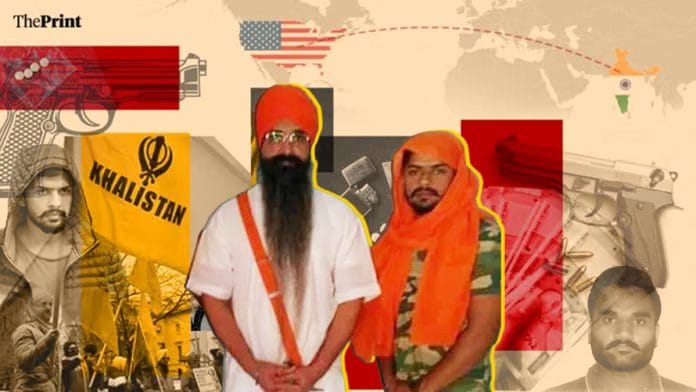
New Delhi: Days after the US cracked down on and indicted the organised crime syndicate led by imprisoned gangster Lawrence Bishnoi, a photo has surfaced showing him with Sikh separatist and Babbar Khalsa International (BKI) member Balwant Singh Rajoana, who was convicted for his role in the 1995 assassination of former Punjab chief minister Beant Singh.
The photo in circulation on X, coupled with a Federal Bureau of Investigation (FBI) raid image showing Khalistani flag imagery outside the California home of an accused indicted in the US case, has once again brought into focus the nexus between Sikh separatist groups and transnational gangster networks operating across the US, Canada and several other countries.
The BKI is a militant secessionist organisation aiming to establish an independent Sikh state called Khalistan. Founded in 1978, it has been declared a terrorist entity by several governments, including India.
“Bishnoi has been running this syndicate since 2015 from jails in different states. He met people from multiple gangs, including the BKI, to expand his network. For years, this association has worked in their favour as long as their targets are common,” an officer from the Punjab Police told ThePrint, adding that links between the crime syndicate and BKI have been established.
A key BKI member, Rajoana had earlier told the police that Beant Singh’s assassination was meant to avenge the “atrocities against innocent Sikhs in Punjab”.
The police officer said that “while BKI stands for Sikh separatism, it is important to note that the ideology of both the Bishnoi gang and BKI may not be the same. However, they both have been charged with crimes, and share funding”.
“The Bishnoi syndicate got associated with pro-Khalistani elements due to their wide base across Indian states, availability of shooters and easy availability of funds,” the officer added.
Bishnoi’s photo with Rajoana, who is a familiar name in Punjab’s separatist movement, has sparked outrage on social media.
Author Kushal Mehra, who lives in Canada and has a thorough understanding of Punjab, spoke about the photo of the Khalistani flag and gang bust by the US government.
“There is no believer of Khalistan. And, this is not separatism. The ideology has transformed from what it used to be back in the 1980s. One cannot forget that Bishnoi is a gang leader, and Khalistan has always been a gang movement,” he told ThePrint.
He termed Bishnoi’s association with separatism as an “act of cosplaying”.
“This ‘supposed movement’ has transformed into a drug network, and this platform (Khalistan) is being used to build the network,” he added. “Bishnoi is a typical gangster and Khalistan is used as a victimhood point, that’s it.”
“Bishnoi is no believer. He is a user of this very movement,” Mehra asserted.
Errant cop-turned-terrorist
Rajoana joined the Punjab Police in 1987 and was deployed as a security guard with a Patiala-based journalist in 1993. He bears the name of his village Rajoana, near Ludhiana, and is believed to have joined BKI in the 1990s when Punjab was in the grip of Sikh militancy, according to a special CBI court order.
A plan to assassinate Beant Singh using human bombs was conceived in June 1995. The masterminds—BKI chief Jagtar Singh Hawara and his associate Jagtar Singh Tara—chose Dilawar Singh, a dismissed policeman, and Rajoana, a serving constable, as human bombs. Rajoana was the “backup” bomb in case Dilawar failed, the court document states.
On 31 August, 1995, when Beant Singh was leaving office for the day and his cavalcade was still parked in the high-security civil secretariat in Chandigarh, Dilawar blew himself up, killing the CM and 16 others on the spot. At least 15 people were also injured in the powerful RDX blast.
In the court order, the prosecution states that “Beant Singh has been assassinated pursuant to a deep rooted criminal conspiracy masterminded by Babbar Khalsa International, an international organisation, as it perceived that Beant Singh usurped power after 1992 election in the State of Punjab and is responsible for indiscriminate atrocities the against the innocent Sikhs.”
BKI is labelled a terror group and banned by India under the Unlawful Activities (Prevention) Amendment Act, 2004. The Canadian government terms BKI as a Sikh terrorist entity that aims to establish a fundamentalist independent Sikh state called Khalistan (Land of the Pure) in what is presently the Indian state of Punjab.
BKI’s activities include armed attacks, assassinations, and bombings. The outfit has members outside of India, in Pakistan, North America, Europe and Scandinavia. In recent years, Indian police have arrested associates of BKI, recovering illegal arms and ammunition, and circumventing narco-smugglers seeking to procure weapons for BKI or provide money to its operatives, according to Canada’s Public Safety listing.
Gangsters & separatists
Links between the organised gangs and Sikh separatist groups are well documented.
The National Investigation Agency (NIA), in its chargesheets filed against Bishnoi and his close aide Goldy Brar in March 2023, alleged their links with the BKI.
The NIA stated that “a considerable part of the money generated through these extortion activities is sent to Canada, the US, Dubai, Australia for the use of their abroad-based associates and family members to fund pro-Khalistan extremists”.
Brar, who heads the North American region of the syndicate, according to the US indictment, has also had a long association with the BKI. He faces multiple cases, including for the murder of Punjabi singer Siddhu Moosewala, and the killing of 2015 sacrilege case accused Pradeep Kumar in Faridkot.
In its March 2023 chargesheet, the NIA also alleged that the Bishnoi syndicate provided shooters and logistical support to BKI terrorists, including for the 2022 Mohali RPG attack. It said the attack was carried out on the directions of Harwinder Singh alias Rinda, a Pakistan-based BKI member. Rinda died in 2022.
Brar was also found to have direct links with Lakhbir Singh alias Landa, another BKI operative based in Canada and working closely with Rinda, as revealed in NIA investigations so far.
According to police sources in Punjab, Bishnoi and Brar have close ties with BKI associates, who are backed by Pakistan’s spy agency Inter-Services Intelligence (ISI).
The BKI is also linked to the 1985 bombing of Air India flight 182, in which all 329 on board died.
“This association has already been established by Indian security agencies and the state police, but the official channel would take time to establish links. We had already established that these syndicates are not limited to India, or cities in Canada, including Surrey and Toronto. This has global ramifications, and it requires collaboration of all national and international security agencies,” the police officer quoted earlier said.
“First, the Canadians woke up, when violence was reported across districts, and now, the Americans have woken up. This is an important step,” he added.
When the FBI cracked down on members of the international crime syndicate of Bishnoi and others, one raid image by freelance photographer Josh Edelson showed FBI officials and drones outside a home in Stockton, California, that has a blue and yellow Khalistan flag.
The US indictment states that the house belongs to Gurlal Singh, said to be a key associate of Jaggu Bhagwanpuriya, an associate-turned-rival of Bishnoi, imprisoned in India. Gurlal has also been indicted.
According to the indictment, Gurlal, of Stockton, California, threatened a family in LA to pay $400,000 as extortion money, and as they refused to pay, he provided the victim’s name to corrupt law enforcement officials in Punjab, asking them to trace their kin and frame them in a case of murder.
(Edited by Nida Fatima Siddiqui)