


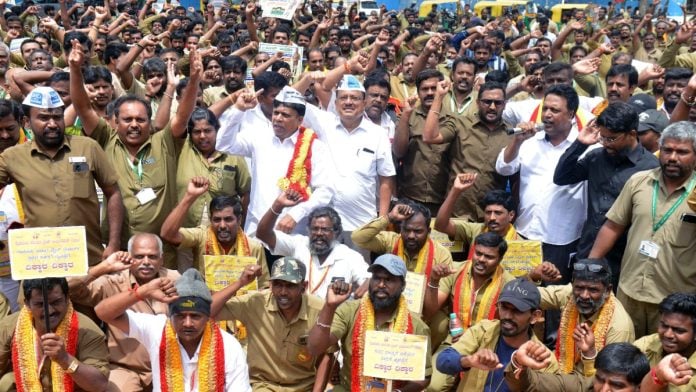
Bengaluru: A Vietnam-based EV taxis giant, protests by local autorickshaw and cab drivers’ unions and the potential revival of the defunct meter. These are some of the central factors at play as service providers and policymakers navigate Bengaluru’s complex private mobility space.
For the past two weeks, various autorickshaw and cab drivers’ unions have been trying to bring all stakeholders onto one platform and plan protests against Vietnam-headquartered Green SM’s offer to provide cab services in Bengaluru at Rs 8 per km, one-third of the current base fare of Rs 24 per km.
“This would turn into unhealthy competition and be disadvantageous to existing players. Everyone has to adhere to the base price set by the government,” a senior government official told ThePrint, requesting anonymity.
To be sure, the transport department has already approved licences for at least 100 EV cabs by Green SM and the second tranche of approvals are currently under review.
Local autorickshaw and cab drivers are up in arms, arguing that the entry of EV cabs would potentially impact their income since app-based aggregators have been known to use deep discounts to attract consumers in the past.
On Monday, Karnataka Transport Minister Byrathi Suresh announced that the government plans to make the installation of meters mandatory for all taxis, including those operated by app-based aggregators, through a new law.
The government official cited above said that the Motor Vehicle Act mandates the use of meters in autorickshaws and cabs operating in cities, and the new proposal is nothing more than the implementation of existing rules. But autorickshaw meters in Bengaluru have long served as more like an ornament, enabling drivers to demand astronomical fares even for short distances.
This very practice helped the growth—and adoption—of app-based aggregators who started with deep discounts but now have surge pricing and other add-on charges that translate to much higher costs than regulated fares, adding to the messy system, according to experts, autorickshaw and cab drivers, consumers and regulators who spoke to ThePrint.
Cities in India and other global centres have faced similar challenges with traditional service providers clashing with disruptors as companies like Uber and Ola (in India) have now become mainstays.
With mass mobility options like Metro, suburban rail and a stagnating fleet of buses, commuters in Bengaluru have fallen back on relying more on private transport, including autorickshaws and cabs, which has added to the growing congestion problem in India’s IT capital.
Bengaluru, with an estimated population of 1.4 crore, now has more than 1.3 crore vehicles, with nearly 1,500 new vehicles entering the city’s already clogged streets each day, making it one of the most congested cities globally.
Successive governments in Karnataka have been cautious not to approve innovative mobility solutions as the nearly two-lakh strong autorickshaw driver community forms a significant constituency.
Further, it remains unclear if app-based companies come under the Transport Department or the Information Technology department. The government maintains it is the former, while service providers argue that it is the latter.
The Karnataka government has oscillated between approving two-wheeler taxis and banning them, adding to the constant friction between riders of various services on the city’s streets. The new proposals are likely to suffer the same fate as resistance builds up against innovation in mass mobility.
The Supreme Court Friday upheld the 23 January Karnataka High Court order setting aside a ban on bike or two-wheeler taxis in Bengaluru. Local autorickshaw and cab drivers have often clashed with bike-taxis over the perceived loss of incomes, causing friction between service providers within the private mobility space.
Although Uber and Ola have offered these services in the past, the companies had to withdraw them after government crackdown.
“The decision brings much-needed regulatory clarity and recognises bike taxis as an important mobility option, offering commuters an affordable and convenient way to navigate congested cities while creating flexible earning opportunities for drivers,” Uber said in a statement Friday.
‘How will meters benefit app-provider?’
Industry players ThePrint spoke to said they are reviewing Green SM’s deep discounts, and will contest if the Transport Department approves the mandatory metre policy and accepts the Vietnam-based giant’s offer of Rs 8 per km.
“If meters are brought in, then how does it benefit the app-provider who is the discovery platform and enables the driver to get rides? It would go against the very tenet of our services which is to give consumers the convenience of door-to-door pickup services from a tap on the app,” said one senior executive of a leading app-based aggregator, requesting anonymity.
Uber is currently reviewing the government proposal on mandatory installation of meters but has yet to receive the notification on installing meters, it is learnt.
Companies like Uber and Ola, which command a significant share of the app-based cab services market, have relentlessly challenged state governments, including Karnataka, on regulations that they say curtail their operations. The two companies have periodically offered two-wheeler taxis as well as ride-sharing services but pulled back at the hint of crackdowns.
Almost four years ago, Bengaluru’s Auto Rickshaw Drivers Union (ARDU), feeling slighted by Uber and Ola’s changing payment policies and increasing platform commissions, came together and started Namma Yatri–an app-based autorickshaw service.
Although drivers said they were satisfied with the money being paid to them directly, consumers have faced the brunt of additional—and often hidden—charges, including ‘advance tips’. The practice of ‘advance tips’ continues despite the central government warning aggregators of action.
In May last year, Pralhad Joshi, the Union Minister of Education, Consumer Affairs, Food and Public Distribution & New and Renewable Energy said that this practice was “unethical and exploitative”.
“Such actions fall under unfair trade practices. Tip is given as a token of appreciation not as a matter of right, after the service. Taking cognisance of this, I had asked CCPA to look into it and today CCPA has issued a notice to @Uber in this regard, seeking explanation from the platform. Fairness, transparency and accountability must be upheld in all customer interactions,” he said.
The practice of 'Advance Tip' is deeply concerning. Forcing or nudging users to pay a tip in advance, for faster service is unethical and exploitative. Such actions fall under unfair trade practices. Tip is given as a token of appreciation not as a matter of right, after the… pic.twitter.com/WaPH26oT9G
— Pralhad Joshi (@JoshiPralhad) May 21, 2025
‘Its a trap’
Local autorickshaw and cab drivers have seen their incomes drop significantly in recent years, especially with schemes like the free bus rides for women under the Shakti scheme, claimed multiple drivers who spoke to ThePrint.
They fear that the transport department’s approval of Green SM will only make matters worse.
Although fuel and gas prices are market-linked, the Karnataka government last revised its base prices for autorickshaws three years ago. The current base price for auto rickshaws is Rs 18 per km and a minimum fare of Rs 36, which was revised about three years ago, said autorickshaw drivers.
Manjunath, the president of Adarsha Auto Union, told ThePrint that LPG and CNG prices have fluctuated heavily during the same period.
“A litre of LPG and CNG costs between Rs 70-100. CNG gives a mileage of around 20-25 km per litre, while LPG gives around 40-45 km per litre. But converting CNG to LPG also costs money that comes out of our pocket with no support on base fare revisions from the government,” he told ThePrint.
He said that the existing Rs 18-24 for autos and cabs itself remain insufficient while companies like Green SM are offering services at Rs 8.
This, he added, will be a trap for both consumers and drivers.
“Earlier Uber and Ola also gave deep discounts but later hiked up prices. Why should we believe that Green SM will be any different? Once consumers get used to the services, we drivers will be forced to buy into these cars or lose our income as consumers will opt for cheaper services,” he said.
Green SM, however, is expanding aggressively into Indian cities, which could potentially dent the market share of existing players.
On 13 November, the Vietnam-based company announced that it had obtained licenses in Delhi, Haryana and Uttar Pradesh to cover the NCR region as well as Karnataka. It is already operational in Delhi-NCR and Hyderabad and is looking to expand into Bengaluru and Chennai.
“Green SM aims to provide customers with safe comfortable journeys along with consistently high service standards, while creating earning opportunities for local drivers. Green SM believes that quality service and environmentally friendly vehicles can help encourage greener travel habits in major cities,” Rohit Sharma, CEO of Green SM India, said in a statement.
(Edited by Amrtansh Arora)
Also Read: Tech-based transport’s teething troubles in Bengaluru: Autos vs bike taxis, gaps in govt policy