





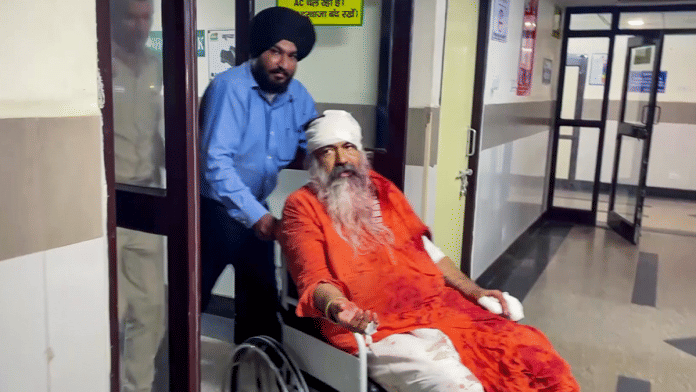


Gurugram: Three days before Thursday’s highway blockade in Ambala, the man whose car was at the centre of the original confrontation was in a hospital bed, describing an ambush. Three days after it, he was still the reason roughly 400 people faced police cases, and why Sikh groups in Haryana were preparing to knock on the door of the Akal Takht.
Gursimran Singh Mand, who enjoys Y-plus protection, has spent much of the past decade positioned exactly where Thursday’s violence erupted — at the friction point between Hindu nationalist politics and Sikh separatist politics in Punjab and its neighbourhood. To some, that has made him a marked man.
To others, it has made him a professional provocateur who walks into gurdwaras and calls it activism.ThePrint tried to reach him with calls and text messages, but his cellphone remained switched off.
From Youth Congress to anti-Khalistan front
Mand was born on 19 October 1974, in Bhutta village of Ludhiana district, into a farming family with a background in local political and cooperative activity. He entered public life through the Congress, working with the Youth Congress in Ludhiana and later its training cell, and has said his politics were shaped by watching separatist violence unfold in Punjab through the 1980s and 1990s.
He stayed active in local Congress circles even after the party’s defeat in the state in 1997; social profile aggregators still list him as a national joint coordinator with the party’s Kisan Congress cell.
That Congress lineage now sits awkwardly alongside the identity he has built since: national president of the International Anti-Khalistani Terrorist Front (IAKTF), and, per his own social media bios, national spokesperson of the Shree Niranjani Akhara, one of the Hindu monastic orders that takes part in the Kumbh Mela.
His Instagram and X bios carry the tagline ‘Jai Hindu Rashtra’. His Facebook page, run under the name Gursimran Singh Mand, carries the akhara’s endorsement in its description.
Critics have gone further than Mand’s own bios in placing him politically. BKU (Charuni) president Gurnam Singh Charuni, at a dharna outside Panjokhra police station days before Thursday’s clash, said no action was being taken against Mand “just because he speaks in favour of the Rashtriya Swayamsevak Sangh (RSS) and the Bharatiya Janata Party (BJP)” — an allegation of political patronage rather than a confirmed affiliation.
Mand has not himself claimed the BJP membership in what is publicly available; his self-description stays with the akhara and his anti-Khalistan front.
However, his Instagram posts include a VVIP invite to attend the swearing in ceremony of West Bengal’s first BJP CM Suvendu Adhikari with a text post “First in my bloodline to see Saffron Govt in West Bengal. Truly blessed to witness this historical event. Thank you @narendramodi Jee & @amitshahofficial Jee for making this possible.”
In another post, Mand is seen garlanding Adhikari on his victory from Bhawanipur Assembly constituency.
Also Read: IPS pelting stones, cop pointing AK-47 at farmers. How Hansi marked 1st I-Day as Haryana district
A history of threats
Media reports say that Mand has repeatedly been the target of threats tied to his activism. In 2022, after the murder of Hindu outfit leader Sudhir Suri in Amritsar, Mand said he had received threats from pro-Khalistan figures and gangsters; Punjab Police responded by restoring his security cover and an escort vehicle, eventually assigning 10 armed gunmen. Punjab Police had briefly withdrawn that cover after the Aam Aadmi Party (AAP) government took charge in the state.
In March last year, Mand said he received a bomb threat from gangster Goldy Dhillon over a foreign WhatsApp call, prompting another police case.
Later that year, after he filed a Supreme Court petition seeking a terrorist designation for Pakistan-based gangster Shehzad Bhatti, he reported fresh threats involving grenades and rocket launchers directed at his family—threats that came with Y-plus security cover, including CRPF personnel.
That security detail became directly relevant 7 August, when two of the policemen assigned to protect him, identified as Rakesh Kumar and Kulbir Rana, were among those injured as his vehicle was surrounded outside Gurdwara Shri Panjokhra Sahib.
Mand has said he and his son, Bhavjot Singh, were attacked with swords and sticks after he refused demands to raise slogans against the prime minister and the RSS, and to call for the release of Amritpal Singh. Sikh community representatives dispute that account, alleging instead that Mand drove his vehicle into a crowd of devotees after being asked to follow gurdwara protocol.
Why he divides opinion
Mand occupies an unusual space in Punjab’s public life, one that will only sharpen as the state heads toward elections due next year.
To his supporters, he is a nationalist who has taken on separatist networks at real personal risk, backed by a documented trail of threats and enhanced security. To his critics within the Sikh community, he is a man who has repeatedly inserted himself into contentious religious spaces, and whose confrontations, this one included, tend to escalate faster than they get resolved.
The Haryana Police on Friday registered two fresh reports over Thursday’s highway blockade near Gurdwara Shri Panjokhra Sahib in Ambala—one each at Baldev Nagar and Panjokhra police stations, naming around 200 people in each case, including Haryana Sikh Gurdwara Management Committee (HSGMC) president Jagdish Singh Jhinda. The First Information Reports (FIRs) invoke sections covering attempt to murder, causing hurt with dangerous weapons and damage to public property.
Friday’s cases follow a week of escalating confrontation. The Haryana Police fired tear gas and used lathis on Thursday to clear thousands of Sikh protesters who had blocked the Delhi-Amritsar national highway for over six hours—the culmination of a standoff that began with a confrontation over Mand’s SUV outside the gurdwara on 7 August.
Sikh community representatives allege the road to the gurdwara had been closed to vehicles because of the crowd due to Gurparb, that Mand sat inside his car for close to 15 minutes despite being asked to follow protocol, and that he then drove it forward, hitting devotees and injuring at least one of them.
Mand has given a different account. He said he and his son, Bhavjot Singh, were sitting in the car when a group surrounded it and attacked with swords, sticks and other sharp weapons. His SUV’s windshield and window panes were smashed. Besides Mand and his son, two policemen assigned to his security—identified as Rakesh Kumar and Kulbir Rana—were also hurt.
Roughly 1,500 to 1,600 people had gathered at the gurdwara on Thursday morning, according to the police, after community leaders had earlier set a deadline demanding a case against Gursimran Singh Mand.
Talks with the police were underway when a section of the crowd broke away and blocked the highway. Protesters removed police barricades and took alternative routes to reach NH-44 near Jaggi City Centre in Ambala Cantonment, shutting down both carriageways for over six hours.
At least six police personnel were injured, including a DSP, and HSGMC president Jhinda was also hurt in the melee. BKU (Shaheed Bhagat Singh) spokesperson Tejveer Singh said the protest had been meant to stay peaceful, but that barricades and tear gas provoked the confrontation, and that the police action near a school caused difficulty for students and parents.
Traffic was restored around 9 pm, and DGP Singhal visited injured police personnel at the military and civil hospitals in Ambala.
(Edited by Nardeep Singh Dahiya)
Also Read: Sikh extremists using Canada to ‘fund & promote violence in India’—Canada intel report