


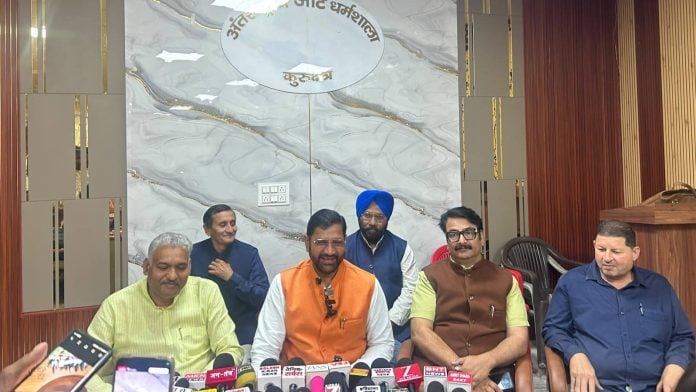
Chandigarh: Nearly a thousand years ago, a bronze idol of Vishnu stood in a temple at Thanesar, in what is now Kurukshetra. Then Mahmud of Ghazni arrived and the idol was carried away to Afghanistan. Now, the Haryana government’s heritage body wants it back.
The Haryana Sarasvati Heritage Development Board, chaired by Chief Minister Nayab Singh Saini, has written to the Ministry of External Affairs (MEA), seeking diplomatic intervention to trace and repatriate the idol of Bhagwan Chakra Swami.
The letter, dated 5 November and seen by ThePrint, is signed by the Board’s deputy chairperson, Dhuman Singh Kirmach.He has urged the ministry to open diplomatic communication with the government in Afghanistan “to investigate the present location and status” of the original idol.
The letter then lists four more requests. The first is that Afghan authorities allow access to historical sites, museums and archaeological collections in Ghazni where the idol may have been kept. The second is that the Archaeological Survey of India (ASI), Indian historians and international heritage experts help authenticate it.
The third is that the Centre starts “diplomatic and cultural discussions” for a peaceful return. The fourth is that, if the idol is found but cannot be returned right away, Afghanistan helps with its documentation and conservation, and gives public recognition to its link with Thanesar.
Chakra Swami, or Chakraswamin, means “lord of the discus”, a reference to Vishnu’s Sudarshan Chakra. Thanesar was among the most venerated Hindu pilgrimage centres of its time, and the idol was its principal deity.
Mahmud of Ghazni, the ruler of the Ghaznavid empire, raided northern India repeatedly in the early 11th century. Historical accounts place his attack on Thanesar around 1014 CE, though dates vary across sources.
The Vishnu temple was attacked and the idol taken to his capital in present-day Afghanistan. His raid on the Somnath temple in Gujarat followed about a decade later. Al-Biruni, who lived at Ghazni, wrote of the two idols lying together there.
The Sarasvati Heritage Development Board rests its case on two historical sources. The first is the 11th-century Persian scholar Al-Biruni. In Alberuni’s India (Volume I, page 117), he describes the idol, called Cakrasvamin, as a bronze image nearly the size of a man. He writes that it was then lying in the hippodrome at Ghazni, alongside the idol of Somnath.
The second source is the ASI’s annual report for 1875–79, in which the Society’s first director-general Alexander Cunningham refers to the same account.
According to the report, Abu Rihan, as Al-Biruni is also known, recorded that the invaders found at Thanesar a statue that people believed to be as old as the Mahabharata war.
Cunningham added that the historian Ferishta renders the name as Jag-Soma, a misreading of Chakra Swami in Persian script. Both authors, the report says, state that the statue was taken to Ghazni “to be broken and trodden under foot”.
“Bhagwan Chakra Swami is not merely an ancient idol. It represents the civilisational, spiritual and historical identity of Kurukshetra, the sacred land of the Mahabharata and the Bhagavad Gita,” Kirmach told The Print on Thursday.
“Bringing it back to India would be a matter of immense cultural and historical significance. It would restore an important part of our heritage and strengthen the historical identity of Kurukshetra as a major centre of India’s ancient civilisation.”
The Sarasvati Heritage Development Board was constituted on 12 October 2015 to revive the Sarasvati river and develop heritage sites linked to it. CM Saini now heads it. Kirmach, who joined as vice-chairperson in October 2020, is its deputy chairman.
Over the years the Board has worked on tracing the Sarasvati’s course and planning dams and reservoirs, including at Adi Badri in Yamunanagar. It has also taken up riverfronts, including one at Pipli in Kurukshetra, a Sarasvati museum in Kurukshetra, and a sculpture garden at Sarasvati Tirtha in Pehowa.
(Edited by Tony Rai)