



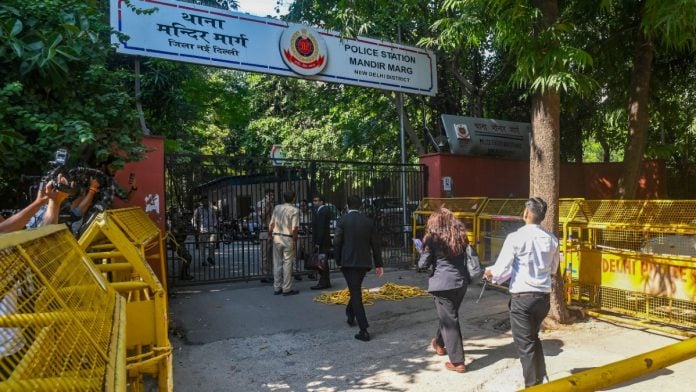
New Delhi: A Special Executive Magistrate (SEM) has extended the judicial custody of Cockroach Janta Party (CJP) co-conveners Ashutosh Ranka and Saurav Das by two more days. Both were produced before the SEM at Mandir Marg police station here Monday.
The lawyer representing Ranka and Das claimed to ThePrint that the SEM “threatened sureties”, and that Delhi Police cited apprehensions to oppose the bail without specifying the basis for the apprehensions.
CJP’s legal affairs head Ratna Singh, too, had alleged that bail proceedings were delayed to prevent the release of Ranka and Das, who were initially sent to five days’ judicial custody on 14 October following their detention from Jantar Mantar the previous day.
The case was registered a day after Jantar Mantar was de-notified as a protest site. Das and Ranka were placed in preventive detention under Sections 126 and 170 of Bharatiya Nagarik Suraksha Sanhita (BNSS) for allegedly violating the bond to maintain peace.
Under Section 126 of the BNSS, a Special Executive Magistrate (SEM) can demand a bond from individuals in detention to ensure peace in situations where a breach of peace or a public disturbance is suspected.
Section 170, on the other hand, empowers the police to arrest individuals without an arrest warrant or a magistrate’s order if they have knowledge of a design to commit a cognisable offence and the offence cannot be prevented by any other means.
Separate from the two FIRs registered against Ranka and Das at Connaught Place and Parliament Street police stations for trespassing, these proceedings arise from a kalandra report (police report detailing grounds for preventive detention) submitted to an Executive Magistrate seeking preventive action to maintain peace.
Sureties (a third person standing in as a guarantor) were required for their release, but the Special Executive Magistrate (SEM) rejected all four offers. Two were rejected because the people standing surety had previously been detained. Another was rejected on the grounds that the person was not a Delhi resident, while the proceedings were being held in Delhi.
CJP’s Ratna Singh questioned the rejections, saying, “They have rejected four sureties till now on vague reasons. They have made people who have FIRs against them for being part of protest as people having criminal antecedents.”
A senior Delhi Police officer, confirming the development, said, “The court has granted two more days in judicial custody to Das and Ranka. We had asked the court for five days.”
“The reasoning we provided was that the situation is still the same. We have to maintain peace, we have not been able to see positive changes, we have sought for extension in judicial custody, to ensure there is no plan for a protest that breaches peace. Until things get back to normalcy,” the official told ThePrint, requesting anonymity.
Also Read: Behind Congress’ open support to CJP, a gradual shift and finding common ground
‘SEM threatening sureties’: CJP lawyer
Lawyer Pushp Sharma, who represented both Ashutosh Ranka and Saurav Das in the bail proceedings Monday, said “it was appalling what was happening inside the courtroom”.
“The arguments happened, and they (police) started saying that there is some apprehension—they are calling a protest again. And we asked them to be specific as to where these apprehensions are coming from. What is the allegation? They said they have made a call for protest. We asked them, where is the call? Show us specific instances. Show us the tweets, show us the Instagram posts,” said Sharma.
He added, “They (police) say it is all in the public domain. They have nothing to show. They filed a 28-page application to restrain them, to keep them in detention. And, that application, even in their own words, has no particular statement, no date or time. It just says that the State has apprehension. That apprehension has no basis.”
Sharma said the CJP’s legal team asked the police under what provision they were seeking to detain Ranka and Das further. “They are not able to answer this. After this, arguments concluded,” Sharma claimed.
He said the SEM told the lawyers that he would take about a half hour to dictate the order.
“He (SEM) took three hours. For two hours and fifteen minutes, he was on a call with someone. And he is writing down his order, handwritten or maybe dictating his order while being on a call. Then he is clicking pictures and sending them to people with whom he was on a call,” said Sharma.
Adding, “And then he calls in surety. He tells us that all the advocates should go out. I will talk to sureties alone. While he is talking to them alone, he asks them questions like: What is your wife’s phone number? Do you know Ashutosh’s father’s name? And then he tells them, do you know that these guys would do it again after coming out. And then they will catch you guys. Basically, the SEM is threatening the sureties,” Sharma said.
The lawyers were then informed that Ranka and Das will be sent back to judicial custody for two more days.
Sharma said the order issued by the SEM Monday took up “the absurd hypertechnical ground” that there was a mismatch between the sureties’ photo on the bond and the surety present in person in the courtroom. “The passport-sized photo might have been around 1.5 or 2 months old. Nobody comes, goes and takes passport size photos every single day. The person might have grown some hair during this time,” said Sharma.
Sharma also said that, inside the courtroom, Ranka and Das “clearly said that we are giving you an undertaking that we will not make any sort of protest calls or we will not do anything that is illegal or outside the bounds of law”.
“When we also told him (SEM) that you record this in your order that these people have made this statement, he just goes silent,” claimed Sharma. Ranka and Das, said Sharma, can be held in judicial custody for a maximum of seven days after which the police “will have to approach the sessions court” for any further extension in judicial custody.
‘No provision for custody for breach of bond’
Referring to the developments Monday, senior advocate Vikas Pahwa called the continued detention of Ranka and Das as “illegal custody”.
“There is no provision in BNSS for taking someone in custody for the breach of bond. The only period in which somebody can be put into custody is if the bond is not filed. Suppose. there is a direction for bond, and the person says ‘I don’t have a bond at the moment or I can’t file it’, then he can be put into custody,” Pahwa told ThePrint.
“But in case he files it and violates it, then there is no provision in BNSS or CrPC in which the accused could have been taken into custody,” Pahwa added.
On the four sureties rejected earlier, Pahwa said, “it is all deliberate”.
“Normally, the accused are released on bail subject to verification of surety. You can’t keep somebody behind bars in the garb of seeking verification, which is completely illegal. And this is not a very heinous offence. I understand if somebody is in custody in UAPA, maybe PMLA (money laundering) cases, and narcotics cases where they don’t trust the sureties, because sureties normally are arranged in those cases,” Pahwa said.
But, in a case like this, he said, “you are adjourning only for the purpose of verification; it’s a completely illegal exercise, and it is all deliberate.”
On 14 October, DCP (New Delhi) Sachin Sharma had said that Ranka, Das, Ajinkya Shinde and 11 other CJP members reached Jantar Mantar during the morning hours of 13 October by trespassing through a private premise. The DCP said that the three individuals were produced before the Special Executive Magistrate (SEM), where proceedings under Sections 126 and 170 of the BNSS were initiated against them.
“After considering the matter, the SEM court, considering the kalandra details and in view of their repeated violations of law, and serious apprehension that if released on bail they will again violate law and instigate others to violate law remanded Saurav Das and Ashutosh Ranka to five days of judicial custody,” DCP Sharma had said at the time.
(Edited by Amrtansh Arora)
Also Read: Delhi protests, mass detentions put SC’s suo motu powers in focus: When does top court step in