





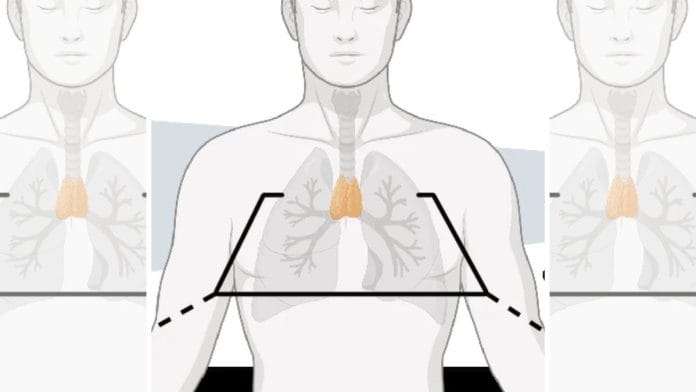


New Delhi: For most of medical history, the thymus has been seen as an organ that does its job early and then retires.
It sits behind the breastbone, just above and in front of the heart, producing the immune cells that defend the body against disease—and then, around puberty, it begins to shrink. By middle age, it largely turns to fat, often even removed during cardiac surgeries.
However, that assumption is now being tested. Two studies published in Nature journal in March found that adults with healthier thymus tissue had lower rates of cancer, longer lives, and better responses to cancer immunotherapy.
Researchers at Harvard-affiliated institutions, with collaborators across Europe, used artificial intelligence to assess thymic health from routine CT scans and found that higher active tissue levels were linked with better outcomes.
The findings came after a landmark 2023 study in the New England Journal of Medicine found that patients whose thymus had been surgically removed were more than twice as likely to die in the five years that followed, and significantly more likely to develop cancer.
The evidence is still early, and medical experts do not fully agree on what these studies prove versus what they suggest. Even so, the thymus is drawing renewed research attention. Scientists are now even exploring whether the thymus can be restored or rebuilt.
Also Read: How a radioactive dye could soon diagnose most elusive form of endometriosis, without surgery
What the new studies found
The two Nature papers published in March this year studied the subject from a different angle.
Instead of looking at what happened to people who lost their thymus, the researchers asked whether variation in thymic health among people who still had one was associated with differences in health outcomes.
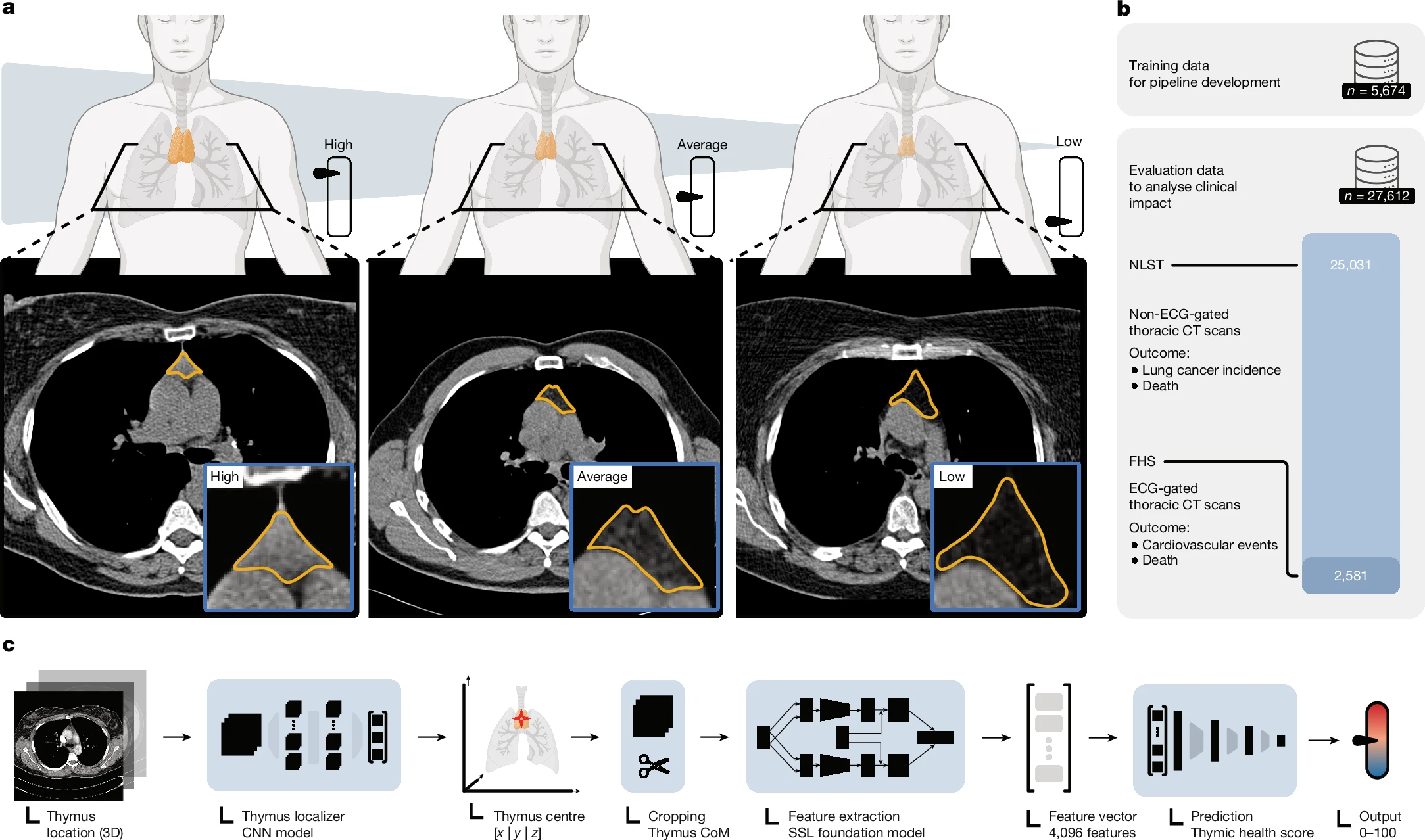
To do this, they developed an artificial intelligence-based, deep-learning framework that could assess the composition of the thymus—its ratio of active immune tissue to fatty tissue—from routine CT scans. The tool produced what they called a thymic health score, which was a measure of how well it appeared to be functioning.
The first study titled ‘Thymic health consequences in adults’, applied this tool to data from more than 25,000 participants. The study was led by the Harvard Medical School in Boston.
The results, after adjusting for age, sex, smoking, and other conditions, showed that people with higher thymic health scores had a 50 percent lower risk of dying from any cause, a 63 percent lower risk of cardiovascular death, and a 36 percent lower risk of developing lung cancer compared to those with the lowest scores.
The second study looked at 3,476 cancer patients who had received immune checkpoint inhibitors—the class of drugs that has transformed oncology over the past decade by helping the immune system recognise and attack tumour cells. Higher thymic health was associated with reduced risk of disease progression and death across multiple cancer types.
The study was anchored by the Dana-Farber Harvard Cancer Center (DFHCC) in Boston, with external validation from UK-based cohorts.
The connection to immunotherapy is, for several doctors, the most convincing part of the research.
Immune checkpoint inhibitors work by unleashing T-cells—the immune cells responsible for identifying and attacking foreign agents—against cancer.
If the thymus continues to produce and refresh T-cells in adulthood—even at a reduced rate—then its health would affect how well a patient’s immune system responds when those inhibitors remove the brakes.
Dr Kanika Sood Sharma, Director of Radiation Oncology at Dharamshila Narayana Superspeciality Hospital in New Delhi, said the connection is plausible. She pointed to a pattern observed in radiation oncology.
“When the chest is irradiated (exposed to radiation) during cancer treatment, immune cells in that region get suppressed. The thymus may play a role in replenishing them and may be one of the contributing factors for the maturation of immune cells that help fight cancer,” she said
However, the evidence is not conclusive. “It may be an extrapolation,” she said.
A gland that trains your immune cells
The thymus is a lymphatic organ comparable in structure to the tonsils and adenoids but situated deeper in the chest. Its primary function is producing T-cells — the immune cells responsible for identifying and attacking foreign agents in the body, including viruses, bacteria, and tumour cells.
“The T in T-cell stands for thymus,” said Dr S.P. Shrivastava, a medical and radiation oncologist at Kokilaben Dhirubhai Ambani Hospital in Indore, Madhya Pradesh. “The cell gets trained there—that is why the name.”
He said that T-cells originate in the bone marrow but travel to the thymus to mature. There, they learn to distinguish the body’s own tissues from foreign invaders.
Dr Shashikara NJ, Senior Consultant in General, GI and Thoracic Surgery at Fortis Hospital in Bangalore, described it as a priming organ. “It slowly recognises which tissues belong to the body and which do not. That is how our immunity develops.”
The thymus works alongside the bone marrow, which produces B-cells responsible for antibody-based immunity.
In childhood, the thymus is large and active. Around puberty, it begins to shrink. “Over a period of time, after 14 years, it decreases in size and is generally not considered to have any active purpose anymore,” Dr Shashikara said.
He added that in many cardiac surgeries, “we clear the fatty tissue in front of the heart, which is largely what the thymus becomes, and nothing significant is visible on most CT scans by that point”.
For cardiac surgeons, the thymus is seen as an organ to work around, not preserve, especially in adults.
“As cardiac surgeons, we usually feel there is no role for the thymus in adults. From what we have known so far, it barely contributes anything,” said Dr V. Devagourou, head of the Department of Cardiothoracic and Vascular Surgery at the All India Institute of Medical Sciences (AIIMS), New Delhi.
“It is considered a vestigial organ beyond a certain point. With cancer immunotherapy coming up only recently, we are still not sure about its role in adulthood,” he added.
The thymus is difficult to study in adults. It cannot be easily biopsied, and assessing its function in adults requires inference rather than direct measurement. For decades, the assumption that it had stopped working after puberty was rarely tested—and medicine proceeded on that knowledge.
The organ did remain a clinical concern in one specific context. For instance, in myasthenia gravis, an autoimmune disorder that causes progressive muscle weakness, the thymus is often abnormal, and its removal is a recognised treatment.
“We have seen people who have myasthenia gravis at the age of 50 plus, and we remove the thymus despite its very small size—because it is still functioning, and functioning against the body,” said Dr Rahul Sharma, Director of Pulmonology and Critical Care at Max Smart Super Speciality Hospital in New Delhi.
But apart from such conditions, a shrinking thymus was understood as simply ageing — not a clinical problem.
“Nobody knows whether, after it regresses, there is any role left—or whether it is just a vestigial organ,” Dr Sharma said. “That is why it is called a mysterious organ.”
He drew a parallel to the appendix, which is assumed to be of no consequence, left alone unless it causes trouble.
What has triggered more research interest into the thymus, Dr Sharma said, is the rise of cancer immunotherapy. Unlike conventional cancer treatments such as chemotherapy, which attack tumour cells directly, immunotherapy works by activating the body’s own immune system to identify and destroy cancer cells and T-cells are central to that process.
“We know that T-cells mature in the thymus. Because of the rise of immunotherapy for cancer treatment, the interest in the thymus and its function has taken a step forward,” he added.
Where clinicians disagree
Not everyone agrees with the new research.
Dr Shashikara raised concerns about the 2023 New England Journal of Medicine study that started much of the current conversation. The study compared thymectomy patients— many of whom had conditions such as myasthenia gravis — with patients who had undergone similar cardiothoracic surgeries without thymectomy.
He argued that differences between the two groups made it difficult to isolate the thymus as an independent variable. “Without proper matching of the individuals being compared, we are basically comparing apples to oranges,” he said.
The study’s authors had anticipated this concern. In separate analyses excluding patients with a history of cancer, autoimmune disease, infection, myasthenia gravis, or thymoma, the association between thymectomy and higher rates of death and cancer still held.
A subsequent study by the same team, using an entirely different control group — general internal medicine patients rather than cardiac surgery patients — arrived at similar conclusions.
Dr Shashikara pointed to a different set of studies that examined the thymus in a more controlled setting.
The MGTX trial, a landmark randomised controlled study published in the New England Journal of Medicine in 2016, compared thymectomy against medication alone in myasthenia gravis patients and found that the surgical group fared better, with reduced muscle weakness and lower steroid dependence.
A two-year extension of the same trial, published in Lancet Neurology in 2019, confirmed these benefits held over time.
Existing research, Dr Shashikara noted, justifies removing the thymus in specific disease contexts; it does not support a broader claim about what the organ does in otherwise healthy adults. He also pointed out that an overactive thymus is not automatically protective.
It is itself associated with autoimmune conditions such as myasthenia gravis and Graves’ disease — conditions where the immune system turns against the body’s own tissues,” he said.
Dr Shrivastava said that the new research must be cautiously viewed. “We don’t have confirmatory scientific evidence yet. Whatever data is being presented may be extrapolated,” he said.
Can the thymus be revived?
The thymus has gone, in a relatively short span, from being considered a closed question in adult medicine to an active area of research — but the evidence has not yet caught up with the interest it has generated.
Scientists are now exploring whether the thymus can be restored at all. A 2025 study in Nature Biotechnology found that injecting certain structural cells into an ageing thymus helped it produce more T-cells and improved immune response in animals.
A 2026 study in Nature Communications showed that thymic tissue could be grown in a laboratory from stem cells, with the lab-grown tissue capable of producing T-cells.
Another review in Trends in Molecular Medicine called scalable thymus regeneration an attainable goal. However, none of this has been tested in humans yet.
“No approved treatment exists to restore thymic function in adults, and no clinical guidelines exist to preserve it during surgery,” said Dr Sharma.
(Edited by Sugita Katyal)
Also Read: Severe pregnancy vomiting has genetic roots—6 new genes discovered in major study