



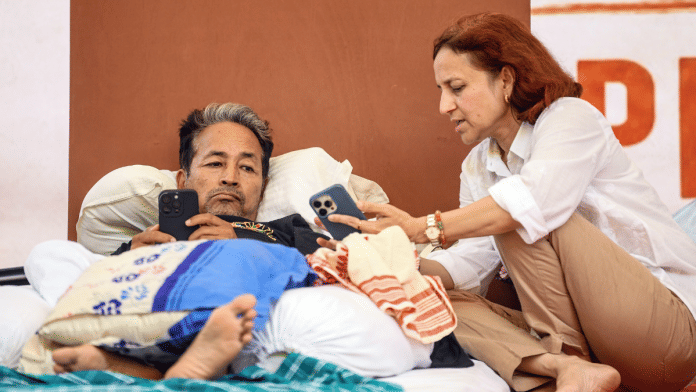
New Delhi: Climate activist Sonam Wangchuk may have ended his 25-day hunger strike late on Thursday, but he’s not out of the danger zone yet. Doctors say his body has entered another medically critical phase, as recovery from prolonged starvation can take weeks to months. The biggest immediate risk is not the fast itself, they say, but how food is reintroduced.
“His body would have become dependent on ketone bodies for energy,” said Dr Ambrish Mithal, Chairman and Head of Endocrinology and Diabetes at Max Healthcare. Ketone bodies are water-soluble molecules produced by the liver when the body starts burning stored fat instead of glucose, its usual source of energy.
“His muscles would have been melting away and his energy reserves largely depleted. You cannot feed suddenly. You have to reintroduce food very slowly, especially during the first three days,” Dr Mithal told ThePrint.
Wangchuk, who had been on an indefinite hunger strike since 28 June in support of the Cockroach Janta Party (CJP)-led protests over the National Eligibility cum Entrance Test (Undergraduate) 2026 paper leak and wider demands for accountability in the examination system, ended the fast after Union ministers J.P. Nadda and Jitendra Singh met him at Medanta Hospital in Gurugram.
After weeks without food, the body switches from glucose to stored fat for energy and gradually starts breaking down muscle protein. Dr Mithal said reversing these changes requires carefully supervised nutrition and close monitoring of blood sugar and electrolyte levels. Patients who have fasted for more than 10 days or lost over 10 per cent of their body weight are usually started on just 5-10 kilocalories per kilogramme of body weight a day, with calories gradually increased over the next few days.
Refeeding syndrome
The major concern after prolonged fasting is refeeding syndrome, a potentially life-threatening condition that occurs when food is reintroduced too quickly after starvation. Dr Mithal explained that eating carbohydrates triggers insulin release, causing phosphate, potassium and magnesium to rapidly move into cells. This can sharply lower their levels in the blood, increasing the risk of irregular heartbeats, seizures, confusion and fluid overload.
“The tendency is to think that if someone has fasted, you should immediately feed them. That is actually the problem,” he said. To prevent this, doctors start with a low-calorie diet and gradually increase food intake over four to seven days.
Mithal also stressed the importance of thiamine (vitamin B1) before and during refeeding because prolonged starvation depletes the body’s stores. “Without enough thiamine, the body cannot process glucose properly. This can lead to serious brain complications within hours to days of restarting food,” he said.
Why recovery takes time
According to Delhi-based nutritionist Divya Gandhi, prolonged fasting first uses up the body’s glycogen stores before forcing it to burn fat and muscle for energy. “The body undergoes ketosis. There is fat loss as well as muscle loss because there is no carbohydrate intake,” she said.
She advised against immediately returning to regular meals. “The food should not be introduced in a hard or fibre-rich form because digestion has slowed down. One should begin with simple carbohydrates such as coconut water or juice, followed by soups or broths. If someone directly starts eating roti and sabzi, there can be acidity and digestive problems because the metabolism has slowed.”
According to Gandhi, regaining weight is only part of recovery. “For the body to become normal, it will take at least a couple of months,” she said. “Muscle recovery naturally takes time. Along with dietary protein, supplements may also be needed, besides vitamins and minerals from fruits and vegetables.”
Dr Rajiv Kovil, a Mumbai-based Diabetes & Obesity Specialist, said the body does not return to normal immediately after eating resumes. “Digestion, insulin secretion and gut function gradually restart over several days,” he said, adding that nutrition should be reintroduced gradually under medical supervision with adequate hydration.
(Edited by Nardeep Singh Dahiya)
Also Read: From Irom Sharmila to Sonam Wangchuk, what law says about hunger strikes & medical intervention