


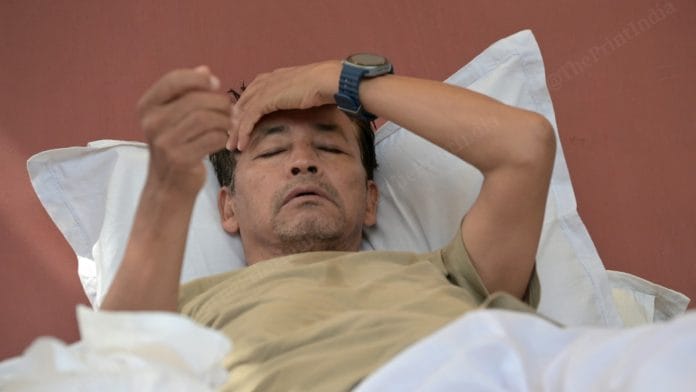
New Delhi: The Delhi High Court’s recent order in the Sonam Wangchuk case, underlining that the “life of every citizen is precious and all medical efforts ought to be made by the government authorities to save the same”, has renewed focus on the legality of peaceful protest and the State’s corresponding duty to safeguard life.
Making these remarks on 16 July while disposing of a Public Interest Litigation (PIL) concerning the climate and education activist’s health during his ongoing hunger strike, the court, however, declined to mandate blanket force‑feeding, instead directing that Wangchuk be shifted to hospital care and placed under continuous medical monitoring.
Government doctors were tasked with assessing his condition daily and providing medical intervention as necessary.
On Sunday, the high court declined the plea of Wangchuk’s wife Gitanjali Angmo to move him out of the Safdarjung Hospital, holding that the shifting was not arbitrary but done due to his deteriorating health condition. Wangchuk was directed to be taken to hospital from the Jantar Mantar protest site and to be kept under daily medical supervision.
Protest as a fundamental right
Protest in India has a deep historical lineage, from ancient traditions of non‑violence and peasant uprisings to Mahatma Gandhi’s satyagraha and modern hunger strikes, shaping both the freedom struggle and democratic dissent today.
Hunger strikes are not unlawful, but they sit at the crossroads of two constitutional guarantees: the right to protest under Article 19(1)(a) and (b), and the right to life under Article 21 of the Constitution. Neither right is absolute; both are subject to reasonable restrictions imposed to balance individual liberty with public order and safety.
The Supreme Court, in the case of Mazdoor Kisan Shakti Sangathan (2018), affirmed that peaceful protest is protected under fundamental rights of speech and expression under Articles 19(1)(a) and 19(1)(b).
Article 19 (1)(a) confers freedom of speech to the citizens of this country and, thus, ensures that the petitioners could raise slogans, albeit in a peaceful and orderly manner, without using offensive language. Article 19 (1 )(b) confers the right to assemble and, thus, guarantees that all citizens have the right to assemble peacefully and without arms.
The Supreme Court has held that a citizen’s fundamental right to protest and assemble peacefully without arms is a distinguishing feature of any democracy, and that it is this feature that provides space for legitimate dissent.
“It encompasses the right to express grievances through direct action or peaceful protest. Organised, non-violent protest marches were a key weapon in the struggle for independence, and the right to peaceful protest is now recognised a fundamental right in the Constitution,” the top court said.
In 2011, yoga guru Ramdev undertook a hunger strike in support of the anti‑corruption movement, which triggered widespread protests across the country. The Delhi Police carried out a midnight crackdown at Ramlila Maidan, prompting the Supreme Court to intervene suo motu.
It held that Ramdev’s decision to sit on a hunger strike did not constitute an exceptional circumstance or imminent threat to public order, and cautioned that fundamental rights cannot be curtailed by casually invoking Section 144 of the erstwhile Code of Criminal Procedure (CrPC), which empowers a magistrate to impose temporary restrictions on assembly, movement, or speech to prevent danger to public order or safety.
Significantly, the court acknowledged the widespread acceptance of hunger strikes as a mode of dissent, observing that such acts are neither unconstitutional nor barred by law. “It is a form of protest which has been accepted, both historically and legally in our constitutional jurisprudence,” the court added.
In a recent 2026 case on protest by hunger strike, the Madras High Court stated: “Raising slogans and showing protest itself would not amount to commission of offence. Showing protest is the hallmark of democracy, which is a fundamental right guaranteed under the Constitution of India.”
Also Read: Sonam Wangchuk’s hunger strike exposes the limits of moral protest in today’s India
Judicial nuance
There is no Indian statute that explicitly authorises or prohibits the force‑feeding of a mentally competent adult undertaking a political hunger strike. In practice, courts resolve such situations by balancing two constitutional imperatives.
On one side lies the individual’s right to life and personal liberty under Article 21, which judicial interpretation has broadened to encompass bodily integrity and autonomy. On the other side stands the State’s duty to safeguard life and maintain public order when a protester’s health reaches a point of grave risk.
Because these principles may collide, courts avoid any rigid formula; instead, they evaluate the protester’s medical condition, decision‑making capacity, and the broader context of the agitation.
In 2025, Punjab farmer leader Jagjit Singh Dallewal was on a fast-unto-death protest during the farmer protests. The Supreme Court then said that “the State of Punjab, the Union of India and other stakeholders have the bounden duty to take all necessary measures to provide immediate adequate medical aid to Mr. Jagjit Singh Dallewal without forcing him to break his fast unless it is imperative to do so to save his life”. This order made it clear that court did not ask Dallewal to break his fast.
Force-feeding
Any discussion of force‑feeding in India must definitely engage with civil rights activist Irom Sharmila, whose protest became emblematic of the tension between autonomy and State intervention.
Irom Sharmila’s prolonged fast against the Armed Forces (Special Powers) Act (AFSPA) from 2000 to 2016 became the defining case on force‑feeding in India. For 16 years, she was repeatedly arrested under Section 309 of the erstwhile Indian Penal Code (IPC), then criminalising “attempt to commit suicide” and subjected to nasogastric force‑feeding while in custody.
Her protest highlighted the clash between the right to protest under Article 19 and the State’s asserted duty under Article 21 to preserve life. In 2016, the Manipur Sessions Court acquitted her, holding that a hunger strike is not suicide, but a legitimate form of political dissent. Importantly, this was before Section 309 was decriminalised, but today such protests are monitored medically rather than criminally.
Section 309 IPC (attempt to commit suicide) was effectively decriminalised in India through the Mental Healthcare Act, 2017, which came into force on 29 May 2018. Before this, the government had announced its intent to repeal Section 309 in December 2014, but the formal legal change took effect only with the 2017 Act.
Alfreza Ahmed is an alum of ThePrint School of Journalism, currently interning with ThePrint.
(Edited by Nardeep Singh Dahiya)
Also Read: Sonam Wangchuk will end fast if MPs assure Parliament debate on education, says wife Gitanjali Angmo