



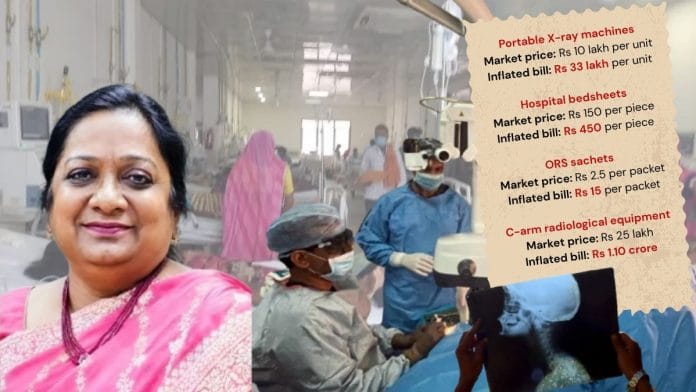
New Delhi: A Rs-2.5 Oral Rehydration Salt (ORS) packet for Rs 15 and a Rs-150 bedsheet for Rs 450. This is no inflation doomsday predictor; it’s a vignette from a massive corruption racket that has quietly unfolded in Delhi’s healthcare department.
Officials from the Capital’s health department rigged the procurement of medicines, surgical items, consumables, and medical equipment, a probe has found. From simple ORS packets to hospital bedsheets and even advanced portable X-ray machines, all medical items billed to the government were inflated by multiple health department officials and private brokers, all now under the Delhi Anti-Corruption Branch’s (ACB) scanner.
Three persons have been arrested by the ACB, even as the Vigilance Department has alleged that the costs of medical items were inflated, government tenders manipulated, and fake front companies created. “Certain public servants and private persons entered into a criminal conspiracy and manipulated procurement processes, tender conditions and technical specifications in order to provide undue advantage to selected firms and suppliers, causing wrongful loss to the government exchequer and corresponding wrongful gain to private persons,” an ACB official told ThePrint.
So far, the ACB has arrested D. Vinod Kumar Ranga, former Head of Office, Central Procurement Agency (CPA), Dr Vatsala Aggarwal, former Director General Health Services (DGHS), and Neeraj Chopra, Deputy Controller of Accounts (DCA), CPA, DGHS since a First Information Report (FIR) was registered on 2 June this year under sections pertaining to the Prevention of Corruption Act 1988 and criminal conspiracy of the Bharatiya Nyaya Sanhita.
The case and the arrests have led to unrest within the medical and political community. It has become the Aam Aadmi Party vs Bharatiya Janata Party vs Congress now, with leaders raising allegations and demanding answers from the ruling party.
Vigilance crackdown
The massive fraud operation came to light following a sudden and dramatic confrontation in May 2026, when officials from the Directorate of Vigilance launched a raid on procurement offices to seize files. The racket began to fall apart on 18 May, when the Vigilance Department visited the Directorate of Health Services, Karkardooma, following a tip-off, to collect records relating to purchase of medicines. Upon arrival, they met Dr Aggarwal, who called Ranga. He told her he was at the Shakarpur office of the directorate, and was asked to wait there.
When the vigilance team reached the Shakarpur office at 5 pm, Ranga was gone. The remaining medical officers said that Ranga had left; his phone was switched off.
The team handed a handwritten list of required files, including contracts of X-ray machines, bedsheets, C-Arms, ORS and other surgical items to the present CPA staff, since it could not be procured without Ranga. The files were handed over late at night. The matter was then handed over to the ACB.
“As per the information received, the group allegedly promoted cartelisation, connived with government officers, manipulated government tenders and siphoned off government money to the tune of several hundreds of crores of rupees,” said the ACB FIR, a copy of which ThePrint has accessed. A case has been registered against Ranga, his subordinates and / or associates, Rangila, and his associates.
Also Read: What’s the CBI’s ‘misconception’ of legal positions that court flagged in Delhi excise case
Key characters
To understand the scale of the fraud, both ACB and Directorate of Vigilance have identified its key faces. First, the FIR names Rajiv Rangila, a private broker and liaisoner at the centre of this case. Rangila operated as the primary coordinator between officials and manufacturing companies.
Rangila did not operate under his own name. ACB officials say Rangila tied up with manufacturers of medical items, fixing rates at which they would supply medical items, and fixing kickbacks in cash.
Fake companies with fake owners were created by Rangila, the allegations say. The names of some of these fake firms are: F Med Devices, Technocrats, Raj Shree, Ashi Surgical and Pharmaceuticals, M Sahib and Sons Pvt. Ltd. ACB officials further allege: “These companies and firms have been created in others’ names but the actual owner and operator of all these companies / firms is Rajiv Rangila.”
Ranga managed day-to-day operations in the CPA. Investigators say Ranga acted as a direct link with Rangila. “Tender documents and skewed restrictive specifications were prepared by Rajiv Rangila in connivance with the manufacturer company. These specifications and tender terms and conditions were tailor-made in accordance with the pre-decided company and supplied to Dr Vinod Kumar Ranga, who gave it to the tender committee,” the ACB has alleged. Ranga then presented these rigged documents to the official tender committee.
According to the investigation, Ranga actively coerced and threatened the members of the tender committee with administrative action if they resisted signing or approving the manipulated files. “The specifications and tender document were being forcibly approved by the tender committee using threats of action against them if they resisted,” it said. Ranga’s was the first official arrest in the case, on 18 June.
Dr Aggarwal occupied the highest administrative role for the Government of the National Capital territory of Delhi. After Ranga forced the tender committee to sign off on the biased specifications, the files were sent to Dr Aggarwal, the probe says. As the head of the department, she gave the final administrative sanctions and approval to the skewed tender terms, restrictive conditions, and rapid procurement methodologies. Dr Aggarwal was arrested by the ACB on 27 June.
Then there is Neeraj Chopra, former Deputy Controller of Accounts (CPA). The ACB probe has revealed that procurement proposals, approval of tender specifications, constitution of procurement committees, approval of procurement methodology and other important procurement decisions were processed and approved at different levels. The investigation has further revealed that procurement proposals involving substantial government funds were processed through the accounts branch of the CPA and financial scrutiny, processing of bills and release of payments was undertaken through the office of the Deputy Controller of Accounts.
How to rig the system
The ACB investigation reveals that this was not just administrative oversight, but organised, step-by-step manipulation of the government procurement framework.
The ACB alleges that Rangila and his chosen manufacturers would first draft biased technical rules. Then such tender documents would be presented by Ranga to Dr Aggarwal, who would approve these tender specifications, terms and conditions. Once approved, Ranga would submit the tenders at the e-procurement portal or Government e-Marketplace portal.
“Turnover, experience and performance were kept at exorbitantly high levels,” the ACB said.
The investigation explains that “such high turnover and other parameters was kept to discourage other bidders from participation in tender. Though these companies of Rangila did not possess any turnover, experience and performance but they qualified in the tender. Other companies who participated were disqualified in technical evaluation without any grounds. The technical evaluation sheet was prepared by Rangila the same day and is given to Ranga which was approved in a few hours by the Directorate General of Health Services (DGHS). The financial bid was secretly opened the same day,” the ACB has said.
After the secret opening, the financial bid evaluation was not made public. Instead, the tender was awarded to Rangila’s fake company. Approval to place order was given the same day by the DGHS, and the purchase order was issued the same day manually rather than being issued on the GeM portal or being published on the e- procurement portal.
The ACB said it is mandatory that work order has to be awarded on the GeM portal for tender done on it and uploaded online, but “manipulation is being done to this level that it is shown to public and other suppliers on e-procurement portal or GeM portal that tender is still under process, is yet to be awarded and status of tender is shown as ‘active’ on online procurement portal”.
Once the paperwork was cleared, the medical items were supplied by the manufacturer company to the CPA, and payment released in one or two days.
The hidden status allowed the fraud to continue completely unnoticed. The tenders which have been long awarded, and for which full payment have also been released, are still visible on the GeM portal as ‘active tenders’ or under process or that financial bid evaluation is under process.
“With this modus operandi, the general public and other companies could not know whether a tender floated by the CPA had been finalised or not, or to whom the order was being given, and at what rates,” the ACB’s investigation has revealed.
Finally, the accounts branch moved government funds to favour the broker over businesses.
Also Read: Delhi ACB arrests top ex-health official in multi-crore medical procurement ‘scam’
Inflated costs
According to ACB sources, the total size of the procurement fraud linked to the CPA is estimated to be worth over Rs 600 crore.
For portable X-ray machines, a single tender on the GeM portal was posted as an order for just two machines to keep competition low, but 448 units were secretly planned. Rangila even partnered with the manufacturer Prognosys, and got his front firm F-Med Devices declared as its distributor. The CPA then placed an order for 448 units. While Prognosys sells it for Rs 10 lakh a unit, the CPA bought them at an inflated rate of Rs 33 lakh each. Rangila was paid Rs 148 crore for machines that do not cost more than Rs 45 crore, the ACB has said.
For basic items like bedsheets and pillow covers, tenders were finalised on the e-procurement portal. The bedsheets were bought at an inflated rate of Rs 450 per piece. In comparison, the exact same manufacturers supply the same sheets with identical specifications to the All India Institute of Medical Sciences and other government departments at just Rs 150 per piece.
To justify the massive cost, hospital authorities were forced to raise fake demands for seven different sheet colours, and to change hospital linen faster just to inflate the order volumes. “Payment of Rs 75 crore has been done for material worth Rs 25 crore, and Rs 50 crore have been taken away by Rajiv Rangila and distributed amongst himself and officers of DGHS/CPA,” said the ACB.
The vigilance probe also found that CPA ordered 50 lakh sachets of ORS. While these sachets are regularly procured by the health department at a standard rate of Rs 2.5 per sachet, the CPA approved a price of Rs 15 per sachet.
The ACB alleges, “Procurement for item which was worth Rs 1.25 crore has been done at Rs 7.5 crore, and Rs 6.25 crore have been taken away by Rajiv Rangila from government exchequer and distributed amongst himself and officers of DGHS/CPA.”
Other essential equipment included C-Arm Radiological equipment, for which one of Rangila’s firm F-Med Devices and Vision Medicaid, the latter acting as a dummy bidder, qualified: while the manufacturer sells the Elite model to other departments for Rs 25 lakh, F-Med Devices billed the CPA Rs 1.10 crore per unit. For seven machines, the government paid Rs 7.75 crores for equipment.
Anaesthesia workstations figured in the fraud too. “Rangila’s front company, M Sahib and Sons Pvt Ltd, was the sole bidder to qualify… single bid was recommended illegally by CPA and also approved same day by DGHS whereas as per the office procedure and vigilance manual whenever single bid is received, tender has to be retendered. Rates at which tender has been awarded are again multiple times the cost of equipment. Public money has again been taken away and distributed among conspirators.”
Local purchases
Beyond the specialised equipment, the investigation also reveals that the CPA completely changed how regular daily medicines were bought for Delhi’s hospitals to maximise profits.
The CPA is required to procure medicines at the state level through e-tenders promoting maximum competition to save money for the government exchequer whereas local chemist tenders are finalised at the hospital level by respective hospitals solely for meeting emergency and day-to-day requirements.
“In local chemist tenders of hospitals, nearby chemists participate, and in CPA tenders, manufacturers participate directly so the medicines procured through CPA Rate Contract tenders are more that 70-80 per cent cheaper than the local chemist tender rates of any hospital,” the investigation has revealed. It showed that the CPA was not “deliberately finalising tenders of medicines at state level and resorted to large-scale procurement of medicines and surgical items amounting to approximately Rs 400 crore using the tenders of local chemists which are primarily finalised by these.”
Dr Aggarwal, Ranga and Rangila purchased surgical items and medicines worth hundreds of crores illegally against a Lok Nayak Hospital tender for local chemist. “It has also come to notice that the CPA is not finalising its medicine tenders and is resorting to procurement of medicines on Lok Nayak Hospital local chemist rates repeatedly by invoking ‘urgent procurement’ without adequate justification, which is a deviation from established procurement norms and financial rules. Procurement of medicines to the tune of Rs 400 crore has already been done by the CPA in this manner and a kickback of around Rs 300 crore has been taken away by Rajiv Rangila from government exchequer and distributed amongst himself and officers of DGHS/CPA,” the ACB said.
More people, including the supplier, are now under the scanner. An ACB official said that payments have been made to the tune of over Rs 600 crore. “Materials have been supplied and equipment has been supplied. It is a matter of accounting and investigation to arrive at the quantum of overpricing and the scam,” he said.
He added that the ACB investigation will look at what prices similar equipment has been supplied to other hospitals. “It takes time to seek replies from other agencies. It is premature to estimate the quantum of the scam.”
Congress vs AAP vs BJP
This particular case has not played out like the previous Delhi Liquor Policy case, the Sheesh Mahal controversy, or even the much older Commonwealth Games scam. It became a headline on the city pages of newspapers and figured in a few odd TV news debates, but only for a few hours. Not every member of the political party had a statement to make, but in Delhi, it has become a Congress vs AAP vs BJP debate now. The Congress is demanding a Central Bureau of Investigation into the matter, and the AAP wants answers.
At the time the arrests were made, several issues like the Ram Mandir donation case and the Pune based realtor’s murder had already garnered almost all the headlines. The BJP, however, organised press conferences, and provided explanations.
AAP Delhi Unit president and former Delhi minister Saurabh Bharadwaj has been raising the issue on social media. “The way news unfolded when AAP was in power was different. This scam hasn’t even been covered by conventional media,” he told ThePrint.
Bharadwaj said, “None of what I have raised is an allegation. This was written in the ACB’s FIR. These facts are stated with names and modus operandi. Even the tender number is recorded. In my first press conference, I sought a reply from the Delhi Government—who is Vatsala? Who appointed her? She wasn’t the senior most doctor. There were many seniors. Why was she promoted?”
“This was restricted to one column in newspapers,” he added.
Bharadwaj said Rs 100 crore of kickbacks were reported when the liquor policy scam broke out, “which wasn’t even proven. This scam is much more than that.”
Meanwhile, Delhi Health Minister Pankaj Singh told ThePrint that BJP has no tolerance for corruption. “We identified irregularities in the medicines and medical supplies, and conducted enquiries on the matter after Delhi Chief Minister Rekha Gupta ordered for it. Based on the ACB’s investigation report, action will be taken. Politics over such cases continue, but our priority is to take action.”
(Edited by Nardeep Singh Dahiya)
Privatize healthcare but make health insurance mandatory, with cashless transactions. And make it easy to switch health insurance, with premium refunds, if customer is not satisfied.
That way, govt will not have to pay tax money, for looting which corruption occurs.
Competition between health insurance providers, will make sure costs are low.