


New Delhi: Households directly financed more than half of India’s expenditure on specialised inpatient treatment and nearly two-thirds of specialised outpatient care in 2023–24, an analysis of the latest National Health Accounts (NHA) estimates shows. This was despite a decline in household out-of-pocket expenditure (OOPE) as a share of total health expenditure from 43.4 percent (Rs 3,82,629 crore of Rs 8,81,359 crore) in 2022-23 to 42.7 percent (Rs 4,06,197 crore of Rs 9,52,122 crore) in 2023–24, according to the Union Health Ministry’s NHA report, released on 15 November.
The NHA classifies care for conditions such as cancer, diabetes and heart disease as specialised care, while general care includes treatment for fevers, hypertension and respiratory infections. Inpatient care involves an overnight hospital stay, whereas outpatient care covers consultations, diagnostic tests and treatment that do not require hospitalisation.
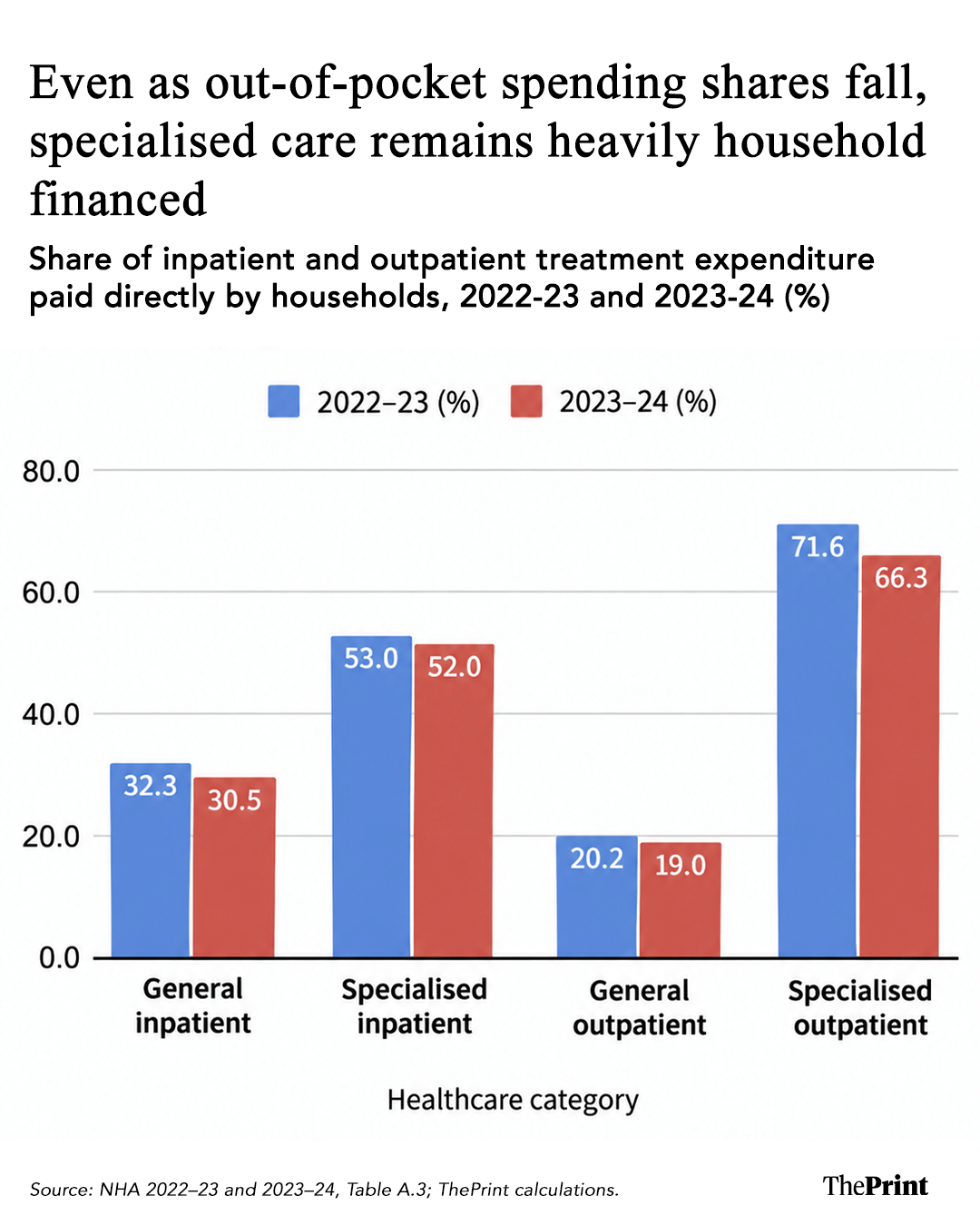
In 2023–24, households financed 52 percent of expenditure on specialised inpatient care, compared with 31 percent for general inpatient care. The gap was wider for outpatient services: households accounted for 66 percent of specialised outpatient expenditure, against 19 percent for general care.
Manya Aggarwal/ThePrint
Health economist Indranil Mukhopadhyay told ThePrint that one reason for the higher household spending share on specialised outpatient treatment was that outpatient services fall outside the coverage of Ayushman Bharat PM-JAY, the government’s flagship health insurance scheme, which primarily covers hospitalisation.
Although specialised consultations are available at lower costs in government hospitals, Mukhopadhyay pointed to shortages of specialist doctors and uneven availability of such services in the public sector. This can leave patients dependent on private healthcare, particularly those with chronic conditions requiring frequent consultations. Medicines also account for a significant share of outpatient expenditure, he added.
For specialised inpatient care, Mukhopadhyay said insurance coverage does not necessarily eliminate out-of-pocket spending. While PM-JAY covers specified hospital procedures and associated expenses, patients may still incur costs for services outside the scheme’s coverage or face difficulties accessing cashless benefits.
Also Read: Can blood sugar be controlled without drugs or insulin? A new wireless implant offers hope
Household spending shares fall, but actual expenditure rises
Between 2022-23 and 2023–24, the OOPE share declined across all four categories of inpatient and outpatient care, both general and specialised. The largest reduction, of 5.3 percentage points, was recorded in specialised outpatient care. However, the total amount financed directly by households increased in nominal terms.
Household spending on specialised inpatient care rose from Rs 48,319 crore to Rs 51,121 crore, while expenditure on specialised outpatient care increased from Rs 13,111 crore to Rs 13,883 crore.
The rise in aggregate expenditure does not necessarily mean individual patients paid more for treatment. These figures represent total household spending across the country, not the average amount spent per patient.
Mukhopadhyay cautioned against treating the NHA estimates as a complete picture of current household healthcare spending. He noted that the estimates continue to draw on the 2017-18 National Sample Survey on health, with adjustments for subsequent years. This may not adequately capture changes in disease patterns and healthcare delivery following the Covid-19 pandemic.
Households bear most costs of diagnostics, transport & home-based care
Households also continued to finance a substantial share of expenditure on several healthcare services beyond inpatient and outpatient treatment.
In 2023–24, households directly financed Rs 28,243 crore, or 96.4 percent, of the total amount of Rs 29,289 crore spent on laboratory and imaging services, which include diagnostic tests conducted separately from treatment packages. This was marginally lower than the 96.8 percent recorded in 2022–23, when households paid Rs 26,708 crore out of the total expenditure of Rs 27,578 crore.
For patient transportation, including ambulance and emergency medical transport, the household-financed share stood at 78.5 percent, compared with 78 percent in 2022-23.
Households bore nearly all expenditure on home-based curative care, or treatment provided at patients’ homes, with an OOPE share of 99.6 percent in 2023–24, broadly unchanged from the previous year. The share for dental outpatient care rose from 61.2 percent to 62.6 percent.
These figures cover expenditure classified under the respective healthcare functions. Diagnostic tests and other services included in hospital treatment packages are counted under inpatient care rather than as separate expenditure.
(Edited by Chingkheinganbi Mayengbam)
Also Read: After price cap on cancer drugs, are medical devices next? Why it may not cut pvt hospital bills