



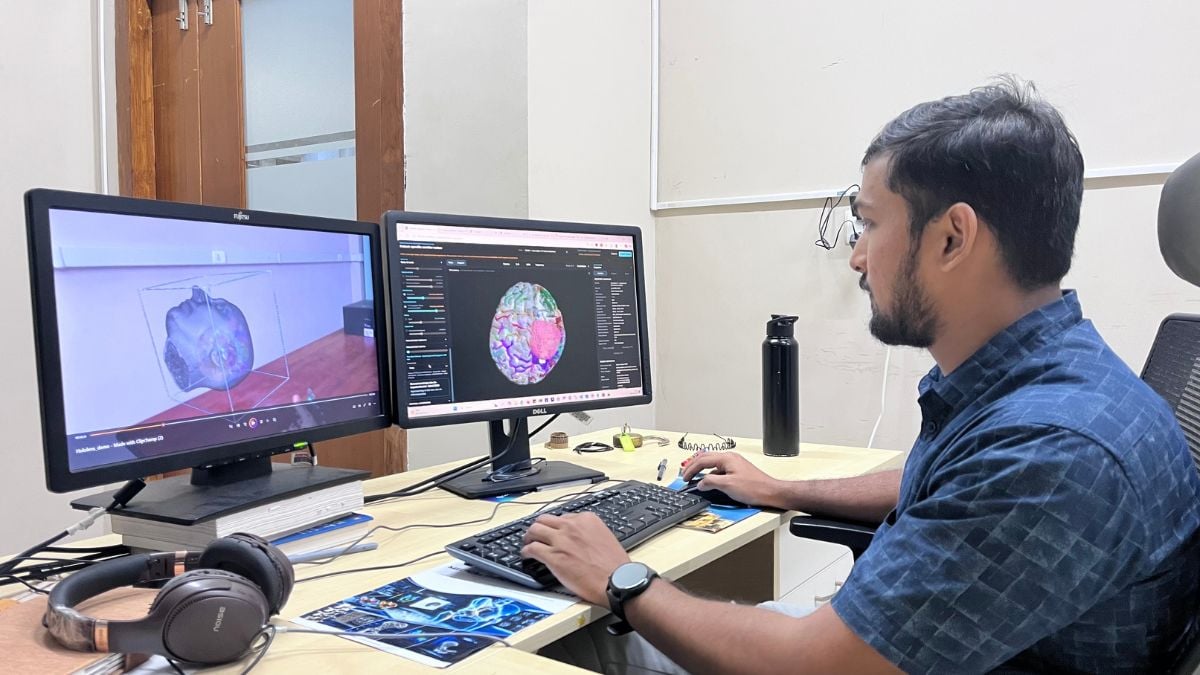
Chennai: On two adjoined screens in a laboratory at the Indian Institute of Technology (IIT) Madras, a cursor glides through a three-dimensional model of a human brain. Naveen Kumar, a Phd researcher, marks a tumour, then the blood vessels and delicate structures that crowd around it.
Built from MRI scans, the model lets a neurosurgeon rehearse the safest route to the tumour long before the first incision.
Kumar is not a doctor. He studied electrical and electronics engineering at National Institute of Technology (NIT) in Surat, spent about a year and a half working at Tata Motors, and then joined IIT Madras for an integrated master’s and PhD. His work spans the areas of artificial intelligence, machine learning, and medical image processing.
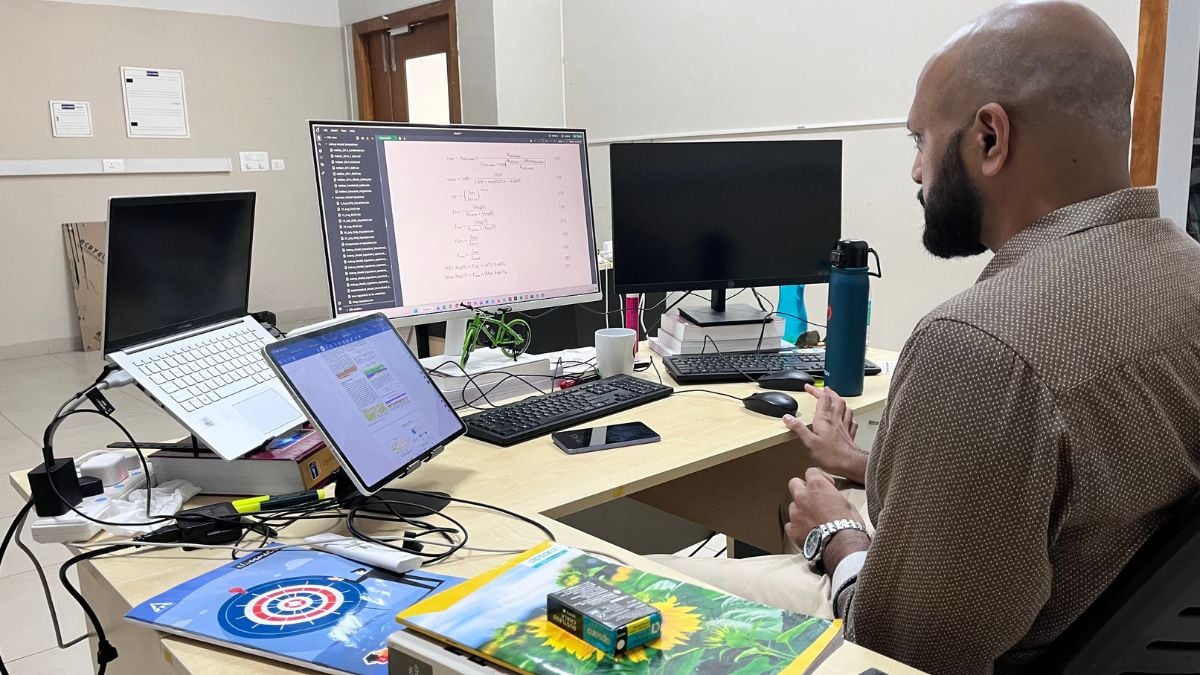
In another lab, a PhD student uses mathematical equations to model how the heart’s electrical signals travel. The model helps him study how disruptions in these signals can cause an irregular heartbeat, and how the heart might respond to different medicines.
Both projects come from IIT’s Department of Medical Sciences & Technology, set up in May 2023. They are also the groundwork for a far larger ambition: Establishment of a full-fledged School of Medical Sciences, with a hospital, at IIT Madras, one of India’s leading engineering institutions.
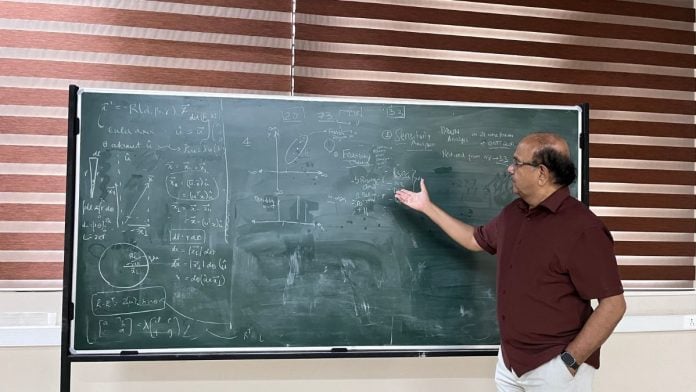
“IITs must [also] go into the medical domain. If medtech does not exist, we are gone…,” institute director Prof. V. Kamakoti told ThePrint last week in an interview.
India has been building medical capacity at remarkable speed. The Union government reported 1,39,864 MBBS seats across 846 medical colleges in August 2026, up from 51,348 before 2014, a rise of 172.4 percent.
Yet, beneath the number of seats lie older and stubborner problems. India has more medical colleges than any other country. It produces around 1 lakh to 1.3 lakh MBBS graduates every year, but many institutions lack innovation and practical relevance.
“Does India’s medical training prepare doctors to tackle problems that require new scientific approaches, technologies and tools?” asked Prof. R. Krishna Kumar of IIT Madras’s Department of Medical Sciences & Engineering. The problem, he said, begins much earlier, in how children are made to choose what they want to study.
“Students are asked, while in school, to choose between becoming a doctor or an engineer,” he said. “I feel this division has hurt progress.”
Prof. Kumar, who has worked with doctors for over 25 years, describes medicine as a three-rung ladder. At the bottom is cellular physiology, where mathematics can describe how cells behave. In the middle is functional physiology, the measurable quantities, such as blood flow, that tests actually record. And at the top is clinical physiology, where a doctor turns those readings into a decision about a patient.
“The core that connects cellular physiology with the clinic is absent in this country,” he said.
Prof. Kumar gave the analogy of a car. A BMW driver, he said, needs a licence and skill, but someone else designed the engine and the steering. The doctor, likewise, is the final link to the patient, not the designer of every tool. Medicines have pharmacologists, who study how the body works and design drugs around it. Medical devices have no such specialists, he said. Engineers build them, and doctors use them, but few people understand both sides well enough to design them around the body.
The consequences, he said, show up in the operating theatre. He said, “I would rather have engineers who understand physiology working inside hospitals, and doctors who know what to ask of them.”
The department’s ongoing work, he said, shows what such a bridge might look like.
‘Treating patient on a computer’
One of the many other ambitious ideas taking shape here is the Digital Twin, a computer replica of an individual patient built on physiology rather than raw data alone. It takes into account the functions, mechanisms, and physical and chemical processes that operate within the human body.
“Within five years, good hospitals will employ simulation experts so that doctors can treat the patient on a computer before treating the patient in the ward,” said Prof. Kumar, talking about the digital twin project.
Prof. Kamakoti said that India’s own vaccine experience during COVID-19 showed what domestic capability can do for healthcare.
“IITs and the Indian Institute of Science should introduce medical programmes that teach doctors engineering principles, rather than confining the two fields to specialised research projects,” he said.
Modelling heart to detecting cancer with AI
Professor Kamakoti’s argument becomes easier to grasp as one walks through the department’s labs, where researchers are keen to share their work. One of the many doctors the department is teaching fundamental mathematics is Dr Joson Mathew, a PhD student in the department who studied medicine in India and holds a post-graduate degree from University College London, is working on a patient-specific renal model.
The mathematical model he is building shows how the kidney functions during heart failure. Another student Vittal Rao is developing computer models of individual patients’ hearts to study how the organ’s structure affects its electrical signals and how these signals are recorded on an electrocardiogram (ECG). The models could help doctors understand the causes of abnormal heart rhythms and predict how a patient’s heart might respond to treatment.
Not all of this work happens on a screen. A few corridors away, the same thinking is applied to living tissue, where the question is whether a drug works before it ever reaches a patient. Researchers here are working with organoids, tiny three-dimensional structures grown from cells that reproduce selected features of human tissue.
At the campus, Dr Gautham Sankara Narayana, a cellular biologist, is growing miniature heart tissues called organoids from reprogrammed adult cells. The project is led by Dr Anubama Rajan, a Baylor Medical School-trained stem cell specialist. These three-dimensional structures mimic some features of a real organ.
“Such models could help screen potential treatments before the costlier stages of testing. Organoids grown from a patient’s own cells could, in principle, reveal how that person might respond to a drug,” Dr Narayana said.
Researchers, he explained, can induce a heart-failure-like condition in the tissue and test whether a drug improves its beating. The long-term goal, he said, is to reduce animal testing by studying how drugs affect human cells and tissues in the lab before testing them in people.
Worldwide, researchers are exploring organoids and other human-based models to make drug testing more reflective of how medicines work in the human body.
In September 2026, the US Food and Drug Administration (FDA) issued a rule saying that validated non-animal methods, including cell-based tests and computer models, can be used to assess drug safety where appropriate. The rule is due to take effect in February 2027, subject to the regulatory process.
If organoids let researchers study how living tissue behaves in the lab, artificial intelligence (AI) offers another way to investigate disease using medical images. Chinmay Raut, a 26-year old scientist at IIT Madras’s Health Informatics and Imaging Lab, is working with Prof. Pradeeba Sridar, Assistant Professor in the Department of Medical Sciences and Technology, on Indian Council of Medical Research (ICMR)-funded research in medical image analysis for breast cancer.
After completing a dual degree in engineering design, specialising in biomedical design, at IIT Madras in 2023, Raut briefly worked at electric scooter maker Ather Energy before moving into healthcare research.
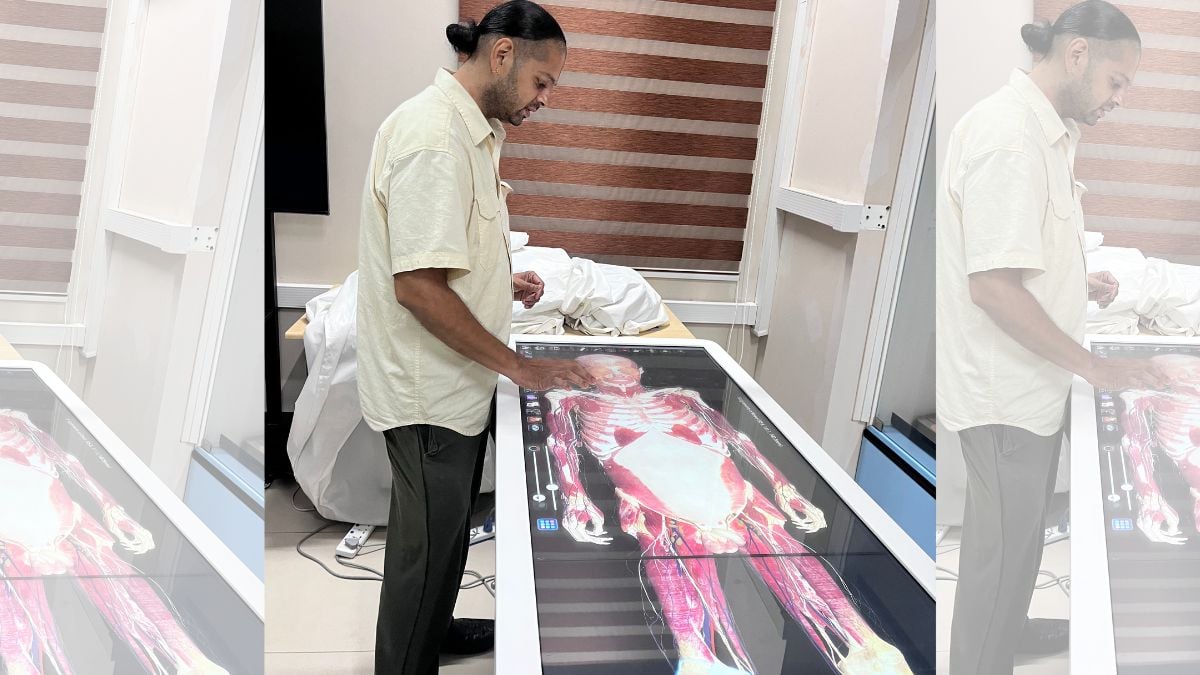
The shift demanded that he learn more than just computing. “An anatomy lesson is a must,” he said.
The department uses an artificial cadaver to teach engineering students human anatomy, helping them understand the body they are trying to model.
Raut’s project focuses on a question doctors face when treating breast cancer: has the cancer spread to other parts of the body? This spread, called metastasis, can affect treatment decisions. Doctors may use ultrasound to examine the lymph nodes, but a biopsy, in which a tissue sample is examined, is used to confirm whether cancer has spread.
Raut and Sridar are developing an AI model that analyses ultrasound images to predict whether a cancer is likely to metastasise. To train the model, the researchers use “ground truth”, biopsy images of both cancerous and non-cancerous patients, as reference. Each ultrasound image is linked to a biopsy result.
The model learns from these labelled images to identify patterns associated with cancer, then uses those patterns to make predictions about new images.
The team used about 55,000 ultrasound images available on open-source platforms to develop a foundation model, which learns general features of breast ultrasound images. It then evaluated its approach using about 400 images from around 200 patients at the All India Institute of Medical Sciences (AIIMS), New Delhi, with biopsy results available to confirm whether the cancer had spread.
The model achieved an accuracy of about 74 percent. “Anything above 80 percent is considered good,” Prof. Sridhar said.
However, there are limitations. Patients who undergo biopsy may not represent all people with breast cancer, and the dataset contains a relatively high proportion of cases in which cancer has spread. This makes it harder to determine how reliably the model would perform across different patient groups and stages of disease. Researchers are exploring ways to show radiologists not just a prediction, but also how confident the model is in that prediction. Ultimately, the tool would assist doctors in their clinical judgment.
The project also highlights a wider challenge in medical AI. Many publicly available datasets come from Western populations, and models trained on them may not perform equally well for Indian patients.
“Using data from AIIMS allows the researchers to test their approach on Indian patients, although larger and more diverse studies will be needed before its clinical usefulness can be established,” Raut said.
Also Read: IIT Madras researchers have found why the ocean’s rare bacteria can’t be ignored
Doctors learn maths, engineers learn medicine
Raut’s shift from electric scooters to sonograms points to the bet at the heart of the department. As Prof. Kumar explained: “Doctors and engineers can learn enough of each other’s fields to work on the same problem.”
Explaining the curriculum, he said, engineers in this department take courses on physiology and anatomy, while doctors take courses like mathematics for physiologists and machine learning for physiological systems. Dr Mathew is one of them. His new tools, including linear algebra and probability, are not typically part of a medical degree.
Prof. Kumar said the courses are deliberately framed, based on the individual projects.
“We can’t afford to have them sit through the full engineering curriculum,” he said. Doctors are taught how to turn a piece of physiology into a mathematical question, and how to read the answer afterwards. The heavy calculation in between, he said, can be left to software.
The department has two doctors with MDs working on research full-time, he said. One is building digital twins of diabetic patients.
To keep the exchange going, students and researchers explain their fields to one another through informal tutorials. Formal courses come with quizzes and end-semester exams, and some require students to work with real datasets and implement methods from research papers.
The plan has its share of sceptics too.
Critics say that IIT Madras should deepen its existing strengths instead of entering a field with different demands. Institutions such as Massachusetts Institute of Technology (MIT) and California Institute of Technology (Caltech), partner with medical schools rather than run conventional ones. Critics also warned that clinical training, patient safety, regulation and hospital administration could draw leadership time and resources away from the institute’s core research.
Prof. Kumar disputed this logic. “In modern research, breadth is no longer the opposite of depth; for hard problems, breadth is what makes depth possible,” he argued, adding that technology now runs through medicine, from imaging to AI, and institutions have to adapt.
He said that the school is the next step on a predetermined path, not a sudden leap. Partnerships and MoUs are useful, he said, but do not always produce deep integration.
According to him, closer ties could let clinicians become investigators, framing research questions and working with engineers throughout, rather than meeting them only when a specific project needs them.
Why a medical school
If doctors and engineers can already learn each other’s language, why does IIT Madras need a hospital of its own? Prof. Kumar explained that the department already collaborates with seven hospitals. But collaboration is different from a dedicated setup.
A doctor at a private hospital may work with the department out of passion, yet his full-time job is treating patients elsewhere. “If a cardiologist doesn’t come to today’s meeting, I can’t ask him,” he said. “I can only request.” The school, he argued, would bring doctors with dedicated time for research.
“Elsewhere there is a hospital and a medical college first, and then research,” he said. “We feel we have to start medical research before the medical college.” The department’s publications, he added, are what draw partners such as the Mayo Clinic in the US.
This is not meant to be one more medical college with 150 MBBS seats, he said. The point, he added, is how a medical student thinks after being immersed in an engineering environment. Doctors, he said, take fantastic risks but are driven by protocol. “We are not worried about the 90 percent of cases treated routinely. It is the difficult 10 percent, where no standard protocol applies, that needs a different kind of training,” he said,
Prof. Kamakoti said the proposed hospital would offer primary and secondary care, while researchers would also take up problems from tertiary care. Exposure to every level of the system, he argued, would help doctors see the range of problems medical technology must solve.
He said he is in touch with the National Medical Commission (NMC), India’s medical regulator, to fulfil the necessary approval requirements.
“We need to start; there is no second thought about it,” he said.
This reporter visited IIT Madras on an invitation from the institution.
(Edited by Amrtansh Arora)
Also Read: Kamakoti is not the typical IIT grad. No passport, failed JEE, he is now set to reform the NTA