





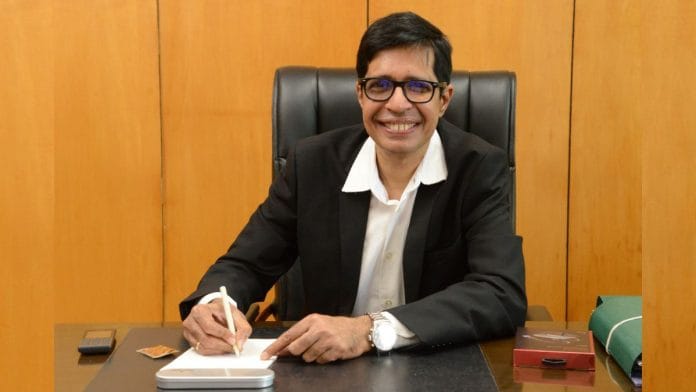

New Delhi: V Kamakoti, the director of IIT Madras, is on the hot seat. Again. He is not new to courting controversies. But since he was appointed as one of the six members of the task force created to reform the National Testing Agency and India’s public examination systems, opposition politicians just won’t let his past comments on gaumutra go.
The newly formed task force that arose after the CJP protests over NEET exam leaks will be led by Infosys co-founder Nandan Nilekani, and other members include former chairman of ISRO, S Somanath, and former director of the Intelligence Bureau, Tapan Deka. But the most debated team member in India today is Kamakoti. From Priyanka Gandhi Vadra to Congress leader Karti Chidambaram, not to mention the social media lampooning, many have bitterly questioned his scientific temperament and his capability to reform the entrance exam system.
“As a country, we have been running examinations for a century, and occasionally we have seen paper leaks. Right now, the biggest challenge is that the number of students attempting these examinations has scaled up. When I gave the JEE in 1985, there were hardly 5,000 candidates, today there are 1.5 million. That is great news, but it is also a challenge,” Kamakoti told ThePrint.
Over the years, India has deployed technology in conducting examinations at scale. There are optical scanners, image processing techniques, and even computer based tests.
Kamakoti explained that in the case of NEET, computer based tests are challenging because India has the capacity to conduct a one-session CBT for a maximum of 300,000 candidates but NEET has nearly 2.2 million aspirants.
However, Kamakoti said this year’s NEET leak did not stem from the technology itself. According to him, when the Radhakrishnan committee gave over 250 plus recommendations to address the 2024 NEET leak, the NTA took them seriously. This time, the issue arose long before the printing and the distribution. For Kamakoti this signals the biggest challenge India faces to resolve such issues — trusting people.
“The biggest challenge rests purely upon how to get people to be trustworthy. In every room cameras have been put up. AI can be used to spot suspicious actions too. But we need to see if technology can help us trust examination paper setters. Because we cannot say ‘AI can set question papers’,” said Kamakoti.
Paper setting is a complex task and will invariably need several humans in the loop. For an inclusive exam like NEET where the paper is translated into several languages, people are an important component. If even one of them is compromised, then the entire system “shatters” and that is what India has seen, he said, referring to the 2026 leaks and the subsequent student protests that erupted across the country.
“Freedom of speech is extremely important, and if the question paper is leaked, and the examination is cancelled, then that is a horrible thing for students, I absolutely agree. We must concentrate on solving the problems,” he said, as he prepares to meet the newly established task force.
However, Kamakoti has also found himself in the midst of a controversy when Priyanka Gandhi Varda criticized him on 28 July in the parliament. Vadra referred to Kamakoti as a “gaumutra (cow urine) expert,” for his comments during a 2025 speech on Maatu Pongal. In his speech, Kamakoti had recounted the story of sanyasi (monk) who recovered from fever after drinking cow urine.
The comment drew criticism from several scientists and politicians at that time who accused him of spreading “pseudoscience”. However, whatever Kamakoti’s personal beliefs may be, they have not interfered with his work. Neither has he ever conducted any research on cow urine at IIT Madras.
But, this is the third time the “gaumutra” debate is dragging Kamakoti’s name into the national conversation. The first was in January 2025 when he made the remark, and the second was earlier in 2026 when Kamakoti was awarded the Padma Shri in the Science and Engineering Category.
Also read: What senior RSS, BJP leaders may be trying to convey to BJP through their remarks on youth protests
An academic full of contradictions
From the gaumutra remark on one end to leading the chip design initiative, his public image is one of stark contradictions. Kamakoti isn’t easy to squeeze into a single box.
At IIT Madras, Kamakoti built the institution’s chip design programme from scratch, leading up to eventually launching the indigenous Shakti processor in 2014, India’s first home-grown computer chips. These processors are now used in defence, government applications, computers servers, and even research.
Under the leadership of Kamakoti, IIT Madras has reached significant milestones since 2022. In 2023, it became the first ever IIT to establish an offshore campus in Zanzibar. Additionally, it has maintained its position as the top-ranked educational institution in India in the National Institutional Ranking Framework (NIRF) rankings.
Kamakoti told ThePrint that the success of IIT Madras is not driven by the vision of a single director but by the five-year strategic plans collectively developed by faculty of all ages. Every department undergoes peer reviews, and the institution sets its bench marks for the number of projects, patents, scholarships, and other such metrics.
“One of our biggest achievements has been generating hundreds of patents every year. In 2024 we had 382 patents, last year we had 470, this year we have 482 already,” said Kamakoti, adding that the institution’s focus on incubation and start ups is essential for building a future where entrepreneurship takes centre stage.
Kamakoti admits that for a young start up to take off, funding of 5 to 20 crore is crucial, and to facilitate that IIT Madras is soon going to announce a thousand crore fund.
But Kamakoti’s journey up the academic ladder has hardly been that of a stereotypical IIT topper. The man who went on to be the chairman of the Joint Entrance Examination (JEE) admits that he too failed it once.
“As a young JEE aspirant in 1985, I scored a single-digit mark out of 100 in Chemistry. That particular day of the examination was unfavourable to me. And yet, decades later, I became the JEE Chairman, thereby proving that achievement is not linked to scores, marks and grades,” Kamakoti wrote in a 2023 article for the Indian Express.
An introverted boy
A young Kamakoti was once an opening batsman for his school’s cricket team in 7th grade, he told Sudeshna Das, consulting editor of the EFY, in a 2024 interview. When a bouncer hit in spectacles and sent his father worrying about potential head injuries, Kamakoti’s cricket bat was thrown into a well, drowning with it what may have been an illustrious career as a sports person.
Instead, as a young boy growing up in the villages of Mudikondan and Vishnupuram in Tamil Nadu, he developed a deep respect for farming and agriculture, and even learnt to play the violin from a teacher across the street. He carried his love for music even into his college days, using it when he found himself surrounded by complex mathematical equations.
“I remember struggling with certain intricate organic chemistry formulas. At that time, I transformed them into equations resembling music with mathematics and memorised them with the help of musical rhythms. Looking back, this creative memorisation method was quite effective,” he told Das.
When Kamakoti was in 10th grade, his grandfather, an astrologer, predicted that he would excel in academia. That self-fulfilling prophecy pushed Kamakoti to push ahead with his studies.
Yet, he claims he was not an academically exceptional child through school. After class 12, he failed to clear the IIT-JEE and joined the Sri Venkateshwara College of Engineering instead. Eventually he did return to IIT Madras, where completed a masters and PhD in Computer Science and Engineering. By 2001 he would find himself a faculty at the institute, and 21 years later, he would take over as director.
At a time when the ‘brain drain’ was sucking away talented Indian students to foreign universities, Kamakoti took a vow never to leave India. His trajectory stands in stark contrast to those of typical IIT students. An IIT tag is often regarded as a one-way ticket to the United States.
“During my college days, I had the privilege of being in the presence of my Guruji, the Acharya of Kanchi Kamakoti Peetam Sri Chandrashekarendra Saraswati. He advised me to stay in India and contribute to the country through my work. I took a solemn vow that I would not travel abroad, obtain a passport, nor leave India. I resolved to stay in India and dedicate myself to serving the nation,” he told Das.
Even now, Kamakoti does not have a passport. He never did.
Also read: Students, courts & bulldozer fears. The fight for UP’s Mohammad Ali Jauhar University
Kamakoti, the academic
After his PhD, Kamakoti delved into research in computer science churning out several publications. It was around then that ATI Technologies, a Silicon Valley company setting up an office in Chennai recruited him.
Kamakoti was making Rs 200,000 a month, and working on forming a group of pre and post silicon processor verification and testing units. But soon, he received offers from the Indian Institute of Science and IIT Madras to join them as an assistant professor.
“On one side was my current job, paying around Rs 200,000 per month, and on the other, an assistant professor position offering Rs 21,000 a month. During this period, my Guruji was not present, but his teachings had instilled in me a sense of clarity and purpose,” he said.
In his decades-long career at IIT-Madras, Kamakoti has won a long list of awards. He is the recipient of DRDO Academic Excellence Award, Indian Electronics and Semiconductor Association Techno Visionary Award, ‘Abdul Kalam Technology Innovation National Fellowship’, ACCS Life-time Achievement Award, IBM Faculty Award and VASVIK Industrial Research award.
He is a member of the National Security Advisory Board and he was also the Chairman of the Artificial Intelligence Task Force constituted by the Ministry of Commerce and Industry.
A researcher turned administrator
Being an academic administrator has plucked Kamakoti out of computer science lecture halls and put him in a position where learning about things beyond his discipline is a daily task. The 58-year-old misses research when the semester is particularly busy, but he has no complaints.
“As a director, I need to learn about all 18 departments and so I get to learn about many other things too. Yesterday, I attended a conference about sustainability so I had to learn about recycling, climatic conditions, and what an El Nino does. We have over 100 events like these, and every time I have to present a handbook or a souvenir, so it makes the job very interesting,” he said.
With the formation of the new task force announced by PM Modi on Sunday, Kamakoti’s background in computer architecture and information security will now be applied to making the examination system in India more robust.
Way to go insulting someone who decides to stay in india and work. If someone leaves india then they are brain drain. So anyone who does not qualify JEE is not qualified to be part of NTA?
YOU BEING A BLOODY WOKE PAPER, PRINT, HAVE NO STANDING OR ELIGIBILITY TO PUBLISH BIASED ARTICLES ON BHARAT’S AFFAIRS….,.THIS PAPER TO BE BOYCOTTED BY SANATANIS