


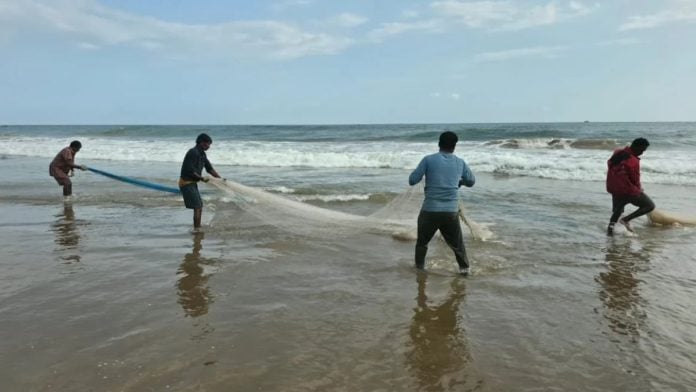
Konark/Bhubaneswar/Cuttuck/Puri: Forty-three-year-old Prem Raja untangled his nets, stacked his fishing boxes, and rushed to the harbour on his second-hand scooter on a sultry November morning in his small fishing hamlet in Odisha’s Puri district. After a two-week suspension due to severe cyclones and rough sea conditions, fishermen from Chandrabhaga’s Nolia Sahi were finally allowed to venture out again.
But Raja knew the reprieve was short-lived. With a third cyclone threatening to hit the Odisha coast, he had little time to make the most of the next fishing window.
This year, he has spent too many days ashore but not by choice.
“Growing up I have not seen so many cyclones in such close succession. The ocean was our peace. Now it is angry,” Raja said. He has no time for eye contact; he needs to catch the early tide and bring in a good catch of black and white pomfret, hilsa, rohu, and catla before the harbour is closed again.
The sea that has always been a source of livelihood for Odisha’s fishing communities is increasingly becoming a source of uncertainty.
In less than a month, two severe cyclones have battered India’s east coast, disrupting fishing activity, damaging boats and equipment, and depriving thousands of families of their daily earnings. The severe cyclonic storm Arnab made landfall on 28 October, affecting Odisha and Andhra Pradesh, with sustained wind speeds of 125-135 kmph and gusts reaching 150 kmph.
Just days later, on 3 November, Cyclone Murasu struck the two states, compounding the damage. Villages drowned, roads flooded, trees were uprooted, fishing gear was damaged, and there was a prolonged loss of income.
As communities struggled to recover from the back-to-back storms, another weather system is threatening the coast. On November 20, Akvan made a landfall near Odisha’s Gopalpur as a weakened cyclonic storm, with winds gusting up to 90 kmph.
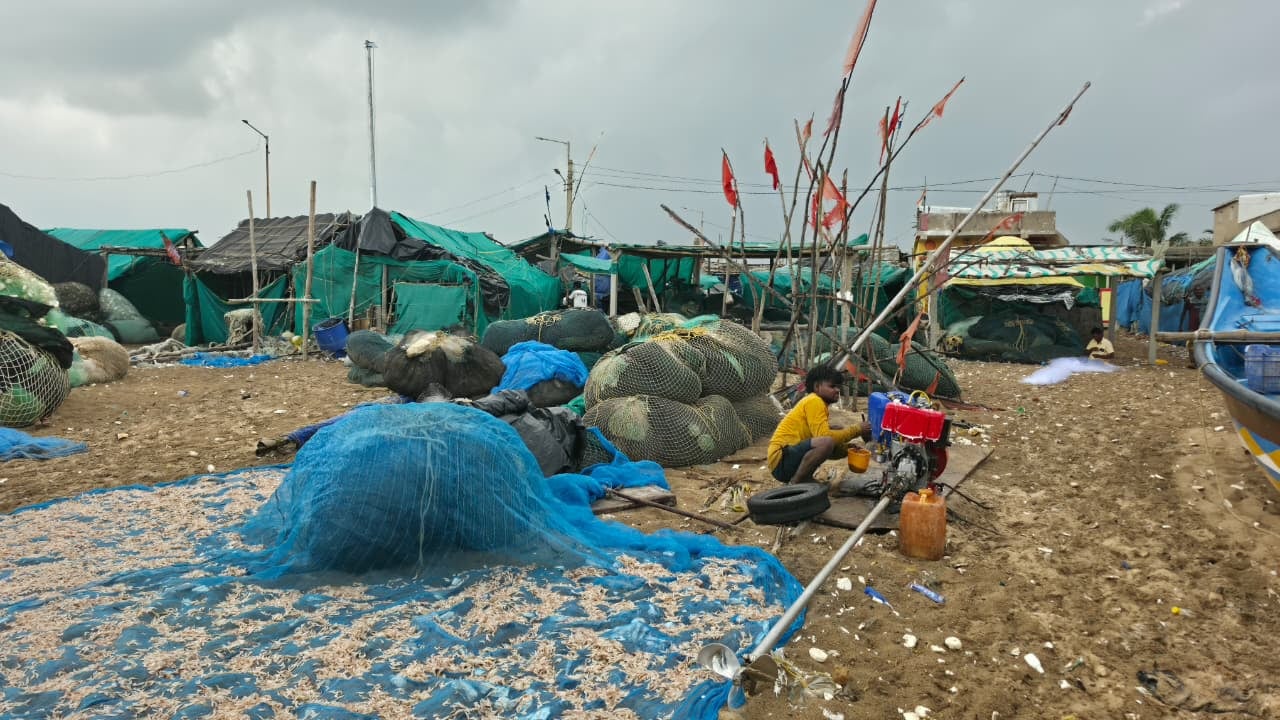
Fishermen now face a new predicament: the increasing impossibility of sustaining a livelihood when the sea is accessible for fewer days, catches are declining and the costs of going out are rising. India’s disaster-response systems have become more adept at predicting and preparing for cyclones. But for those who depend on the ocean, survival increasingly means navigating the economic fallout long after the storms have passed.
A 2023 assessment by the Ravenshaw University in Odisha’s Cuttuck indicates that over the past five years, fisherfolk in the state have lost an additional 35-40 days at sea each year because of climate-related disasters.
This is over and above the state’s mandatory annual two-month fishing ban — from April 15 to June 14 — imposed to allow fish stocks to regenerate during the breeding season.
For the government, the challenge now is to find ways to help coastal fishing communities adapt to increasingly volatile conditions at sea, while also ensuring that the younger generation does not abandon the profession altogether.
Experts warned of similar challenges owing to warming oceans all around the Indian coasts.
“In recent years, we have seen that all oceans are warming up. The intensity of cyclones does not depend on sea surface temperatures but on the volume of water in the ocean. The more the thermal energy, the more intense the cyclones,” said Madhavan Nair Rajeevan, a senior climate scientist and former secretary of the Indian government’s Ministry of Earth Sciences (MoES).
High operational cost, low incentives
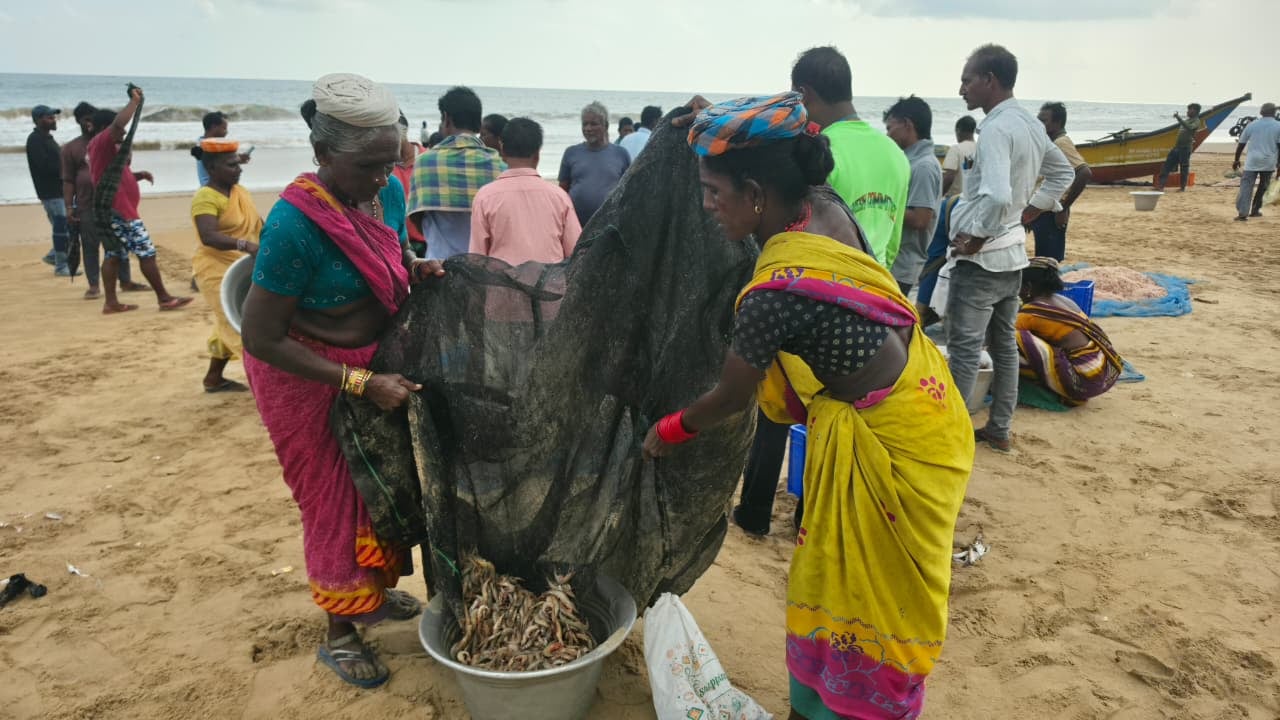
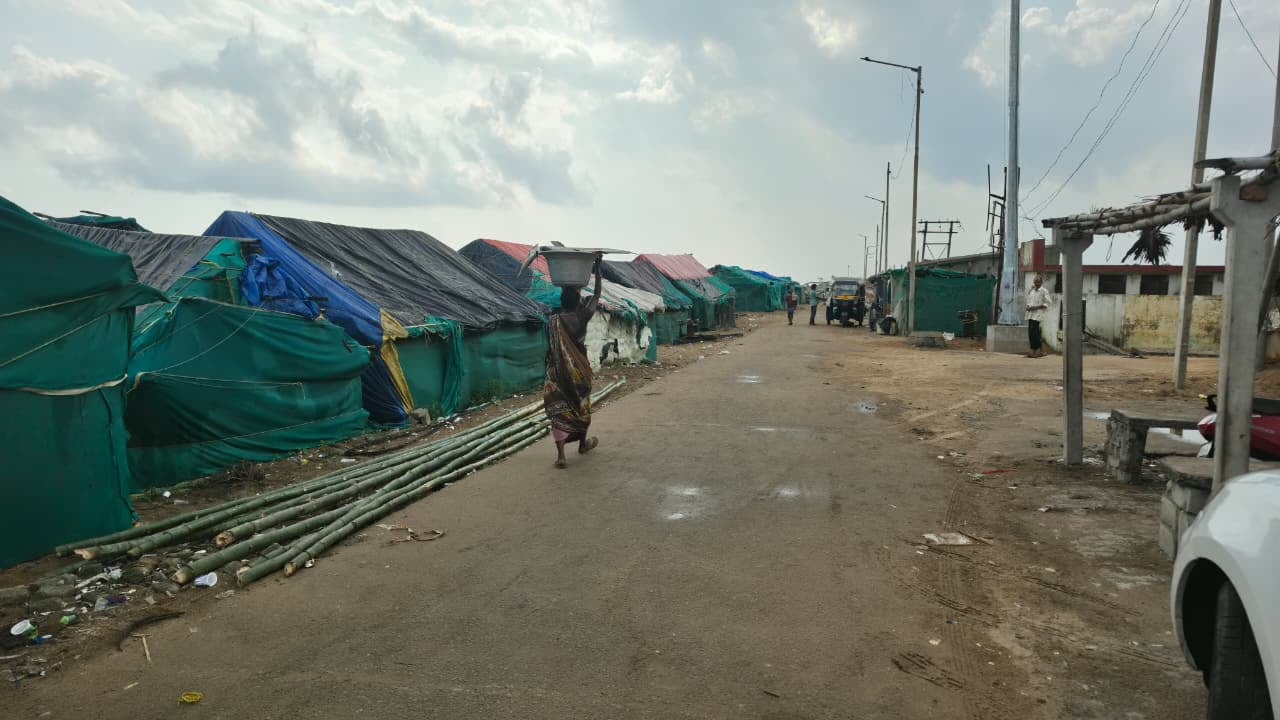
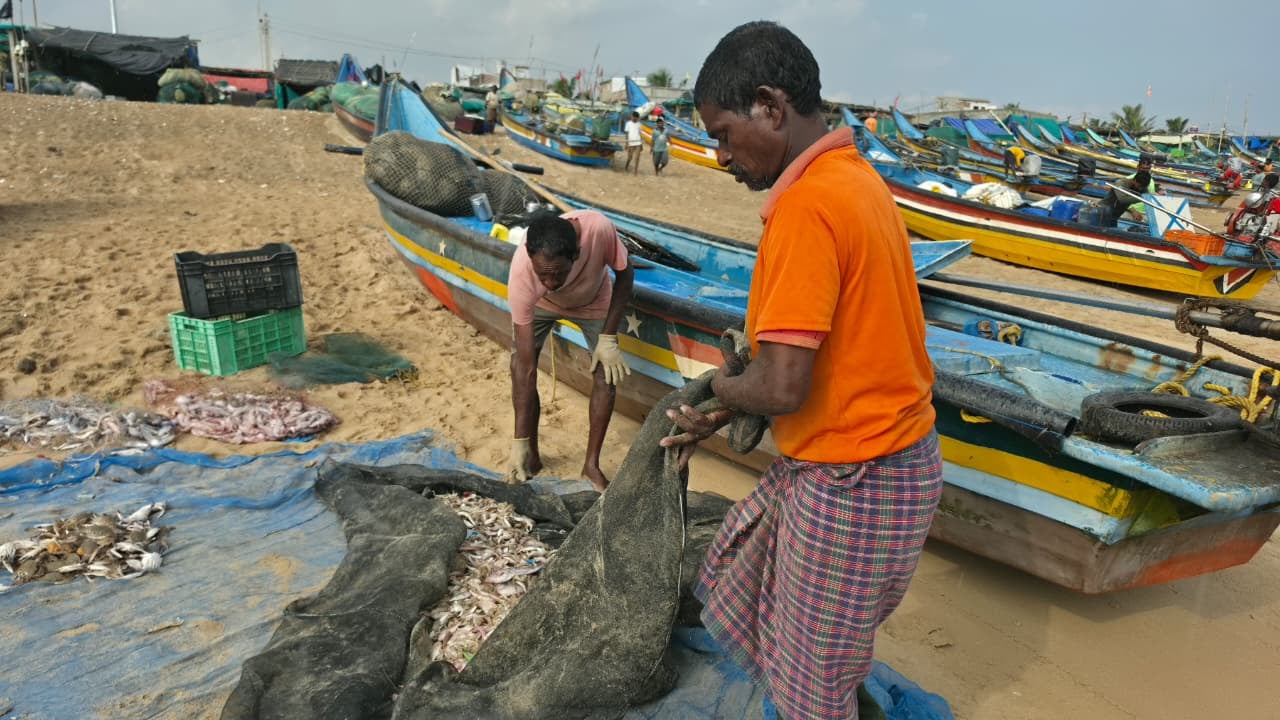
An afternoon at Penthakata fishing village is a sensory portrait of Puri’s fishing economy. The men in the village have just got back from their daily fishing expedition. The air is thick with the scent of freshly caught shrimp, catfish, and sardines, the ground is slimy and in the background, Telugu music is blasting in full volume.
Penthakata is geographically part of Odisha, but the village is dominated by residents from the neighbouring Andhra Pradesh, who have over the years moved to the state in search of gainful employment.
The boats returning to the docks is only the beginning of what’s to come. The catch has to be quickly unloaded from the jetties, segregated and distributed to individual dealers. The bigger, high-demand fish varieties are immediately packed in ice boxes for the bigger markets in the city, the smaller fish go to the local vendors. The remaining are the varieties that do not pass the quality check. But nothing goes to waste.
The younger generation do not want to take so much risk for such little return. Fishing is an identity of Odisha, it has traditional roots and we want to ensure that it continues and is passed on from generation to generation
– Draupadi Manjhi, Puri district fisheries officer
These low-quality fish and shrimp are dried in the sun and sold as aged fish or marinated in oil and spices to make pickles.
The economy does not end here. People are involved in making nets, maintaining boats, managing harbours, renting out boats and providing loans to small and medium fisherfolk.
According to fishers, they lose between Rs 15,000 and Rs 20,000 during a 15-day shutdown. On a traditional boat, a four- to five-day fishing trip usually costs them Rs 8000. This includes the cost of fuel, ice and on-board food for crew. On a mechanised boat, the daily operational cost increases to about Rs 30,000 to Rs 35,000. So, depending on the boat size, fishermen earn anywhere from Rs 50,000 to Rs 1.50 lakh per trip. During Cyclone Arnab’s closure, fishing crews estimate losses of about Rs 5-7 lakh.
Despite a bustling view, Mahesh Gundaraju, a community leader who has been extensively working to improve the livelihood of the fishing families in Puri, said that fishing as a profession is no longer lucrative. The catch is low, the operational costs are higher and there is greater risk of life and property.
“In the last decade, many families have moved out of the village to cities. Their incomes are not enough to sustain their families. The investments required are high, but what they catch is barely enough to make ends meet,” Gundaraju said.
Gundaraju explained that not everything a fisherman catches are his earnings. They have to account for taxes, fuel prices, boat maintenance and crew salaries in their final income.
The economics of each fishing trip are changing, too.
Sumanta Banerjee, the researcher of the 2023 paper ‘Climate Change and Marine Fisheries: Stakeholders’ Perspective from Coastal District of Odisha, India’ published in the Asian Journal of Agricultural Extension, Economics and Sociology, highlighted the impacts of climate change on the state’s fisherfolk.
“During our interaction with the communities, we found that fishermen have to go deeper into the ocean to catch the same quantities of fish. And this change has come in just the last 25 years,” Banerjee explained.
The study found how the fishing trips made by fisherfolk of Odisha had become longer, and the number of fish caught had decreased. The varieties of fish caught by the communities had also become thinner.
Citing an earlier study, which has also been quoted in his 2023 paper, Banerjee said that it was found that in the east coast of India, out of the 68 fish varieties that have been studied, around 69 per cent were identified as vulnerable to the impacts of climate change.
“Fishes living near the surface or inhabiting surface waters, such as tuna, mackerel, and sardines, are the most affected by changes in temperature,” Banerjee said.
Among the species that were the worst hit were the bombay duck, tuna, shark, various types of shrimp, pomfret and catfish. These are also the varieties that were earning the fisherfolk the most income.
For instance, a kilo of silver pomfret fetches a fisherman anywhere between Rs 500 and Rs 700 in harbour. When it is sold at retail markets, the same goes for up to Rs 1500 a kg. Similarly, depending on the size and quality of shrimp, the retail price can go up to Rs 1000 a kg.
The importance of early warning systems
Twenty eight-year-old Jasowini Mohanty is a fisheries department field officer posted in Puri district. During the recent cyclones Arnab and Murasu, her team was responsible for alerting the fishing villages of the impending storm and temporarily moving families to safer locations.
At least 200 people in the district had to be evacuated. The drive was conducted using early warning messages, physical announcements using loud speakers, and door-to-door accounting of registered fishermen to make sure they are not in sea.
“We have a cyclone protocol in place. Since we have had so many cyclones in the last few years, every cog in the wheel knows exactly what their duty is when an alert is issued. It is a well oiled machine,” Mohanty said.
India has a four-stage cyclone warning and management system. The system comes into force much before the cyclone actually hits the coast. The protocol is set to ensure that governments, disaster management authorities, fishermen and other coastal residents have enough time ahead of a cyclone to save their lives and move their property.
The met department keeps a constant watch on India’s waters. As soon as a depression develops, which is likely to affect its coast, a pre-cyclone warning is issued to senior government officials, including the Cabinet Secretary and chief secretaries of vulnerable coastal states. This warning needs to be issued at least 72 hours before the cyclone’s landfall is forecasted.
The next few hours are crucial. India’s early warning system, which is an effective mix of satellite tracking and weather modelling systems, provides precise information about the cyclone’s location, intensity, direction of movement and likely affected coastal districts.
Once a clear picture of these aspects is recorded, advisories are issued to fishing communities, residents, media houses and local disaster managers at the ground level.
At least 24 hours before the cyclone landfall, a more specific warning is issued by the Met department. By this mark, scientists are able to provide more details of the likely landfall point, time, wind speeds, intensity of the winds and accompanying rainfall. These alerts provide more information about possible damage and recommend precautionary action.
India is using its space ecosystem, Earth-observation capabilities and space-based applications for shoreline monitoring, inundation assessment, cyclone and extreme-weather early warning, and climate-risk assessment
– Union Environment Minister Bhupender Yadav
IMD Director General Mrutyunjay Mohapatra said that over the last few years, India has gained an expertise in cyclone forecasting. Their timely alerts have ensured that states are prepared for what is to come and the potential destruction caused by these storms to local communities are minimal.
“We are a member of Regional Specialised Meteorological Centres recognised by the World Meteorological Organization (WMO). We have improved our early warning systems immensely over the last few years, to a point where we are now offering our forecasts to other countries as well,” Mohapatra said.
India currently provides tropical cyclone forecasts, storm-surge advisories and severe-weather information to 13 countries in the North Indian Ocean region, including to Bangladesh, Pakistan, Sri Lanka, Myanmar, Iran, Qatar and Saudi Arabia.
The outreach has not stopped there. In 2024, India announced that it was also assisting five countries — Nepal, Maldives, Sri Lanka, Bangladesh and Mauritius — build their own early warning capabilities.
Union Minister of Environment, Forests and Climate Change Bhupender Yadav told ThePrint that ahead of the 31st edition of the Conference of Parties (COP) in Antalya, Turkey, India has also offered to share its knowledge and technical expertise with its Pacific partners.
“India is using its space ecosystem, Earth-observation capabilities and space-based applications for shoreline monitoring, inundation assessment, cyclone and extreme-weather early warning, and climate-risk assessment,” Yadav said.
“India believes in the idea of ‘Vasudhaiva Kutumbakam’ (the world is one family. So, by that principle, we have offered to share the knowledge we have built and mastered,” he added.
Action on the ground
While the top brass talks about cyclones as a game of forecasts and an impact of climate change, it is people like 21-year-old Subbodh Kumar, a local volunteer with the Odisha government’s fisheries department, who handle the heat on the ground.
Kumar enrolled into the state government’s Sagar Mitra scheme in 2025. Under this programme, his role is to become a link between the government and the fishing communities.
In simple terms, Sagar Mitras are local field-level workers who act as intermediaries. But they don’t just come into action when a cyclone hits. Their job profile involves building a community relationship, a channel of trust, so that when a disaster hits, these communities follow government instructions through these volunteers. They help fishers access information, government schemes and services, and also build detailed data on the community whereabouts and track their fishing activity.
Kumar is so deeply integrated into the community that he — an Odia — is well versed in Telugu, a language more comfortably spoken in the Andhraite fishing colonies in Odisha.
“Knowing their language automatically builds trust and that is what you need to do when you need to convince families to leave their houses and assets behind and evacuate when a disaster hits,” he said, before strutting around the villages in his jurisdiction, greeting everyone he met.
Field workers like Kumar are the government’s foot soldiers, who become the final connection in ensuring the success of India’s early warning system.
“So, if I am assigned a village, I will be responsible for knowing how many fishermen regularly go to sea, and how many are part-time fishers. I know exactly which fisherman goes to sea and when he has returned. This helps the government intervene in case there is a mishap. Coast guards are alerted and the naval police come into action if a boat is missing for over 48 hours,” Kumar said.
The government is also using the latest gadgets and technology to fight the impacts of climate change on their waters. To regularly track the movement of fishermen in the state, the government has started fitting high-frequency communication devices and transponders in mechanised boats. These machines are meant to track the movement of fishing boats and they immediately send signals to life guards on shore if the boat is caught in a high tide situation or is lost at sea.
There are also schemes that provide compensation to cover the loss of boats and fishing gear damaged during such disasters. The government also provides fisherfolk livelihood and nutritional support during fishing bans.
These initiatives serve a dual purpose. They are meant to keep fisherfolk safe during rough sea days but it is also done to ensure that the younger generation does not move away from the profession.
“The younger generation do not want to take so much risk for such little return. Fishing is an identity of Odisha, it has traditional roots and we want to ensure that it continues and is passed on from generation to generation. These schemes are meant to make the profession more lucrative even under the shadow of climate change,” said Draupadi Manjhi, Puri district fisheries officer.
Also read: How Shahjahanpur brought down stubble-burning fires
Traditional fishing knowledge and weather advisories
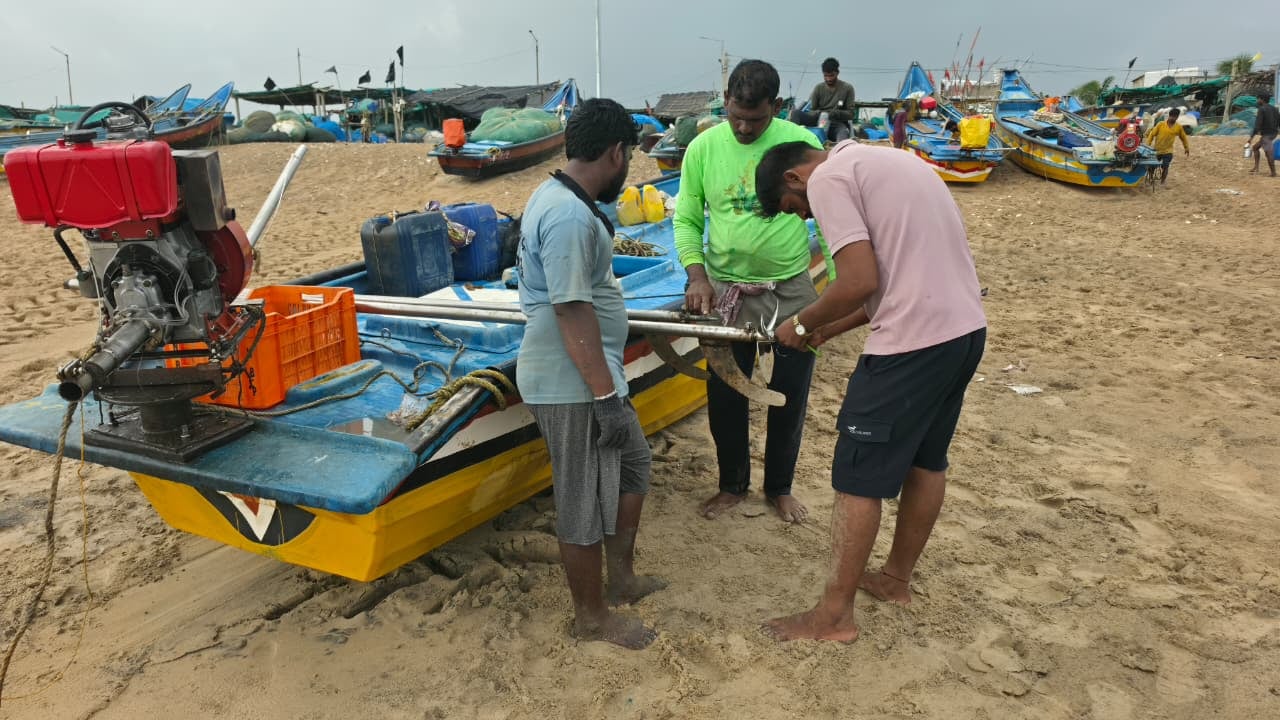
On paper, these government interventions appear foolproof. On the ground, however, implementation has been far more difficult. Fishermen often resist evacuation orders and are reluctant to install tracking devices on their boats, despite the government offering financial assistance. Even those who agree to install transponders do not always switch them on when they venture out to sea.
Much of this resistance stems from a conflict between official weather advisories and the traditional knowledge that has guided fishing communities for generations. Many fishermen believe they can read the sea and anticipate rough weather themselves. Government warnings, they feel, often keep them ashore unnecessarily, costing them valuable days of work and income.
“There is resistance. Many do not follow instructions because they think they are being kept off the sea unnecessarily. They say they can look at the sea and predict a storm. But we have to trust the science. If there is a weather advisory, we have to stop them from venturing out; we cannot rely on their assessment,” Manjhi said.
For generations, older fishermen have relied on subtle changes in their surroundings to anticipate storms. The colour of seawater, the density and movement of clouds, changes in wind direction and even the behaviour of fish are among the signs they watch for. Dark clouds gathering in the north-east, for instance, are traditionally considered a warning of an approaching cyclone. An unusual increase in jellyfish caught in fishing nets is also believed to signal an impending storm.
A 2024 study published in the Indian Journal of Traditional Knowledge, ‘Negotiating Cyclonic Storms on Odisha Coast: Integrating Meteorological with Traditional Knowledge’, showed how communities in Jagatsinghpur, Kendrapara, Ganjam and Puri use such observations to prepare for cyclones.
The study documented an extensive, informal system of traditional knowledge built around multiple environmental indicators. It also showed that many of these methods were not too removed from modern-day science of weather forecasting.
The challenge of protecting these communities, however, extends beyond reconciling traditional knowledge with scientific forecasts. India’s latest Nationally Determined Contribution (NDC) for 2031-2035 recognises coastal regions as vulnerable to climate change and commits to greater investment in adaptation.
But it does not set out specific targets for protecting marine ecosystems or supporting small-scale fishing communities facing increasingly difficult conditions at sea. Fisheries appears only as a generic sector in an annex listing areas that countries could consider in their adaptation plans.
At COP31, India also announced a partnership with small island developing states to strengthen coastal and ocean resilience through shoreline monitoring, early-warning systems and ecosystem restoration.
But for fishers along Odisha’s coast, the question is whether these commitments will translate into support for the losses they face every time rough seas or cyclone warnings keep them ashore. They say that as weather patterns have become increasingly erratic, their traditional indicators are no longer as dependable.
The skies that look clear during the day, turn dark and cloudy within hours.
This is causing a growing, though reluctant, acceptance among the fishing communities that the knowledge passed down through generations may no longer be enough to keep them safe.
“I remember my grandfather and even my father could stand on the hull of their boats in the morning and tell you what the weather would be like over the next fortnight. But now, with the weather becoming so unpredictable, many of these traditional techniques are not dependable,” said R Anjaneyulu, a 34-year-old fisher from Konark.
This story was produced with the support of a reporting grant from Informed Earth as part of the COP31 Ocean Virtual Reporting Fellowship.
(Edited by Aamaan Alam Khan)