







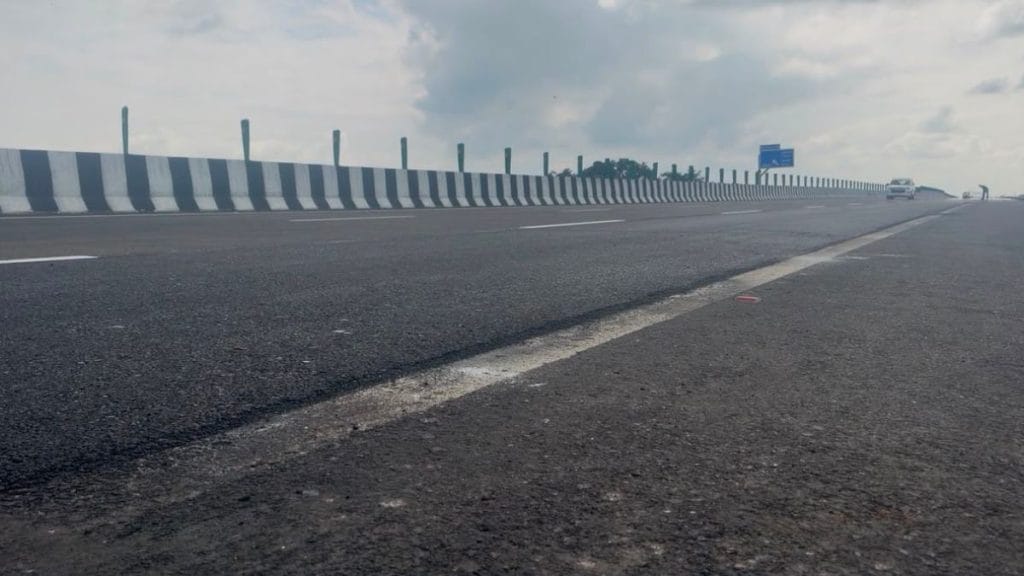
Lucknow/Kanpur: The promise was repeated from the same stage by three of Uttar Pradesh’s most powerful politicians: get to Kanpur from Lucknow in 35 to 45 minutes, down from the two-to-three-hour crawl on the old highway with a new, seamless road built to carry cars at 120 kmph. But just three weeks after the 13 July inauguration, commuters were driving around road rollers, excavators, caution tape, and workers tearing up the carriageway and laying it again.
At Km 64 of Uttar Pradesh’s newest expressway, the promise of speed has already run into the business of repair.
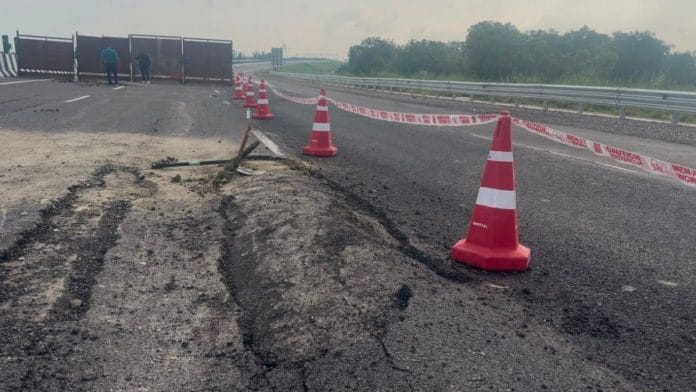
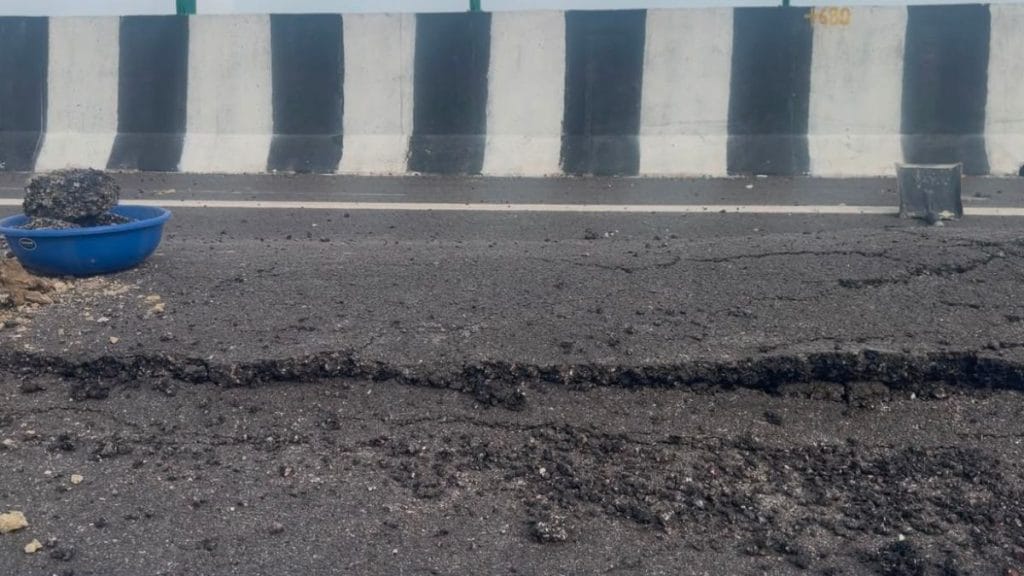
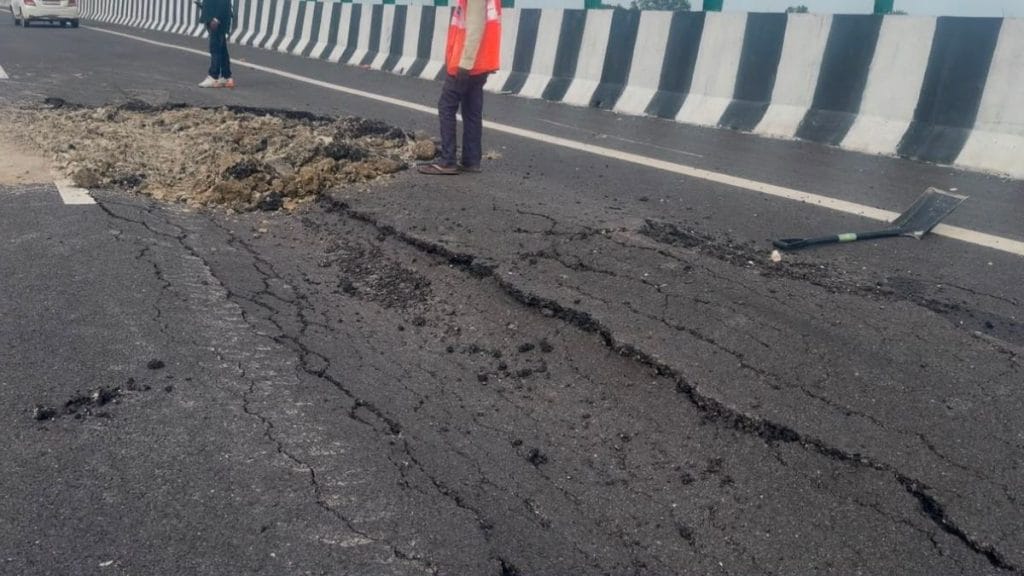
A 300 metre stretch of the six-lane carriageway was being rebuilt just 12 days after it opened after what the National Highways Authority of India calls a “localised surface slippage”. Elsewhere, smaller patches of fresh asphalt marked other repairs along the 63-km corridor.
The road was supposed to make the Lucknow-Kanpur commute routine. Instead, barely a fortnight after opening to traffic, the question became how much of the new road needed fixing — and why.
India has become very good at announcing infrastructure. Projects are being built, inaugurated and advertised as symbols of a new, connected state. But whether it can withstand its first monsoon, carry traffic safely and continue to perform after the cameras leave is a whole other question.
Uttar Pradesh is building roads and expressways at a scale meant to transform how the state moves. But these cracks in execution expose a less flattering side of that infrastructure boom. A link road to the Ganga Expressway in Unnao washed out after the season’s first rain, barely two months after its inauguration. In Hamirpur, six workers were killed when part of an under-construction bridge collapsed in May; and in Hardoi, a bridge beam collapsed during construction a month later, injuring two workers.
India is in the middle of one of its largest infrastructure-building drives, pouring public money into highways, expressways, bridges, airports and urban transport. In May, the Union road transport ministry reviewed the quality and maintenance of 11,672 km of national highways in Uttar Pradesh, after receiving feedback through the media and social media. The ministry specifically stressed adherence to quality standards, sustainable infrastructure and monsoon preparedness.
The Lucknow-Kanpur Expressway had been held up as precisely that kind of infrastructure: access-controlled corridor designed for high speeds, equipped with automated construction technology, multi-lane free-flow tolling and a network of cameras and incident-detection systems.
Naturally, the expressway was inaugurated by Defence Minister and Lucknow MP Rajnath Singh, Union Road Transport and Highways Minister Nitin Gadkari and Uttar Pradesh Chief Minister Yogi Adityanath as a showcase of the state’s new infrastructure ambitions. Singh said the long-standing congestion problem between Lucknow and Kanpur had been resolved as the leaders cut the highway ribbon built at Rs 4,700-crore by the PNC Infratech-backed concessionaire Awadh Expressway Pvt Ltd.
Adityanath described the project as part of a “New Uttar Pradesh”.
“‘New Uttar Pradesh’ has been established as an excellent model of good governance with excellent security and world-class infrastructure,” he had said.
Less than two weeks later, on 26 July, a section near Km 64 in Unnao’s Korari area developed surface slippage after rain. NHAI initially said the affected portion involved the upper wearing course rather than the underlying road structure and that it had been repaired. But subsequent inspections and repair work have brought a larger set of questions into view.
The road, meant to save commuters time and make the Lucknow-Kanpur travel an easy route, is instead making many of them sit through roadwork.
A showcase expressway
The Lucknow-Kanpur Expressway, notified as National Expressway-6, includes elevated sections through Lucknow’s Amausi and Shaheed Path areas, along with three key bridges, 28 minor ones, 38 underpasses and six flyovers designed to move traffic around one of Uttar Pradesh’s busiest urban corridors.
The project was also meant to showcase construction technology. NHAI had selected the corridor for 3D Automated Machine Guidance, which uses digital engineering models and satellite positioning to guide construction equipment with greater precision. The system was presented as a way to improve both speed and accuracy during earthwork and paving.
The finished road was also fitted with a Multi-Lane Free Flow tolling system, allowing vehicles to pass without conventional toll booths through FASTag and Automatic Number Plate Recognition. More than 80 high-definition cameras, 16 video incident detection systems and speed radars were installed along the corridor, according to launch-period reporting.
It was inaugurated only after engineers cleared bridge load tests, superstructure and substructure checks, and safety-infrastructure verification before the concessionaire received its Provisional Completion Certificate in February 2026 and a Final Completion Certificate around 11 June, less than a month before opening.
On paper, it was supposed to be a technologically advanced corridor designed to make the Lucknow-Kanpur journey faster, safer and more predictable. And yet, recently, the most visible technology was considerably more basic.
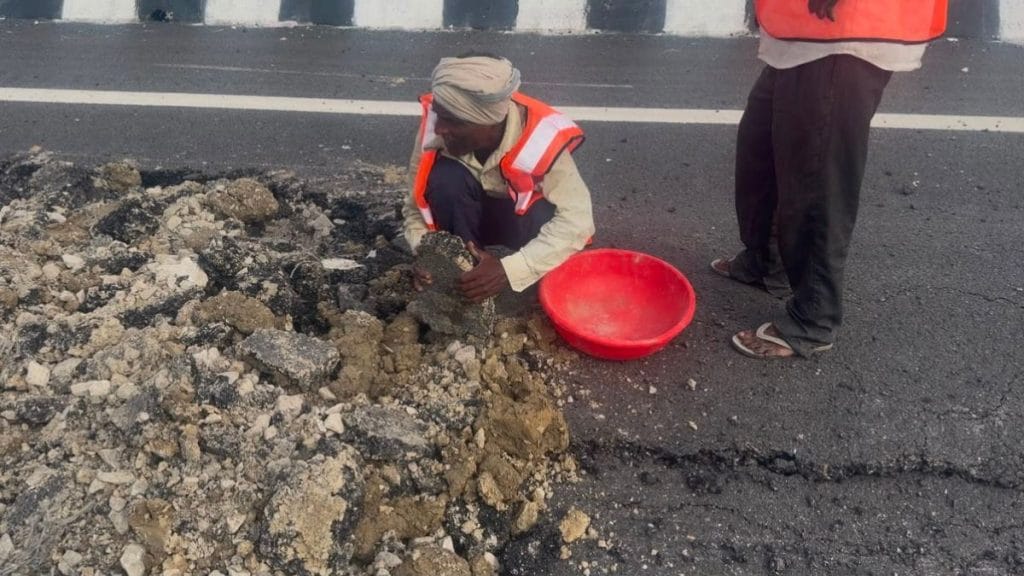
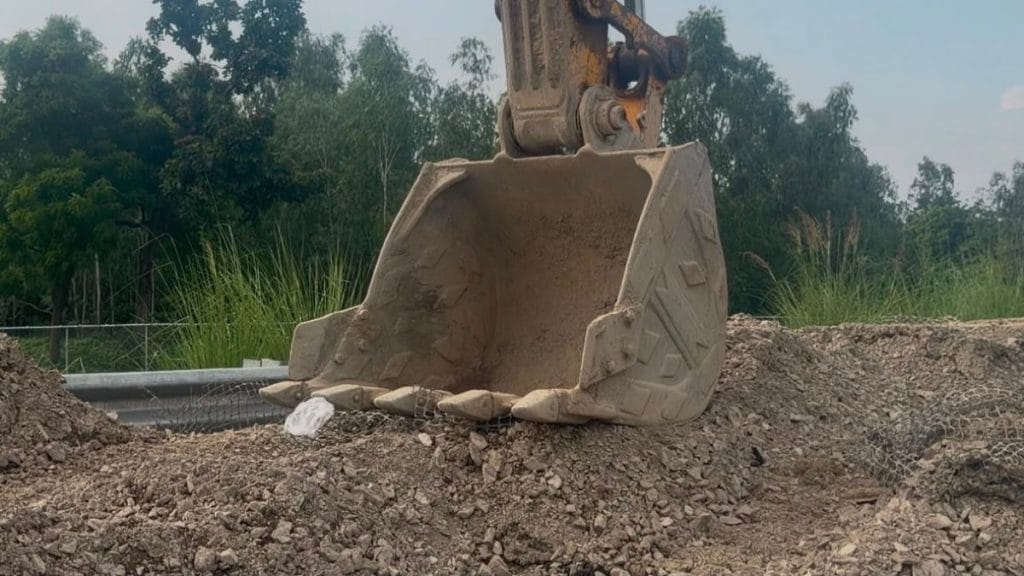
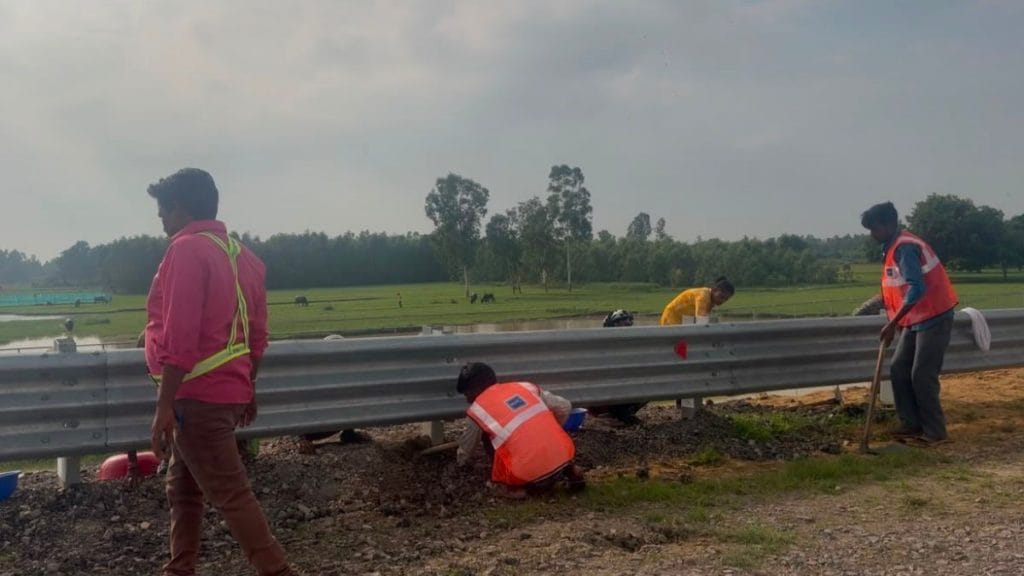
At Km 64, a soil compactor and hydraulic excavator worked on the damaged stretch. A water tanker kept the ground wet for compaction. A cold-milling machine was removing the damaged asphalt surface. Nearby, workers were preparing to lay fresh material and repaint road markings.
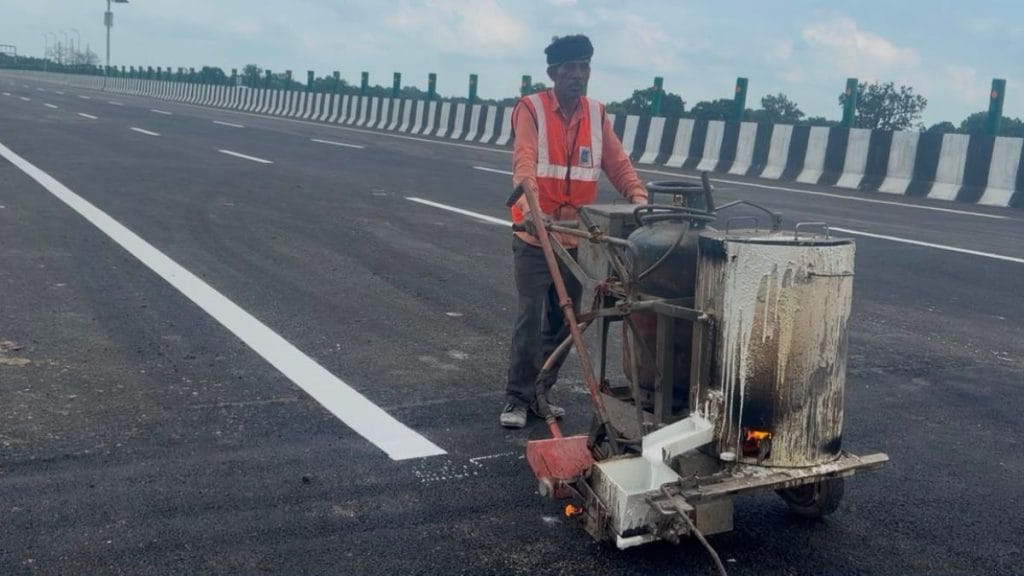
Around 10 workers were spread across the Km 64-65 stretch. Some, including women, were clearing pooled rainwater along the footpath. A worker operated a hand-pushed thermoplastic road-marking machine, laying a new white edge line along a section that had been repaired.
The expressway was built in two packages through separate special purpose vehicles incorporated by PNC Infratech. Package 1, executed by Kanpur-Lucknow Expressway Pvt Ltd, runs 17.52 km from Shaheed Path near Lucknow airport to the Sahib river bridge. Package 2, executed by Awadh Expressway Pvt Ltd, runs another 45.24 km and accounts for most of the repair work now visible on the corridor.
NHAI officials said Package 1, though shorter, includes roughly 10 km of the elevated corridor and accounted for about Rs 2,000 crore of the project’s overall cost. No defects requiring repair have been reported in that section, they said. The problems have largely been concentrated in Package 2.
The first warning
The first major public alarm came on 26 July, when videos of damaged road surface near Unnao’s Korari area began circulating online. Samajwadi Party’s Banda district president Madhusudan Kushwaha posted footage showing the damaged stretch and later another video showing repair work.
SP chief Akhilesh Yadav amplified the second video on repair work, writing on social media: “Running less, sinking more: Lucknow-Kanpur Expressway! Cost: Rs 4,700 crore!”
NHAI pushed back against the description.
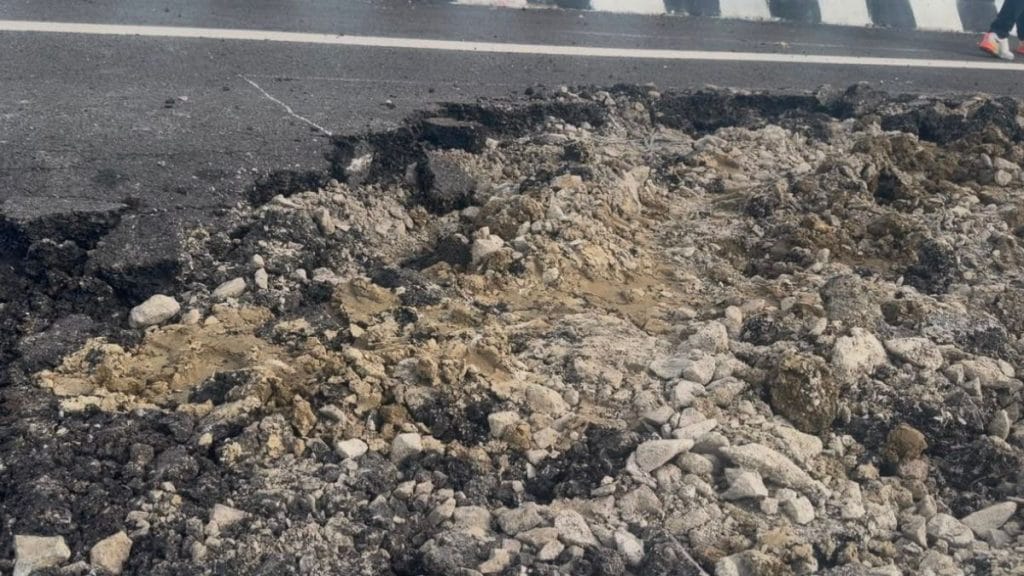
Its initial response was that the road had not “caved in”. NHAI Project Director Nakul Prakash Verma told news agency PTI that the affected area involved only the upper wearing course over about 40 metres and said the damage could not technically be called a road cave-in. He described such issues as possible on long bituminous roads.
But the controversy did not end with the first repair.
By early August, NHAI had ordered a wider inspection of the 63-km corridor and begun taking administrative action. The authority said its engineers and technical experts had found no deterioration in the base or structural layers, while an IIT Kharagpur-led technical committee, headed by pavement expert Professor KS Reddy, was tasked with examining the highway’s stability.
Km 64 was not the only fresh patch
Travelling through the corridor makes it clear that the Km 64 damage is not the only place where repair work is visible.
Fresh asphalt stands out against older, dust-covered sections of the carriageway. On the stretch, repairs were visible around Km 58; four patches clustered around Km 53; two smaller repairs around Km 52; and further patches appeared near Km 49, Km 48, Km 37 and Km 28.
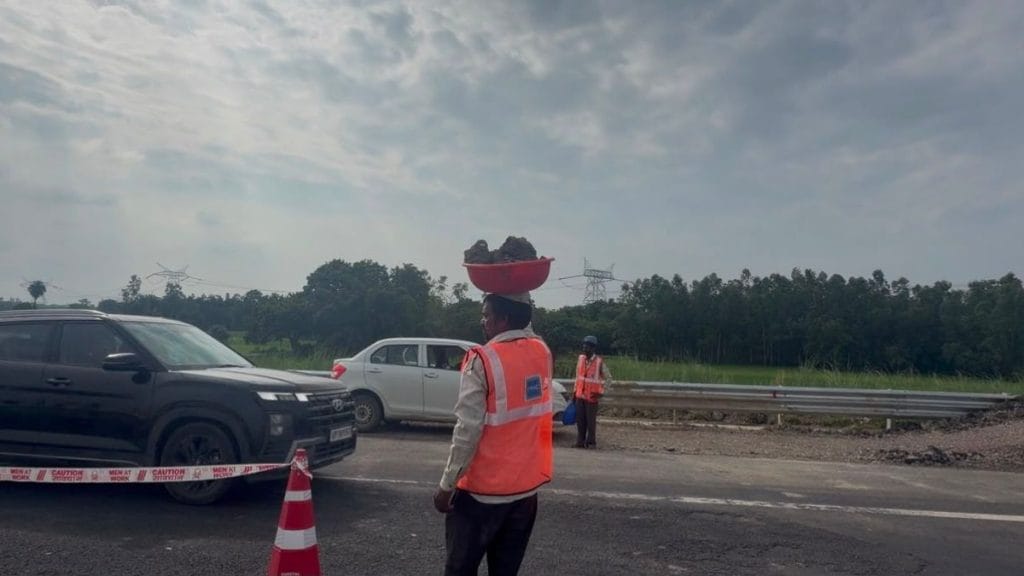
At Km 39, the damage was still being worked on. Two workers carried plastic baskets of broken asphalt away from the carriageway, timing their crossings around moving traffic. The damaged section sat close to the lane divider, with vehicles continuing through the adjacent lane.
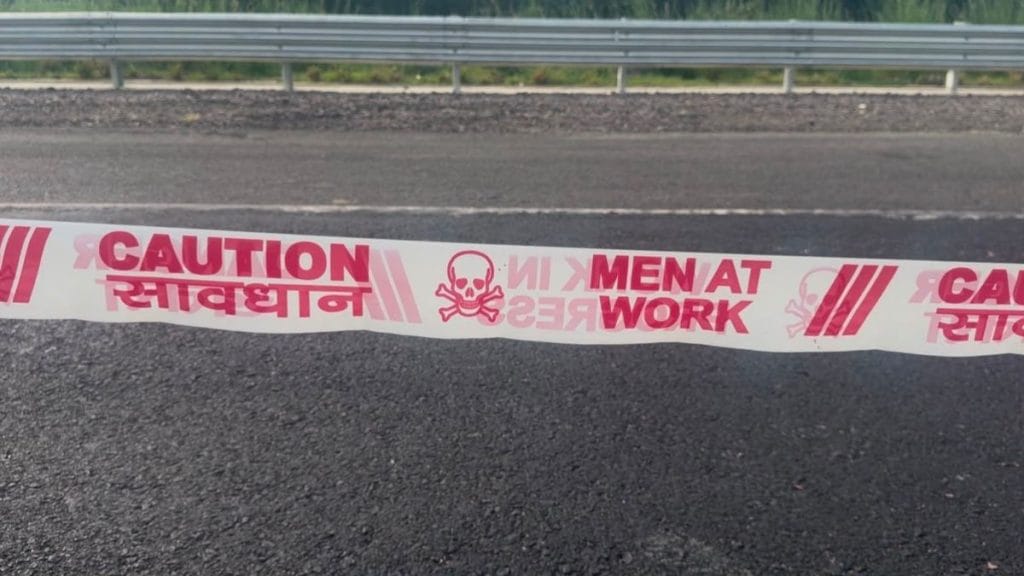
Reflective cones and caution tape marked the work area. A warning sign carried the words “Men at Work — Khatra” alongside a skull-and-crossbones symbol.
At another point, a roughly 10-metre damaged section was being repaired.
Along parts of the route, piles of discarded material lay beside the carriageway. Workers said old reinforcement mesh had been removed from some sections and replaced.
At some freshly repaired sections, industrial fans had also been deployed to dry the surface faster. An NHAI official said this was not part of any prescribed repair method.
“There are roughly 400 people working at the highway site, including machine operators, toll booth workers and labourers. Everyone is coming up with their own solutions, so someone might have thought that deploying industrial fans is a good idea,” the official said.
An NHAI official on condition of anonymity said around 80 patches across the expressway have required fixing. Of these, about 20 required more substantial repair work, while the remainder involved smaller potholes that could be addressed through routine patching.
NHAI has not shared a complete location-wise list of the repairs, saying much of the work falls under routine maintenance. The exact cause of the slippage has not been established yet.
Price of a road still being fixed
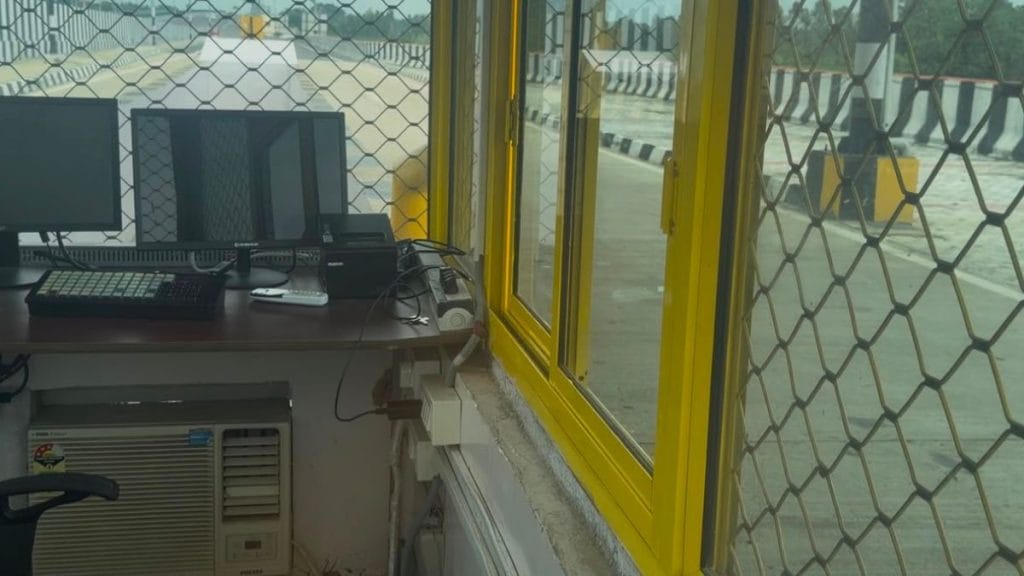
The empty toll plazas tell their own version of the story. The booths sit neat, freshly painted but entirely empty. After NHAI’s action over the damage, toll collection was suspended until rectification work is completed. NHAI has said the resulting toll losses will be recovered from the concessionaire.
One employee, transferred only days ago from a toll post on an expressway in Amritsar, now spends his shift with nothing much to do.
“I’ve been collecting tolls here since 13 July, overall, but otherwise I have been collecting tolls for the past 10 years now,” he said on the condition of anonymity. “I have never seen an expressway fall into disrepair just days after inauguration. Repairs happen — but usually only after a year of wear and tear.”
The toll itself had also changed within days of the opening. Traffic is thin along the route. A white sedan pulls up — the driver wants directions to the Ganga Expressway — and the toll worker points the way before stepping back into the white-coloured building that has been made for his rest next to the empty booth.
The toll rates had, too, been revised just days before the damage was reported, but the increase was part of the regular annual revision and was unrelated to the incident, according to NHAI officials.
When the expressway opened, cars, jeeps and SUVs were initially charged Rs 275 for a one-way journey and Rs 415 for a same-day return. By 22 July — barely a week after inauguration, and days before the slippage at Km 64 — NHAI revised the rates upward: car tolls rose to Rs. 285 for one-way travel and Rs. 425 for round-trips.
The 50-trip monthly pass went from Rs. 9,220 to Rs. 9,450. Commercial vehicles took a steeper hit, with buses and two-axle trucks moving from Rs. 935 to Rs. 960 and heavy vehicles with four to six axles rising from Rs. 1,470 to Rs. 1,505.
The older Lucknow-Kanpur highway, NH-27, was not spared either. Tolls at its Nawabganj plaza climbed in the same round of revisions, from Rs. 95 to Rs.100 for cars one-way and from Rs. 325 to Rs. 340 for buses and double-axle trucks.
The timing added to commuter frustration. The expressway had been criticised as expensive even before operations began, with users weighing the higher toll against the promised reduction in travel time.
Also Read: Students, courts & bulldozer fears. The fight for UP’s Mohammad Ali Jauhar University
NHAI turns on the contractor
The controversy has also drawn attention to who built the road. PNC Infratech, the listed construction company behind the expressway, is controlled by four brothers — Pradeep, Chakresh, Yogesh and Naveen Kumar Jain.
Naveen Jain is a former whole-time director of the company who still holds a promoter stake, is also a sitting BJP Rajya Sabha MP from Uttar Pradesh and a former mayor of Agra.
PNC Infratech has a sizeable highway portfolio, with projects across Uttar Pradesh and other states with more than Rs. 6,731.8-crore set of highway and expressway awards allotted, covering projects from Aligarh to Kanpur.
It also continued to win NHAI work just days before the problems on the Lucknow-Kanpur Expressway. The company was, before the row, awarded three highway projects worth about Rs 3,483 crore— one in Barabanki and two greenfield stretches of the Delhi-Vadodara Expressway in Gujarat.
Even as NHAI insists that the road remains to be “completely safe” and built “in accordance with all prescribed quality standards”, a fairly aggressive set of penalties have been imposed against nearly every layer of the project’s execution and oversight.
The authority has initiated proceedings to declare Awadh Expressway Pvt Ltd a “non-performer” — a tag that would make it ineligible to bid for the authority’s future projects — and proposed penalties against the concessionaire, while also moving against officials involved in the project’s execution and supervision.
With this, a proposed penalty worth 2 per cent of the performance security, debarment proceedings of up to three years against the company’s head of pavement and highways and other responsible staff, and a downgrade to its Pavement Condition Index rating that would hurt its standing on future tenders. The concessionaire has also been ordered to fund the entire rectification itself — a bill NHAI puts at roughly Rs. 3 crore so far.
The expressway has a 15-year defect liability period, under which the concessionaire is responsible for rectifying defects at its own cost.
Three officials tied to on-ground supervision—construction agency project manager Vivek Kumar Gupta, Independent Engineer team leader Surendra Kumar and resident engineer Yatendra Kumar—have been removed and barred for two years from participating in projects under the Ministry of Road Transport and Highways, NHAI or NHIDCL. Project director Nakul Prakash Verma has been repatriated to his parent department, while a chargesheet is being prepared against him and his predecessor, Saurabh Chaurasia.
Repairs still continue on the new expressway. For now, the 40-minute promise remains suspended somewhere between the ribbon-cutting and the roadwork.
(Edited by Stela Dey)