







New Delhi: Rushing through the narrow, crowded lanes of Sitaram Bazar near Chandi Chowk, Umar, a daily-wage labourer, moves with practised swiftness–carrying his eight-year-old daughter perched on one side of his shoulder, a heavy bag slung over the other. The walk from her English-medium school to home is more than a kilometre. But he doesn’t complain even though there is an Urdu-medium MCD school closer home.
“What if we belong to the labour class? Our daughter still deserves quality education,” he said, pausing briefly to wipe the sweat from his forehead.
Just a few years ago, in Old Delhi, Shahdara, Old Seelampuri, and parts of Central Delhi, Urdu-medium MCD schools were the first formal point of education, trusted by families across generations.
Today, that trust is beginning to erode.
But the numbers are gradually dwindling. Enrolment in Urdu-medium primary MCD schools has fallen from around 34,000 students in the 2021-22 academic year to nearly 25,000 in 20 25-26, as per the MCD data accessed by ThePrint.
Like Umar, 31, many parents are willing to work extra hours or juggle multiple jobs to send their children to schools they believe offer better prospects.
The shift is not a statement on the value of language itself. For many families, Urdu continues to hold cultural and emotional significance. But when it comes to schooling, aspirations are increasingly shaped by what parents believe will secure better opportunities.
“Our fathers studied in Urdu, our grandparents did too — it’s part of who we are. Urdu is our identity. But today, we have to think about their future,” said a man, waiting outside a Hindi-medium school to pick up his child.
Across the national capital, the Municipal Corporation of Delhi (MCD) runs thousands of primary schools, yet only 22 have Urdu as the sole medium of instruction, while another 38 offer it alongside Hindi and English.
On paper, these schools follow the same NCERT curriculum guidelines as their counterparts. They are neither madrasas nor minority-run institutions. But on the ground, perception is shifting.
Urdu-medium education, some parents say, carries a burden of reputation. In the current socio-political climate, many want their children to move beyond the confines they themselves have lived in.
“It’s not that I don’t want them to study in Urdu,” said 35-year-old Rehman, a daily wage worker. The hesitation comes from somewhere deeper. In the current climate, Rahman, whose children are studying at a Hindi-medium MCD school, worries about what it means to send his children to a school marked by language—and by extension, identity.
“Why should they carry that?” he asked.
Beyond individual anxieties, the conversation points to larger questions about the education system as a whole.
“The issue is not just about language—the issue is about quality of education, availability of resources, and the kind of future that education promises,” said Tafseer Husain, a poet who works with Rekhta.
Dwindling numbers
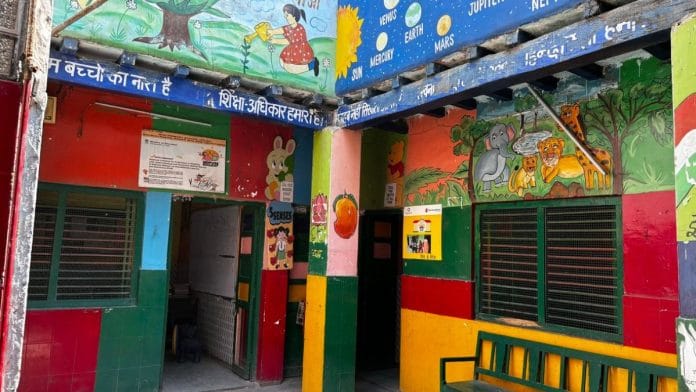
Inside the rundown MCD Primary School in Sitaram Bazaar, the principal’s office holds a stack of half-opened boxes labelled “learning enhancement kits,” leaning against a damp wall.
Dust has settled over them. Inside are protractors, rulers and geometry tools—still neatly packed, untouched. Just outside, at least 30 children squeeze into a classroom where desks are splintered, and paint peels off.
“We don’t even have time to open them and see what’s inside,” said one of the teachers, who also works as the administrator and IT handler. Between roughly 150 students across grades, and only a handful of staff, their workload is cut out. Two additional teachers were assigned after repeated appeals, but the workload, she claimed, remains overwhelming.
In another classroom in Old Seelampur, the strain reveals itself differently. A girl, no older than eight, lingers near her teacher’s desk at the end of the day.
“Ma’am, when will we get our books for the session?” asked the girl.
The teacher has no clear answer. Soon, parents arriving to pick up their children asked the same question. She later admits that her Class 4 students did not receive their books at all last year.
These everyday gaps sit within a larger pattern. MCD schools together cater to roughly 8.5 to 8.6 lakh students from nursery to Class 5 in Delhi. Of these, Urdu-medium schools account for just around 15,000 students—a small fraction, and one that appears to be shrinking.
Over the years, several such schools have been merged or closed, often citing low enrolment or poor infrastructure. In 2024, around 60 schools were merged. However, the trend is not new. In 2009, an Urdu-medium girls’ school in Ballimaran was merged after its building was declared unsafe.
Even with these mergers, the numbers are not promising.
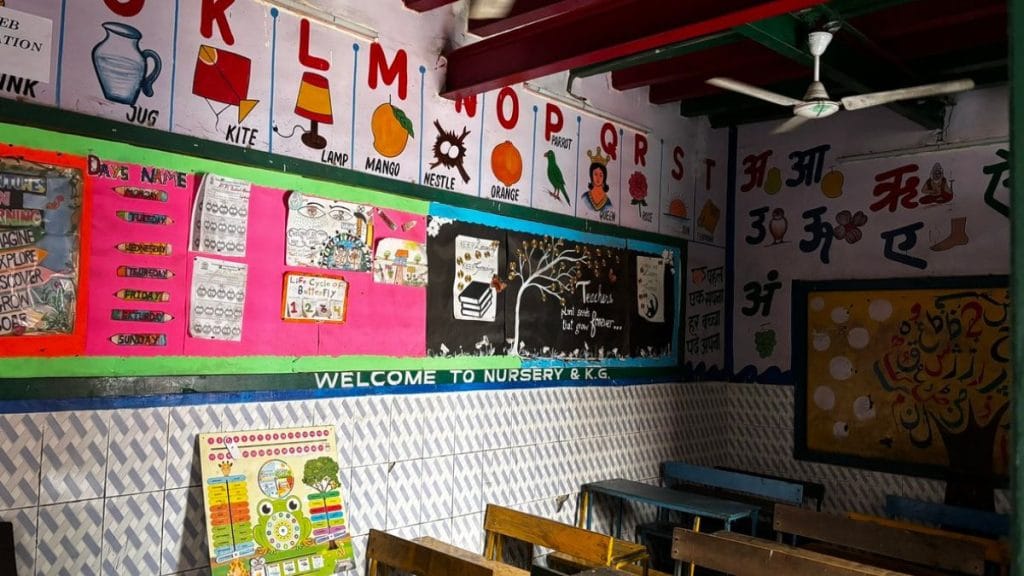
A school in Old Seelampuri, which had 669 students enrolled in the 2021-22, has seen a steady decline since, dropping to around 390 last year. Now, enrollment lies stagnant at roughly 300.
Teachers said that some children are delayed in getting admission, and in some cases, are turned away, as schools struggle to process incomplete or missing documents for each child.
In classrooms, the effect is clear. Teachers said that many students in higher classes struggle with basic skills like reading, understanding text, and simple maths.
“Now, the child is in Class 4, but at a foundational level, he is still at the level of Classes 1 or 2, so there has been little progress,” said a teacher at Sitaram Bazar’s Urdu-medium school.
Even when they try to adjust their teaching, with limited time and staff, it is difficult to help every child catch up.
According to MCD data, accessed by ThePrint, reveals that of 654 sanctioned teaching posts, 627 are filled, leaving 27 vacancies.
“There is no shortage of teachers in MCD. But, distribution is skewed,” a senior MCD official said, adding that some schools have fewer teachers due to location and posting constraints.
Also read: ‘Guru sahib told me to risk my life’—Punjab farmer ends 18-month protest over sacrilege law
A shift in thought process
Rehman sits on the edge of his bed at his small two-room house in Old Seelampuri, half-listening, half-watching, as his children speak over each other, recounting their day at school. They tell him about the art project they have been given as homework.
He nods along, occasionally asking a question, a faint smile settling on his face. There is a sense of relief in these moments; his children are in school, learning, moving forward.
His children study in Classes 2 and 4 at a nearby Hindi-medium MCD school.
“Nonetheless, I never thought of enrolling them in an Urdu-medium school,” he said.
But even as Rehman expressed concern about the possible stigma Urdu medium schools carry in present-day India, he is quick to add that fear is not the only reason. For him, the decision is also practical. In his mind, English, and to some extent Hindi, has become the language of opportunity.
A few kilometres away, outside an MCD Hindi-medium school in Bulbuli Khana, a woman, a homemaker, waits with her son as she processes his transfer papers.
The boy, 11, with a learning disability, has big dreams for himself.
“I want to be a doctor,” he said.
For his mother, what matters is whether her child will be seen, understood, and supported. When she considered nearby Urdu-medium schools a few years ago, she walked away unconvinced.
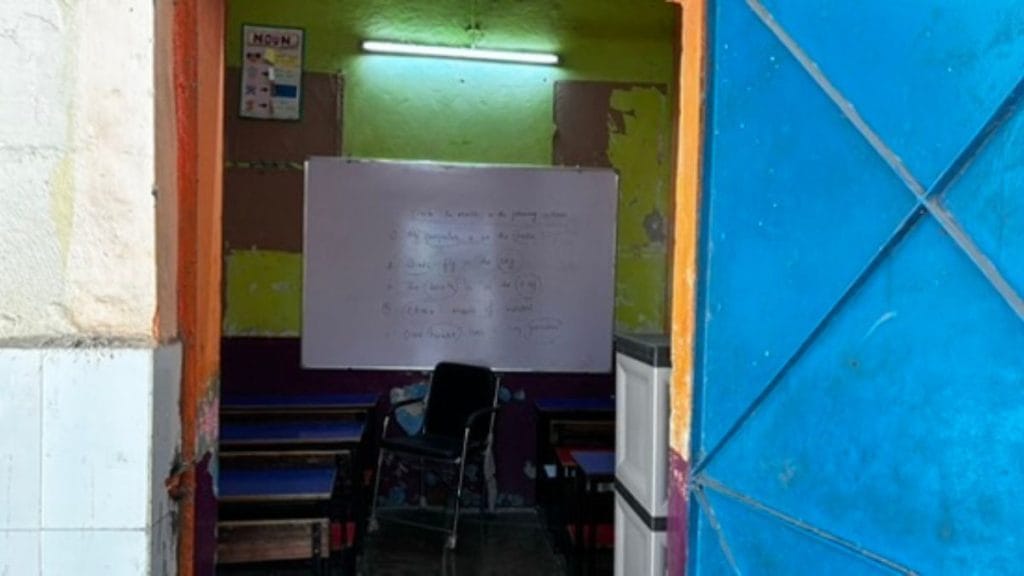
“There were too many children, not enough teachers. How will they look after a child like him? I cannot imagine that happening there,” she said.
Even in neighbourhoods where Urdu is widely spoken, Urdu-medium schools are no longer the first choice for many families. While the corporation schools are free, the government-aided schools have fees of Rs 9,000 a year.
Parents claimed that they are looking for more than just basic schooling; they want activities, personal attention, and space for their children to grow beyond textbooks. Reputation plays a role too, with some describing Urdu-medium schools as places where “serious study” does not happen.
“The issue is mainly the lack of teachers,” Rafia Mahir, MCD councillor for Sitaram Bazar, said, pointing to the shortage of staff in government schools across the area.
Also read: Meet the 1st all-girl Arunachal band. Gilithigreams is singing for Northeast
‘I want to study Arts’
But beneath it all lies a more pressing concern: what comes next?
Many parents with children in Urdu-medium MCD schools worry that studying in Urdu may limit future opportunities.
And it is not just parents who are concerned. Those closely associated with the language echo a similar unease, questioning what the future holds for students who may want to pursue Urdu but hesitate to do so.
Tafseer frames it as a question of direction: where does this path lead, and is the system ready to support it?
“Where is the demand for it? Where will it go?” the poet asked.
Taiyyaba, an 18-year-old Class 12 student at an Urdu-medium government school in Chandni Chowk, said that she wants to pursue Arts after finishing school, but is unclear about how to navigate the process.
“I want to study Arts. But I don’t really know what options I have or how to go about it,” she said.
Many other students said that they lack access to clear career guidance or information about higher education pathways. While some express interest in fields like teaching, civil services, or humanities, they often feel underprepared.
Another girl, also in Class 12, said she is worried about coping in an English-dominated college environment.
“I’m a little scared to step into a world where everything is judged through English,” she said, adding that it often makes her doubt if she will be able to keep up. She added that she takes online English lessons while keeping up with the school curriculum.
For now, students like Taiyyaba are left to figure things out on their own, balancing her aspirations and hopes with hesitation.
“I want to study further,” she said, “I just don’t know how to get there.”
(Edited by Saptak Datta)
Meanwhile the wiser ones amongst us foresaw that Urdu is an impediment to a prosperous future – almost 75 years ago when we gained independence and declared our official languages.
Urdu belongs to no region, no tribe, no community. It belongs to an ideology – the same one which created two hostile neighbours.