





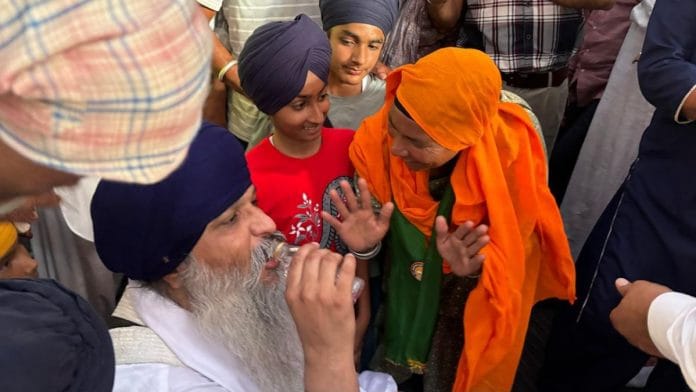


Patiala: Gurjeet Singh Khalsa stepped onto the stage in Samana to chants of “Sat Sri Akal”, hours after ending an 18-month-long protest atop a telecom tower, demanding a law against sacrilege in Punjab.
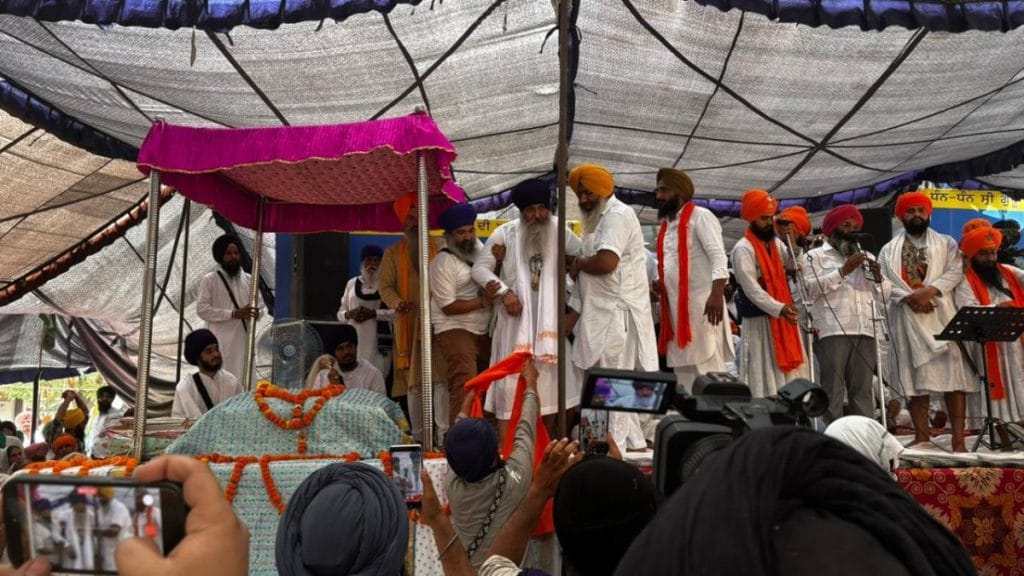
More than a thousand people had gathered at Banda Singh Bahadur Chowk on Patran Road, Samana, where protests have been going on since 24 February. Khalsa arrived at the site in an ambulance and was helped onto the stage by members of his morcha.
Before addressing the gathering, the 43-year-old ex-serviceman and farmer walked straight to the Guru Granth Sahib’s Palki Sahib and bowed before it, visibly emotional.
Earlier in the day, Khalsa had been brought down from the BSNL tower, ending his prolonged protest. The development comes just days after the Punjab government notified the Jaagat Jot Sri Guru Granth Sahib Satkar (Amendment) Act, 2026, following the Governor’s assent, marking a significant moment in an issue that has shaped the state’s politics for over a decade.
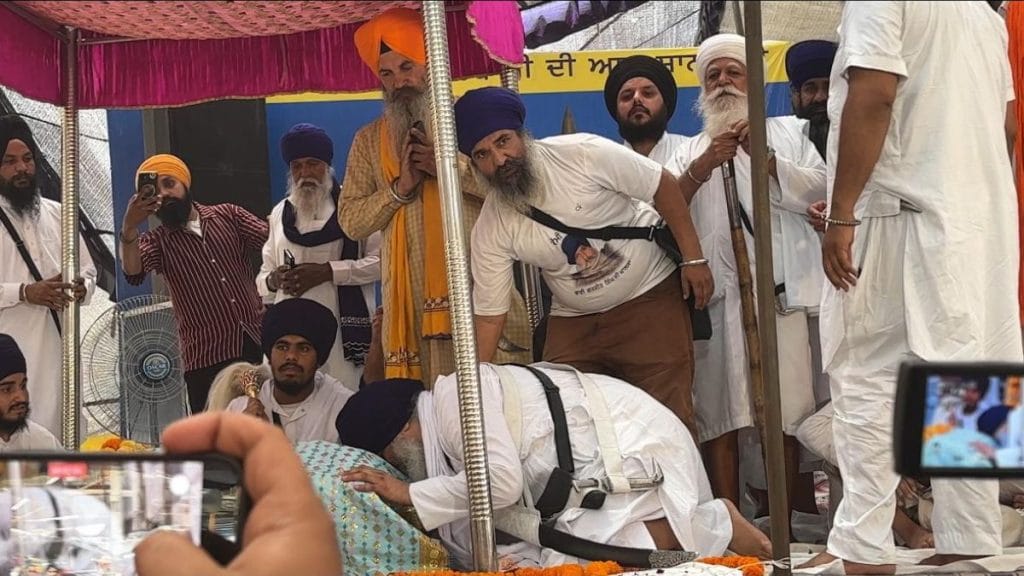
After he climbed down from the tower, Khalsa was taken to a hospital for a medical check-up. A team led by SMO Dr Nandini Sharma and Assistant Professor Dr Parminder Pal Singh examined him and provided necessary care.
He then visited Gurdwara Garhi Sahib in Samana, which he said was central to his decision to undertake the protest.
“I went there and prayed to Guru Sahib. I said that for a long time, our faith has been disrespected, and I want to do something to stop it. I asked for a path. And it is then that I had a vision—I saw kirtan taking place in a vast open space. Guru Sahib told me that I would have to risk my life. I said, ‘Give me strength. I am your Sikh’. Only then did Guru Sahib guide me to climb the tower,” Khalsa said.
Also read: Tawang’s Museum of Valour joins two worlds— a tribe’s heritage and a nation’s border
‘He is like a god to us’
At the morcha site, several leaders and supporters were present, including Ma Jagjit Singh Dallewal, president of BKU Sidhupur; Amitoj Mann, member of the Tower Morcha Samana committee; Gurpreet Singh, coordinator of Tower Morcha Samana; Satnam Singh Baheru, president of the Indian Farmer Association; Iqbal Singh Jhunda, senior leader of SAD (Punar Surjit); Surjit Singh Rakhra, former Punjab minister and senior SAD (Punar Surjit) leader; and Manpreet Singh Ayali, senior leader of SAD (Punar Surjit).
Khalsa was also welcomed by a dhadi jatha, a traditional Punjabi musical group, led by Sabha Singh Sitara, as chants continued across the gathering.
Despite the charged atmosphere, concerns over his health remained. He appeared weak, with high blood pressure, and was seen taking medication while on stage.
Addressing the crowd, Khalsa said many had tried to dissuade him from undertaking the protest, but he remained firm.
“This is my Baba Ji’s order, and I will fulfil it. It is because of this that I found the strength not just to climb the 400-foot tower, but to endure heat, cold and heavy rains,” he said.
Khalsa, who hails from Kheri Nagaiyan village, said his resolve kept him going through the months atop the tower.
Among those present in the crowd was Surinder Singh, who said Khalsa’s protest had inspired many.
“We have waited for this for years. When the Act was finally passed, it felt like justice. What he did made people speak up, and today we are seeing the result of that,” she said.
As the event went on, people gathered around Khalsa, many attempting to bow before him. He repeatedly gestured for them not to do so.
Yet, the reverence was evident. Seated in an electric wheelchair among the crowd, Gurjant Singh folded his hands and listened quietly as proceedings continued.
“He is like a god to us. He has done what no one else could. Sacrilege of the Guru Granth Sahib is a serious crime and should be punished strictly,” he said.
(Edited by Saptak Datta)
Udta Punjab captured the state and it’s people perfectly. Maybe that’s why Mr. Shekhar Gupta did not like the movie and keeps cussing it whenever the topic of Punjab comes up.
Fools and idiots abound in this state, way more so than in other Indian states.