



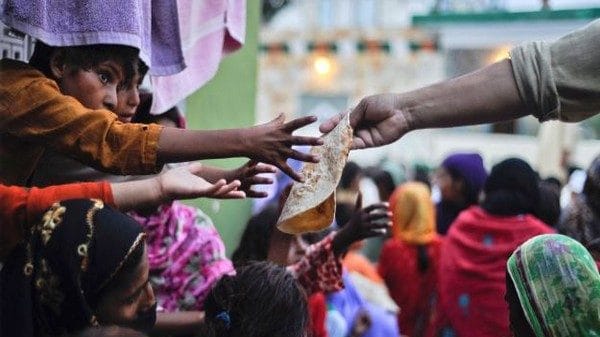

New Delhi: A new report on the living conditions of Pakistani citizens across the rural and urban divide has jolted the nation. In a predominantly agrarian economy, more than a quarter of the households are facing some form of hunger and malnutrition, says the report published by Pakistan Today newspaper, calling the situation a “recipe for social disaster”.
“Families are cutting back on how many cups of rice they make, the size of their rotis, the number of times meat is cooked in a month, how much milk is being given to their children, and even how many cups of tea they are drinking a day,” the report says.
Pakistan’s food insecurity has left citizens angry. They want to know how a predominantly agrarian society is suffering from a food crisis.
Former finance minister Miftah Ismail told ThePrint that Pakistan has been slipping economically in recent years.
“Our average income hasn’t grown. This has resulted in great poverty and food insecurity. Between 2018-19 and 2024-25, the per capita food consumption of not just proteins but of staple food has decreased,” he said.
The answer lies in the fact that Pakistan has been a net food importer since at least 2021. Rising food prices have consequently begun reshaping what people eat, forcing many households to cut back on the quantity, quality, and variety of their diets.
A population that consumes less nutritious food is likely to face future generations who are more vulnerable to illness and less physically resilient. What looks like a food-price problem today could become a much larger social and economic crisis tomorrow.
According to Pakistan’s Household Integrated Economic Survey in 2024-25, the monthly household consumption of wheat has dropped to 6 per cent, rice has come down to 19 per cent, and dal by more than 25 per cent in the last fiscal year. When it comes to protein, the average Pakistani now consumes half a kg of mutton, beef, and chicken combined in an entire month. Less than one egg is consumed every 10 days, while fresh milk is just one small glass a day.
“Currently the wheat prices in Pakistan are much above the international level. Pakistan should allow the private sector to import wheat. It should also work on improving seed quality and help farmers increase their yields. It should reduce rates of power and gas and get the industry going. It should also try to decrease taxes on petrol and diesel,” Ismail told ThePrint.
The social indicators are worse. The share of Pakistani households classified as “moderate to severely food insecure” has risen from 15.92 per cent in 2019 to 24.35 percent in 2025, according to the data released by Pakistan Bureau of Statistics that the report mentions. Over the same period, the proportion facing severe food insecurity has more than doubled, from 2.37 per cent to 5.04 per cent.
Also read: After firing 7 players and head coach, Pakistan cricket turns to LinkedIn. ‘We are hiring’
The solution
But does Pakistan not have its own food? Pakistan is among the major producers of poultry in the world, which grows its own wheat and even has a growing meat supply sector. The issue lies in affordability — weak wheat supply chains, more import of poultry and daal, and more hoarding of food supplies than distribution.
What can be done? According to Pakistani researchers Dr Noman Ahmed and Arfah Ahmed, the solution requires shifting food policy beyond calorie security by diversifying agriculture, reducing supply-chain losses, strengthening health and nutrition services, and improving public awareness.
In an article for Dawn on Wednesday, the researchers wrote that Pakistan’s existing programmes such as the Benazir Nashonuma Programme should be independently assessed, expanded, and better coordinated with agriculture, health, food, and social-protection policies. And as for financing, it can come from redirecting agricultural subsidies, targeted support for nutritious foods, taxes on unhealthy products, corporate contributions, and expanded social protection for vulnerable mothers and children.
“More than 60pc of people in Pakistan are estimated to be unable to afford a healthy diet, demonstrating the importance of affordability alongside food availability. Subsidies could, therefore, be targeted towards low-income households or specific nutrient-dense food groups rather than providing broad subsidies that benefit all consumers equally. This would directly reduce the financial barriers that prevent vulnerable families from purchasing diverse and nutritious foods,” they wrote.
Pakistanis are horrified. “Not only the poor but also the middle classes have been pushed into deep economic insecurity due to loss of livelihood and inflationary pressure. The violence we see at the level of society is downstream from this fundamental reality,” Pakistani anthropologist Arsalan Khan wrote on X.
Another user called it “tragic and criminal”.
Others are angry at the system. “This is a slap on the face of each and every party and dictator that has ruled the country. Think of your fav political party. Can you say that your leader’s kids can’t afford food? It will never be them. Meanwhile, the citizens will fight each other for the same parties and army,” X user Syed Zain Raza said.
Public policy analyst Shuja Azmi agreed. “Since childhood, we’ve been hearing that Pakistan is an agrarian country. We produce enough food not just for ourselves but to export to American and European markets. Fast forward to today and people can’t even afford to eat properly. Children are suffering from malnutrition,” he wrote on X.
An X user put it poetically:
“I starved to death from hunger in my own city, The rations that arrived went straight to the officer’s house.
The sheet kept climbing the shrine, countless in number,
But the lone mendicant outside froze to death in the cold.
The bread of the rich city was snatched by dogs,
The famine of the poor city was divided among the children.
His face told the tale that hunger had struck him down,
The ruler declared, ‘He must’ve eaten something and died’.”
(Edited by Aamaan Alam Khan)