





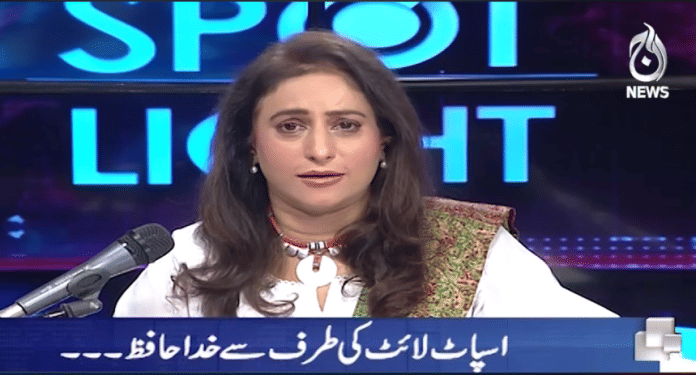


New Delhi: For nearly eleven years, Munizae Jahangir presented her weekly programme, Spot Light, for Aaj News, becoming one of the country’s longest-running current affairs shows. In Pakistan’s tightly managed news media and television landscape, Spot Light had become a rare forum where politicians, diplomats, activists, and dissidents could be pressed on issues that rarely draw attention.
On 23 July 23, Jahangir’s luck ran out. Signing off for the final time, Jahangir told viewers ‘it was an unforeseen reluctant end to this journey”.
The reasons for her removal remain unclear. Critics, however, say Jahangir’s episodes on PoK politics and her last episode, where she questioned Prime Minister Shehbaz Sharif’s coordinator on government spending, was the tipping point.
Media organisations, press freedom groups, and fellow reporters described her removal as part of a broader pattern where critical voices are increasingly pushed off mainstream television.
Speaking to ThePrint, Jahangir said that reporting straightforward facts in Pakistan has now become increasingly fraught.
“It is now increasingly difficult to report facts in Pakistan because if you do report facts, sometimes you are slapped with charges under the PECA law, which has very broad definitions of what qualifies as false news,” she said.
“So the defintion of fake is given but it is vague and can be manipulated by the authorities,” she added.
Jahangir’s mother is the famous Pakistani human rights activist Asma Jahangir, who passed away in 2018. Munizae’s career spans more than two decades across Pakistan and South Asia. She has reported for Dawn, Geo News, and India’s NDTV, where she spent a decade as the channel’s Pakistan correspondent. As editor-in-chief of Voicepk.net, a digital platform, she continues to report on human rights while producing documentaries that chronicle conflict, displacement, and democratic struggles, including the award-winning Search for Freedom, about Afghan women living through war.
Over the years she has interviewed a range of political figures, including Hillary Clinton and Sadiq Khan to Benazir Bhutto, Nawaz Sharif, Imran Khan, and Nobel laureate Malala Yousafzai.
Also read: Pakistan bans Al Jazeera over PoK reporting, accuses it of ‘yellow journalism’
PECA and media freedom
In January 2025, Pakistan’s parliament passed a bill to amend the controversial Prevention of Electronic Crimes Act (PECA) law. The amendments grant the government sweeping powers to regulate social media. Penalties include up to three years in prison and a fine of up to PKR 20 lakh for spreading fake news. The law also prohibits sharing statements from banned organisations or their members, and broadens the definition of social media platforms to include any online information management systems.
Pakistani journalists, digital rights advocates, and civil society have long been waging a war against the PECA law. Originally passed in 2016 to combat cybercrime, it has now become the state’s primary tool to intimidate and criminalise free speech. These concerns have only grown louder with a recent wave of arrests, threats, and abductions targeting journalists.
In August 2025, the Senate Standing Committee on Information and Broadcasting, chaired by PTI Senator Ali Zafar, expressed alarm over the growing misuse of PECA after a Senate report revealed that a total of 689 FIRs had been registered under the law across the country — including nine against journalists. One journalist has been arrested, while seven others are reportedly outside Pakistan, Dawn reported.
For Jahangir, however, the current climate represents not an abrupt break but an evolution.
She began reporting during General Pervez Musharraf’s military rule, when subjects such as Balochistan were largely absent from mainstream broadcasts. Today’s information ecosystem, she says, presents a different paradox.
“Journalistic spaces have always been hard to maneuver and navigate. I started my career under General Musharraf’s regime, and at that time Balochistan was completely blacked out. Now I feel that with social media there is more news that comes out, but the pressure has also increased on journalists in the mainstream, who are barred from reporting it. The sense of frustration among mainstream journalists has grown because social media can and will report those facts while mainstream media is banned from doing so,” she said.
That also exposes the ‘unannounced censorship’ that mainstream media faces in Pakistan, she noted, because journalists are not allowed to report on issues that social media is reporting on, even though these remain critical issues fundamental to people’s everyday lives.
In a tweet on X, she noted that 14 anchors were “forcibly removed from air just for doing their jobs.”
That frustration eventually pushed her beyond traditional television.
“The reason that I started my own YouTube channel is because I was frustrated by the limitations and the unannounced, informal censorship in mainstream media,” she added.
She revealed then how viewers themselves increasingly questioned why important national stories were absent from television screens.
“I was constantly being trolled by viewers that we were not giving out facts that were much needed or that were really the national talking point. We were not touching those issues. It was with some frustration, and having no other choice, that I reverted to social media so as to keep our credibility and our commitment to the viewer—that we would be reporting the facts of the most talked-about news stories in the country.”
Legal minefield for journalists
Pakistan’s media watchdog Freedom Network in a 2026 report noted the atmosphere surrounding journalism has become markedly more hostile.
Its latest quarterly report documented twenty-two cases of intimidation against journalists between April and June 2026, including arrests, assaults, legal threats, kidnappings, attempted killings, death threats, and editorial interference. Following Jahangir’s departure, the organisation described the episode as another troubling milestone.
“Forced censorship is not just the silencing of a single journalist,” it said. “It is also the silencing of the public’s right to information.”
Jahangir describes the legal uncertainty confronting journalists as a “minefield.”
“It’s a minefield, really, simply because of the PECA laws and the vague definitions of fake. A lot of journalists have been charged with sedition. The definitions—whether it’s sedition, fake news, or ideology of Pakistan—are very open to interpretation because they have deliberately been kept broad.
What happens next is what she calls “a fishing expedition.”
“Even in the charge sheet we are not told exactly what we have done wrong. Which tweet are they referring to? Which podcast are they referring to? We are never told. It’s all left to our imagination”.
The Pakistan Federal Union of Journalists called the decision another indication of mounting pressure on media organisations.
“You can silence a voice, but you cannot silence an entire community,” union leaders Afzal Butt and Arshad Ansari said in a joint statement.
Other organizations—including the Rawalpindi-Islamabad Union of Journalists, the Women Journalists Association of Pakistan, the National Press Club, and the Rawalpindi and Islamabad Bureaus Journalists’ Association—issued statements supporting Jahangir and criticising what they described as increasing restrictions on independent journalism.
Digital rights advocate Usama Khilji called the development “a major blow to press freedom and freedom of expression.” Political figures, including former senator Farhatullah Babar and senior politician Afrasiab Khattak, also expressed support.
Jahangir says she benefited from that public backing, while recognising that many reporters outside the national spotlight face much greater vulnerability.
“In my case, I found a lot of solidarity among journalists. The top journalists of this country tweeted about my case. But there are other journalists who may not find that kind of support simply because they may not be as prominent, or they may be from marginalised areas like Balochistan or Khyber Pakhtunkhwa, where they may feel much more isolated,” she added.
(Edited by Prashant Dixit)