





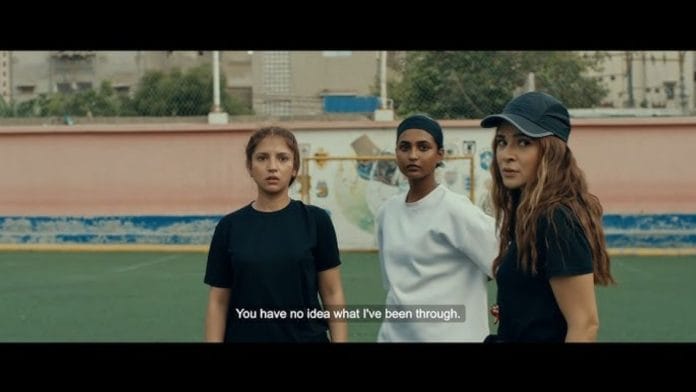


New Delhi: Pakistan’s response to the Indian Bollywood blockbuster Dhurandhar, Mera Lyari, tanked so badly that it barely sold 22 tickets on its opening day in theatres before being taken out.
The film Mera Lyari, starring Pakistani actor Dananeer Mobeen and Ayesha Omar, was released on 8 May. It was conceived by its makers as an uplifting portrait of a neighbourhood long associated with gang wars and political violence. But even before audiences entered theaters, the film got entangled in a geopolitical narrative shaped by Bollywood, online nationalism and India-Pakistan rivalry.
Directed by the Pakistani filmmaker Abu Aleeha, Mera Lyari was widely portrayed online as Pakistan’s response to Dhurandhar, the Aditya Dhar-directed film loosely inspired by Karachi’s infamous Lyari gang wars.
That framing intensified after Sharjeel Inam Memon, a senior minister in Sindh province, publicly described Mera Lyari as a corrective step to what he called “India’s negative propaganda.”
“Lyari stands for culture, peace and resilience — not violence,” the Sindh government declared in a post on X earlier this year. “While Dhurandhar spreads propaganda, Mera Lyari will tell the authentic story of pride and prosperity.”
But the political momentum surrounding the film did not translate into commercial success.
According to Pakistani media reports, the film did not perform well at the box office and was removed from several theaters within days of its release.
Nationalist hype to online ridicule
People’s reaction in Pakistan shifted quickly from nationalist enthusiasm to mockery, introspection and debate over the country’s film industry itself.
“Wrong casting, weak marketing, and a plot that missed Lyari’s soul,” Pakistani commentator Amber Danish wrote on X. “The attempt to counter Dhurandhar through Mera Lyari also went wrong.”
Ironically, she wants Pakistan to make films on Manipur to counter propaganda.
“Wrong casting, weak marketing, and a plot that missed Lyari’s soul, that’s why it flopped. The attempt to counter Dhurandhar through Mera Lyari also went wrong. The movie has a good message, but it can’t be called a film meant to counter Dhurandhar at any cost,” she wrote on X. “Want to counter propaganda? Make a real blockbuster on India’s hidden wounds: Assam, Nagaland, Manipur, Khalistan, and Pulwama. That’s all one needs to know about how to hit where it hurts harder.”
Another Pakistani commentator, Dr. Shama Junejo, lamented the film’s commercial collapse while praising its intentions.
“Very sad to know that #MeraLayari is a super flop at the box office in Pakistan. Millions were spent on making & promotion in the UK & beyond, but it couldn’t attract the audiences. This movie should now be streamed on YouTube or TV channels because the message was really good. #MeraLyari,” she added.
The controversy surrounding the film reflects a broader unease in Pakistan about how the country, and particularly Karachi’s violence-ridden past, is represented internationally.
Also read: Pakistani police detain Sheema Kermani, other Aurat March organisers—‘shrinking liberties’
Real Lyari wars behind the controversy
Dhurandhar had sparked criticism in Pakistan for linking Lyari’s gang conflicts to terrorism, jihadist networks and anti-India militancy. Many Pakistanis argued that the actual Lyari wars were rooted not in ideology but in organised crime, political patronage and turf battles.
The criticism has centered particularly on the portrayal of real-life figures such as Rehman Dakait, played by Sanjay Dutt and Karachi police officer Chaudhry Aslam, portrayed by Akshaye Khanna.
Dakait, one of Karachi’s most feared gang leaders during the 2000s, was widely believed to have enjoyed ties with the Pakistan Peoples Party, or PPP, which has dominated Sindh politics for decades.
After the PPP’s electoral victory in 2008, Dakait attempted to reinvent himself politically under the name Sardar Abdul Rehman Baloch, forming the People’s Aman Committee, an organisation critics said operated as an armed political network in Lyari.
He was later killed in a police encounter led by Chaudhry Aslam in 2009 — an operation that supporters hailed as decisive law enforcement and critics described as staged. After the release of the Dhurandhar trailer in November 2025, videos circulated online of children in Lyari rapping welcome messages for Ranveer Singh and inviting the Bollywood actor to visit the neighbourhood.
“Ranveer Singh, you think you know Lyari?” one child says in a widely shared clip. “Lyari has talent.”
In the end, Mera Lyari may have exposed something larger than a box-office disappointment.
“Asi 4 bandy akathy bay k apni film chala laindy a, we still have good taste in movies,” a Pakistani Facebook user, Mohammad Rashid Siddique, said. (If four of my friends sat together and made a film, it’d be better).
Another bluntly added: “We need commercial cinema, these motivational movies is not cup of our tea honestly.”