



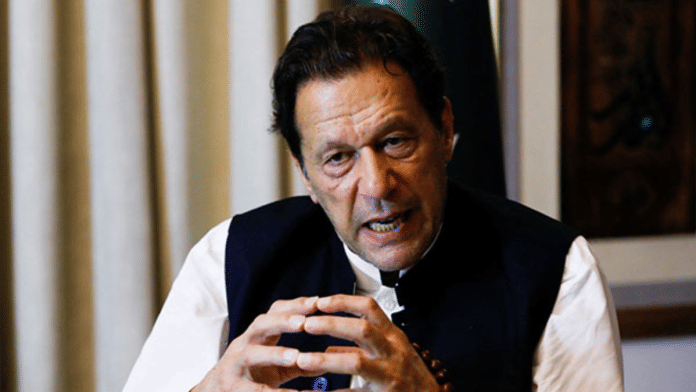
New Delhi: Former Pakistani Prime Minister Imran Khan is dead, claimed journalist Wajahat Saeed Khan on Tuesday. Then he walked back on his claim and said that it wasn’t a confirmed report.
The journalist claimed that an unnamed source at the General Headquarters of the Pakistan Army told him that the PTI leader died in custody. Wajahat Saeed Khan shared a two-part series: ‘Is Khan still with us’ and ‘What happens after Khan’ on 11 August.
However, the journalist issued a lengthy clarification, saying that his sources had never actually confirmed Imran Khan’s death.
In his recent video, Saeed Khan sought to distinguish between what his sources had told him and the conclusions and fears that had circulated his earlier reporting. He said three senior officers inside the Pakistan Army had expressed grave concern about Imran Khan’s fate but had not provided evidence that he was dead.
“Let’s be very clear. They did not confirm that Imran Khan is dead,” he said.
Instead, he said, the officers described what he characterised as a “profound paralysing fear that the worst may have happened or is likely to happen.”
“This could be a push by the generals directed at their chief to end Imran Khan’s isolation. Wajahat has direct access to the DGC and many other high-ranking generals. He broke an exclusive story about how Hafiz directly managed Imran Riaz Khan’s abduction and how Aabpara wanted him released,” said Pakistani commentator Moeed Ahmed.
Wajahat Saeed Khan then portrayed his earlier reporting as an attempt to force authorities to provide evidence that Khan was alive rather than as a definitive declaration that he had died.
“What did we achieve today?” he asked. “I have stirred the authorities to provide proof of life.”
The journalist said his earlier reporting had been based on conversations with senior officials in the Army’s General Staff, Military Intelligence and C4I directorates, as well as a junior commissioned officer. According to his account, the officers were based at Army headquarters in Rawalpindi.
He said the information he received pointed not to proof of Imran Khan’s death but to an extraordinary level of secrecy surrounding his imprisonment and concern among some military personnel about what might have happened to him.
“What they confirmed is their own profound, paralysing fear that the worst may have happened or is likely to happen. The military currently is uncharacteristically, terrifyingly and chillingly silent and tight-lipped,” he added.
“Worse, it is watching and eating its own. As much as they are cracking down on the national citizenry, they are silencing and monitoring their own ranks. This operation is being run by a very small, tight crew of intelligence operatives who report directly to the army chief, Field Marshal, while the rest of the army stands terrified and paranoid,” he added.
Also read: Pakistanis fuming at Asim Munir. After population control, he’ll now oversee monsoon readiness
Chatter, not fact
Wajahat Saeed Khan also described what he said was an increasingly militarised security operation at Adiala jail, where Imran Khan has been imprisoned. He alleged that a military intelligence unit had taken a significant role in the prison’s operations and that sophisticated surveillance equipment had been deployed around the facility.
He also claimed that his sources told him the authorities were preparing for the possibility of Khan’s supporters storming into the prison.
“These rumours, these speculations, these fears come out of genuine concern,” he said.
Several times in the video, Saeed Khan emphasised that the information supplied by his sources was not authenticated evidence of Khan’s death and acknowledged that some of the officers’ assessments were based on fear and informal discussions within the military rather than documented facts.
“They were making assessments based on personal fear and the ongoing chatter in their professional circles,” he said, adding that this was “not actual evidence-based, quantified, authenticated or documented facts but fear and speculation.”
The clarification came after Pakistan’s military public-relations wing, the Inter-Services Public Relations Directorate, rejected Saeed Khan’s reporting as false. He welcomed the response because, in his view, it represented an important development after what he described as months of silence about Imran Khan’s condition.
“I am glad that the ISPR has responded, fake or whatever, because that means Imran is alive,” he said.
He added in his video that members of Bushra Bibi’s family had reported seeing Khan on CCTV during a visit to the prison. Bushra Bibi is Khan’s wife.
“They confirmed they saw him walking on his own two feet on CCTV,” he said.
He added that the family had also reported that Imran Khan was experiencing serious health problems, including vision loss and severe blood-pressure spikes, and had recently been taken to a hospital. These have been reported earlier in local and international media.
Saeed Khan, who said he had known and interviewed the former prime minister for more than a decade, defended his journalistic record and rejected suggestions that his reporting was motivated by support for Imran Khan or his Pakistan Tehreek-e-Insaf party.
“I connected with three senior officers inside the Pakistan Army. A senior officer in the GS Directorate, also known as the General Staff Directorate, which is the operational nerve center of the army. A senior officer in the MI Directorate, that is, the Military Intelligence Directorate, which is the internal eyes and ears of the army. And a senior officer in the C4I Directorate, which basically watches all communications.
These men are not in some far-off outpost in Balochistan or Waziristan. They are in GHQ, the army’s General Headquarters in Rawalpindi. They are in the belly of the beast,” he said in his video.
“My reporting is not pro-Khan. It is simply reporting,” he said.
He described the jailed former PM as a friend, a former interview subject and a national icon, but said their relationship had not prevented him from publishing stories that were politically damaging to the former prime minister.
“The purpose of journalism is to challenge the national narrative,” he said. “It is to change the national conversation. It is to help the polity and the citizenry make better and more informed decisions by holding truth to power and demanding transparency.”
The 72-year-old Imran Khan was elected as Prime Minister of Pakistan in 2018 before being removed from office in April 2022 after a parliamentary vote of no confidence. Since then, his political party, Pakistan Tehreek-e-Insaf (PTI), has faced sweeping restrictions and was effectively excluded from the 2024 general election.
Khan was first arrested on 9 May 2023, triggering mass protests across Pakistan, and was arrested again on 5 August 2023. He has remained in jail since then. Khan was later acquitted in January 2025 in cases involving official secrets and his marriage to Bushra Bibi Khan. He remains imprisoned, however, while serving a 14-year sentence in a corruption case. Bushra Bibi was sentenced to seven years in the same case.
In December 2025, Khan and Bushra Bibi received additional 17-year prison sentences in a separate case involving state gifts.
“For three years, Pakistan’s authorities have systematically denied Imran Khan the right to a fair trial, subjected him to prolonged solitary confinement, and limited his access to medical care and visitation rights. He has not been allowed to meet his family for more than eight months and his vision has reportedly deteriorated significantly. Both he and his wife, Bushra Bibi Khan, have now been denied regular access to legal counsel since December 2025,” Amnesty International released a statement on 4 August this year, on the third anniversary of Imran Khan’s incarceration.
(Edited by Ratan Priya)
Honestly, who cares?
Khan, Sharif, Bhutto, Musharraf, Khan (the other one), Khan (the yet another one), Haqq, Bhutto (the other one), Jinnah, Junejo, . . .
From the POV of Bharata and Bharatiyas, they – and all the rest – are hardly different.