





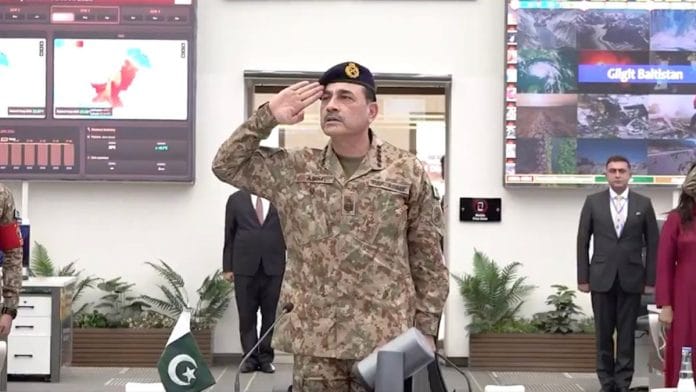


New Delhi: Pakistan Army Chief Field Marshal Syed Asim Munir is a man of many talents. After deciding to dip his hands into the issue of Pakistan’s population growth, he is now going to oversee the country’s monsoon preparedness as well.
Munir visited the National Emergencies Operations Center at the headquarters of the National Disaster Management Authority (NDMA) on Wednesday. A statement issued by the military said NDMA chairman Lt Gen Inam Haider Malik briefed Munir on the country’s operational capabilities, disaster preparedness and integrated, technology-based response systems for the ongoing monsoon season.
The statement added that Munir praised the authority’s efforts, stressed the importance of “operational readiness and timely response”, and reiterated that Pakistan’s armed forces would continue to provide “full cooperation with the civil administration and NDMA.”
Pakistanis are amused: why is the army chief handling disaster management?
Misplaced priorities
Munir’s visit prompted debate over the military’s increasingly visible role in civilian governance.
“Who is the army chief to check Pakistan’s disaster preparedness? Is he a soldier or an elected representative of public? Please help us understand,” an X user called Rogue Perspective wrote.
Another questioned the military’s priorities: “Why??? This is not his job. He should be much more concerned with terrorists running amok in KP & Balochistan. Where are your priorities, sir?
Others argued that disaster preparedness should remain the responsibility of elected officials.
“This work should be done by the government not the army which is supposed to be under the parliament/pm/pres,” Pakistani X user Nehal Arshad wrote.
Some comments reflected broader public cynicism about Pakistan’s civil-military balance. “This system is much better. At least the masses will know who their ruler is, instead of making guesses. This way extra resources allocated to PPP/PMLN lead mix achaar Government can also be saved,” Pakistani cricketer Najeeb Ullah said.
Also read: Munir’s messenger & ‘one-man army’, the rise of Mohsin Naqvi in Pakistan’s ‘hybrid system’
Disaster ‘mis’-management
The National Disaster Management Authority is Pakistan’s lead federal agency responsible for disaster management. According to its official website, the NDMA is mandated to oversee the “whole spectrum of Disaster Management activities” across the country.
It is an autonomous federal authority responsible for formulating and implementing national disaster management policies, coordinating search-and-rescue operations, humanitarian assistance, disaster risk reduction, relief, rehabilitation and reconstruction efforts.
The authority works with federal ministries, provincial governments, armed forces and United Nations agencies, but formally reports to the prime minister through its chairman, who may be either a civilian or a serving military officer. It is currently headed by Lt Gen Inam Haider Malik, a three-star general of the Pakistan Army who took the charge in 2022.
The NDMA was formally created after the devastating 2010 floods to serve as a “one-window operation” for disaster management, coordinating disaster risk reduction, emergency response, recovery and reconstruction, public policy expert Nilofer Afridi Qazi wrote in The Friday Times in 2023.
However, the 18th Constitutional Amendment of Pakistan devolved disaster management to the provinces, making provincial cooperation crucial for the agency’s effectiveness. It has never functioned properly.
“In 2010, the NDMA was hampered in its ability to lead in all the stages of disaster response management effectively,” Qazi wrote. “A whole host of confused actors hampered the NDMA, and its efficacy has resembled a parking lot of non-technical bureaucrats.”
The debate over the army chief’s expanding public role comes only a month after Munir was drawn into another civilian policy initiative.
Last month, Pakistan’s Health Minister Syed Mustafa Kamal told a joint meeting of the Senate Committee on National Health Services and the Senate Functional Committee on Human Rights that Prime Minister Shehbaz Sharif and Field Marshal Munir had convened a meeting to discuss population control measures.
According to Dawn, the minister said the meeting reflected the government’s seriousness in addressing Pakistan’s rapidly growing population. The announcement also triggered widespread reactions online.
Some users mocked the military’s growing involvement in civilian policymaking, with one suggesting that, given Munir’s record, “it would be an easy task” because “he has expertise in killing people.” Others sarcastically asked whether the army chief would now be “distributing condoms on the streets.”
(Edited by Prashant Dixit)