



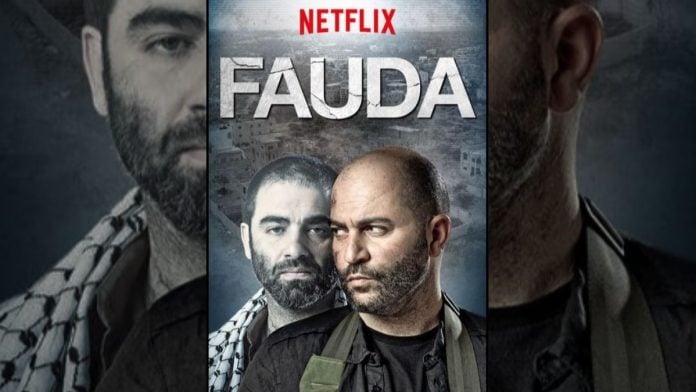
New Delhi: Fauda, a series about the Israel Defense Forces mostly operating in Palestinian territories, has been trending at number one in Pakistan. For a country that does not have diplomatic relations with Israel, and where public discourse about the Israel-Palestine conflict has long been shaped by hostility toward the Jewish state, the popularity of an Israeli action-thriller seems difficult to explain.
Apart from politics, there is a linguistic distance as well. The show is broadcast in Hebrew and Arabic. Hebrew is not spoken in Pakistan, while Arabic is understood by only a small segment of the population. And yet the series has found an audience.
The reasons for Fauda’s popularity in Pakistan are not necessarily political. According to an opinion piece in the Israeli publication Haaretz by Pakistani journalist Kunwar Khuldune Shahid, some of the viewership may be due to what is sometimes called “hate-watching,” while others might just be curious about a conflict they know well but are accustomed to seeing through a familiar lens. Some simply regard it as an exceptionally well-made thriller.
According to Khaldune, one explanation could be that Pakistan is experiencing a widening gap between official narratives and the way younger audiences consume culture and information.
“Even as the Pakistani army has worked behind the scenes with Israeli agencies over the decades, and has recently been testing the waters on formalising relations with Israel, the military has nonetheless upheld an Islamist and often antisemitic public discourse. But Fauda isn’t the first sign of Pakistanis defying such official state narratives in the realm of entertainment,” he writes.
‘Simply watching a television show’
The success of Dhurandhar, a Bollywood film that became one of the most-watched movies on Pakistani Netflix despite its hostile portrayal of Pakistan, offers another example in Khaldune’s view.
However, senior Pakistani critic Kamran Jawaid differs from this perspective. He says the Pakistani audiences have long consumed Indian films and television despite political hostility between the two countries.
Jawaid, a senior film critic at Dawn, recalled visiting India in 1997 and wanting to watch Border, the Indian film on the 1971 India-Pakistan war. The film was sold out in Bombay, and he eventually watched it in Gujarat. Back in Karachi, he said, the banned film was being rented illegally on VHS.
“Yet watching an Indian war film did not necessarily turn Pakistanis against their own country,” he told ThePrint, pointing to the continuing popularity of Indian films and television programmes in Pakistan and to the fact that several Indian productions were among the country’s most-watched Netflix titles.
From that perspective, Fauda may be less a political signal than another example of the porous boundary between entertainment and ideology.
The series is also not an isolated case of Pakistani audiences engaging with material that challenges official narratives. The country’s political and media environment has changed considerably in recent years, particularly amid growing criticism of the military establishment and frustration over political repression and economic difficulties, Khaldune argues.
But Jawaid makes the argument that it would be difficult to conclude from Fauda’s Netflix ranking alone that Pakistanis are undergoing a broad shift in their views of Israel. People, he suggested, were simply watching a television show.
“Things haven’t changed, whether it is Fauda or any Bollywood movie trending on Netflix. Even right now, Baby Do Die Do, Dhamaal 4, Lust Stories 3, Irumudi, Vishwanath & Sons, Gandhari and Alpha trend on Netflix’s top-ten movies here; similarly, four Indian titles populate the top-ten shows list. Given Fauda’s global popularity — and there’s little to discuss on how aggressively streaming algorithms push content onto the viewer — I am surprised it didn’t stay on the charts longer,” he said.
That may be the most straightforward explanation for the show’s moment in Pakistan’s streaming charts. The series has a global audience, and streaming platforms routinely place popular productions before viewers who might never have encountered them through traditional television.
Also read: Pakistani cleric awarded for religious harmony has family links to a ‘blasphemy gang’
‘Entertaining and well-made’
Point in case is a Reddit thread where the Lebanese came together to discuss what made Fauda so appealing despite Lebanon’s animosity toward the country. Viewers offered explanations ranging from the show’s production quality to simple curiosity. One Reddit user said the series was “extremely well balanced” despite its reputation among some viewers as Israeli propaganda, adding that it was made by Israelis and therefore inevitably reflected an Israeli perspective.
Another viewer described it simply as “entertaining and well-made.”
One added: “You can be entertained by a show without agreeing with the politics of it.”
That may be particularly relevant to Fauda. Viewers in Arabic-speaking countries have described the series as compelling precisely because its subject matter is familiar. One Reddit user suggested that people may watch because the story feels “close to home” rather than like a distant American action series.
Another pointed out that some viewers may initially fail to realise that the show is an Israeli production because of its Arabic title.
Then there are also more complicated reasons for its appeal. Some viewers in Lebanon have suggested that opposition to Hezbollah can shape the way the show’s portrayal of armed groups is received. Others pushed back against that explanation, arguing that enjoyment of the series should not be confused with support for Israel.
Jawaid compared the phenomenon to Indians watching Pakistani dramas or listening to Pakistani music: cultural consumption, which does not automatically translate into political sympathy.
“When viewers in India watch Pakistani dramas, or listen to Coke Studio, does that make them any less nationalistic or unpatriotic? The same logic applies to Pakistanis,” he said, adding that it’s disappointing to see Fauda trending in Pakistan.
“I’d wager that most viewers never saw the series from a pro-Israel perspective, or purposely hate-watched it — it is we critics who label stuff as such; people see shows and movies with less ominous motives. The cold, hard fact is that it has not changed people’s perception in the least, despite conspiracy theories and perspective-riddled write-ups. The ground reality and the general perception against Israel don’t change. Ask any layman from any corner of life in Pakistan,” he concluded.
(Edited by Saptak Datta)