



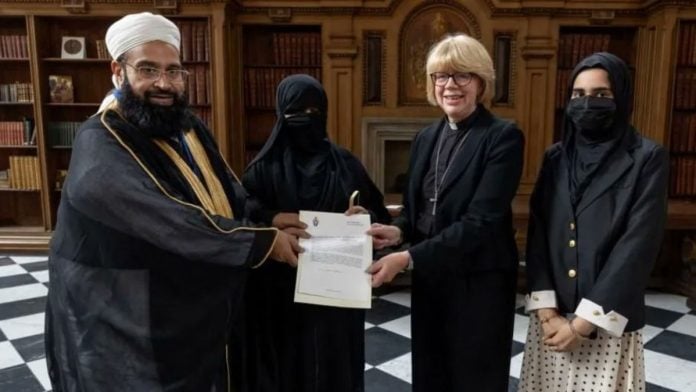
New Delhi: Pakistan’s prominent fundamentalist cleric Tahir Mehmood Ashrafi, who is now the religious coordinator for the Shehbaz Sharif government, received an award from the Archbishop of Canterbury for religious harmony on the anniversary of the 9/11 attacks. Within a week, he was stripped of the award.
A Telegraph report this week revealed that his brother, Hassan Muawiya Ashrafi, was involved in a nexus that used Pakistan’s blasphemy laws to abduct, intimidate, and extort men. Hassan had filed 26 blasphemy complaints over a four-year period, the maximum by an individual in Pakistan, as per rights groups.
Tahir Ashrafi, a former special envoy on interfaith harmony in the Imran Khan government, has spent years presenting himself as a bridge between the government, religious minorities, and conservative Muslim groups.
On 11 September, the Archbishop of Canterbury, Dame Sarah Mullally, presented him with the Hubert Walter Award at a ceremony in London. The award, which cited his commitment to religious tolerance, was withdrawn after reports surfaced that Tahir Ashrafi had previously praised Osama bin Laden. In a 2007 interview to AFP, Ashrafi, as the head of the Pakistan Ulema council, had said that his council was giving bin Laden the “highest title for a Muslim warrior” in protest against Britain awarding Salman Rushdie a knighthood.
Who is Tahir Ashrafi?
Ashrafi plays a dual role, home and abroad. According to The Telegraph, in Western diplomatic circles, he has often been presented as an accessible interlocutor with conservative Muslim groups and as a figure willing to speak publicly against religious violence. He has supported polio vaccinations, condemned the Islamic State, and backed the construction of a Hindu temple in Islamabad.
He also played a prominent role in the 2012 case of Rimsha Masih, a Christian girl who was arrested on blasphemy charges that were later found to be false, and publicly supported calls for an investigation — an intervention that helped distinguish him from some of Pakistan’s more hard-line clerics and even gave him a British citizenship.
But his record on religious minorities is more complicated.
Human rights activists and members of minority communities have criticised his positions on Ahmadis, a minority Muslim sect that Pakistan’s constitution officially classifies as non-Muslim.
In 2020, Ashrafi thanked former Prime Minister Imran Khan for excluding Ahmadis from a government commission intended to protect minority rights.
Rabia Mehmood, a Pakistani journalist and former Amnesty International researcher, has long questioned Ashrafi’s reputation as a moderate religious figure. When Khan’s former accountability minister Mirza Shahzad Akbar praised the expose on X, Mehmood was quick to fact check him and point out that he was Khan’s “Not So Special Representative On Religious Harmony”
In an earlier analysis for Naya Daur in 2020, she wrote how he received “a garlanded Malik Ishaq of Lashkar-e-Jhangvi sandwiched between him and Muhammad Ahmed Ludhianvi of Ahl-e-Sunnat Wal Jammat.”
“He was given the job to ‘mainstream’ Malik Ishaq by powerful quarters. Besides, his relationship with the establishment is not a secret. He was also an advisor to the government during General Musharraf’s era,” she wrote, adding that “as a conservative religious scholar, with an occasionally right message which could get the state out of a fix, he continues to use his influence and power to put members of a marginalized minority at risk. Regardless of his speeches and advocacy against sectarianism, the narrative Ashrafi & Co subscribe to and disseminate will put the onus of harmony among minority sects and how politely their members behave towards followers of majoritarian Sunni Islam.”
Also read: Pakistan’s terrorism crisis worsening as violence falls globally. TTP, BLA driving it
Ties to a troublemaker brother
The investigation by The Telegraph has raised questions about Tahir Ashrafi’s relationship with his brother, Hassan Muawiya Ashrafi, whom police and rights activists have linked to a network accused of exploiting Pakistan’s stringent blasphemy laws.
Ashrafi has denied being part of such a network and has challenged anyone to produce evidence that he or his brother extorted money from alleged victims, going to Pakistani journalist Azaz Syed’s show to defend Hassan.
Blasphemy is punishable by death in Pakistan, and accusations can provoke vigilante violence even before a case reaches court. Human rights groups have documented numerous killings linked to blasphemy allegations over the years.
In a 2021 report, the United States Department of State noted that Hassan had filed several blasphemy complaints against Ahmadis.
Then a 2024 report by Punjab’s Special Branch police attributed a surge in blasphemy cases to what it described as a “blasphemy business gang” involving corrupt officials and intermediaries. The report named associates of Hassan, although it did not itself identify him as a member of the group.
An investigation by the now-exiled Pakistani outlet Fact Focus later described him as a manager of the group’s operations in Lahore.
In court proceedings last year, Hassan denied belonging to a blasphemy gang or taking money from families. He said his complaints were motivated by a desire to protect the sanctity of Prophet Muhammad.
The allegations were examined at the Islamabad High Court after more than 100 families filed petitions. The proceedings, which were livestreamed amid security concerns, examined allegations of missing evidence, inadequate police investigations, and the repeated use of women in online conversations to lure suspects into sharing material that could later be used against them.
Meanwhile, the Pakistan Ulema Council, meanwhile, said in a statement that allegations against Tahir Ashrafi and his brother were “false, unfounded and unsupported by credible evidence” and that legal action had been initiated in response to the Telegraph article.
To this, Pakistani Human rights activist Qindeel Azeem responded: “Misbehaviour does not fly everywhere”.
(Edited by Aamaan Alam Khan)