


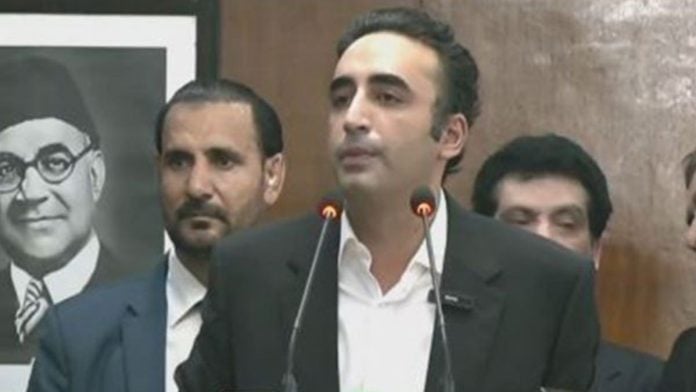
New Delhi: Politician Bilawal Bhutto Zardari has finally found a way to get Pakistan talking, and it may not be just his politics. The Oxford-educated PPP chairman, who has made several faux pas while trying to speak Urdu, delivered a 45-minute speech in the language at the Karachi Press Club Tuesday, and the internet is still not over it.
From jokes about his accent to declarations that he is a “national hero”, social media has turned his speech into an unlikely viral moment.
But beneath the memes and the surprise at Bilawal’s Urdu-speaking marathon was a speech with serious political stakes. The 38-year-old called for a “political reset”, urged the release of former Pakistan prime minister and cricketer Imran Khan and appealed for dialogue with the opposition, while taking aim at the military and acknowledging flaws in the political system. The response has been split between those applauding his newfound candour and those accusing him of opportunism.
In trying to make his point, he also borrowed an ‘expletive’ used by Khan in 2023 to describe Pakistani citizens being treated as powerless, insignificant, or voiceless by the country’s ruling institutions and political establishment. (DD, cross-check this once)
Sara Taseer, the daughter of slain Punjab governor Salman Taseer, had a simple response to his speech: “Bilawal is rocking it.”
But the praise came with a twist. She then wrote an entire poem, albeit sarcastically, adapted from German pastor Martin Niemöller’s famous post-World War II statement, First They Came, which condemns the silence of those who stood by as the Nazis persecuted one group after another. Her version took aim at Bhutto’s silence as Pakistan’s democratic institutions came under attack.
“First they came for Imran Khan,
And Bilawal said nothing,
For he was not Imran Khan.
Then they came for the judges,
And Bilawal said nothing,
For justice was not his concern.”
Sara then goes on with the poem for four more paragraphs, attacking Bilawal on his silence when the Pakistani government was ‘dismantling every piece of democracy and the constitution’.
Others on social media are busy contemplating solutions. Bilawal’s call for Khan’s release and a political dialogue with PTI, according to journalist Waqas, is a quick fix which might be beneficial.
“PPP benefitted from all that. Now that his future is under threat, he needs PTI. However, if there are any smart PTI politicians in the country, out of jail, a temporary alliance with PPP can easily push the Army out of politics for the next couple of decades,” he posted on X.
When another journalist, Ahmed Warraich, shared a clip of Bilawal accepting in his speech that stripping a political party of its symbol was wrong and a ‘mockery of public sentiment’, Waqas added: “PPP benefitted from all that. Now that his future is under threat, he needs PTI. However, if there are any smart PTI politicians in the country, out of jail, a temporary alliance with PPP can easily push the Army out of politics for the next couple of decades.”
Also read: Samay Raina’s India’s Got Latent gets a Pakistani spin. It’s getting copycat insults
A rare admission, or a political reinvention?
Some commentators viewed Bhutto’s acknowledgement of his party’s responsibility as an unusual moment in Pakistan’s political culture.
Former managing partner of Deloitte Pakistan Asad Ali Shah described the Karachi Press Club appearance as potentially historic, arguing that politicians rarely acknowledge their own contribution to the deterioration of the system while still in power.
“Some press conferences make news. This one may make history,” he posted on X. “Bilawal Bhutto did the most unusual thing a Pakistani politician can do: he told the truth while in power.”
But the response from lawyers, journalists and political commentators was considerably less sympathetic.
Barrister Abuzar Salman Niazi accused Bhutto of attempting to reinvent himself as a revolutionary after having contributed to the weakening of constitutionalism, democracy, fundamental rights and other democratic principles.
“After being a catalyst in the destruction of the constitution, democracy, fundamental rights, constitutionalism and virtually every democratic principle, Bilawal Bhutto Zardari has suddenly decided to reinvent himself as a revolutionary,” he wrote on X.
A similar sentiment was echoed by journalist Alifya Sohail, who argued that Bhutto was selectively distancing himself from the 27th Amendment while retaining ownership of the 26th Amendment.
Sohail said that in 2024, Bhutto had himself threatened to pass the 26th Amendment through a “brute majority”. She argued that the amendment had given the executive control over constitutional benches and that one such bench subsequently ruled on the PTI’s reserved seats, allocating them to parties in the ruling coalition.
“The 27th didn’t betray the 26th. It finished what the 26th started,” she wrote on X, challenging Bhutto to return the reserved seats if he believed the majority behind the amendment was illegitimate.
The most politically consequential part of Bilawal’s address was arguably his recognition of the PTI as an indispensable participant in Pakistan’s political system.
The PPP chairman acknowledged what he described as injustices against the opposition over reserved seats and the removal of the PTI’s electoral symbol.
The appeal has prompted speculation about whether the PPP is reconsidering its political relationship with the establishment and the ruling coalition.
Pakistani entrepreneur Hussain Nadim suggested that the current political establishment and Bhutto were looking toward the PTI because public opposition had made the military-backed political arrangement increasingly difficult to sustain.
“PPP doesn’t want the army out of politics; they just want the army off their backs right now. Let alone win a seat, dynastic political parties can’t even go out in their own constituencies without guarantees from the army. These are short-sighted non-political actors that rely on military dictators for their survival against their own people,” he posted on X.
Journalist Rida Hosain raised another contradiction, pointing out that it was the PPP’s governor in Khyber-Pakhtunkhwa who had displaced the elected PTI government in the province.
“And yet we hear lectures on democracy”, she wrote on X.
Dawn editor Cyril Almeida summed it up: “Hard to feel sympathy for any of them… do feel sorry for Pakistan…”
(Edited by Saptak Datta)