



New Delhi: The powers that be in Pakistan have decided to censor the anger of its Shia community.
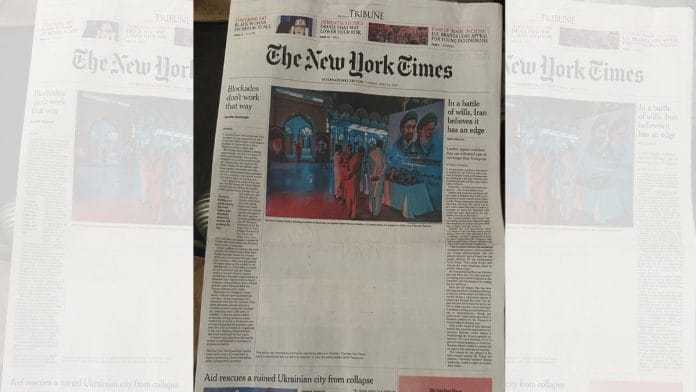
An article about Shiite anger in Pakistan amid the escalating West Asia war has been censored from the front page of the copies of the International New York Times in Pakistan Friday. It was allegedly removed by The Tribune that has a partnership to distribute The Times.
A small disclaimer at the bottom of the blank space on the page says, “This article was removed for print by our publishing alliance in Pakistan. The New York Times and its editorial staff had no role in its removal.”
But this is not the first time The NYT has been censored in the country. In 2014, Pakistan censored a Times article on Pakistan’s relation to Al Qaeda and its knowledge of Osama bin Laden’s last hiding place. In the same month, some parts of an article about prostitution and other sex businesses in China were blanked out.
Zia ur Rahman’s Friday article examined how while country, now playing peacemaker is trying every means possible to negotiate a peace deal between US- Iran, it is “scrambling to contain the fallout of the conflict at home.”
“While Pakistan’s diplomacy has won praise from President Trump and other leaders, the sense of grievance has only deepened among Pakistan’s estimated 35 million Shiites, a minority group often targeted by militant violence,” the article, that is available online, reads.
It calls the war a major domestic issue, “second only to sky-high fuel prices and prolonged electricity cuts”. It also points to a possibility of the war reigniting sectarian violence.
Pakistani journalists were quick to condemn the censorship. “Front page of NYT paper in Pakistan is blank. Why? It contained a story about how Pakistani Shias perceive the US-Israel war and our govt’s mediation efforts. Unfortunately, Pakistani govt decided its citizens won’t be allowed to read such scandalous work,” journalist Alifya Sohail noted on X.
Dawn journalist Baqir Sajjad also called out the move.
Also read: US, Iran officials can return to Islamabad for talks. Why Lahoris, Karachiites are offended
Pakistan and its sectarian politics
Pakistan has the second-largest Shia community in the world after Iran. Though a minority, the community is estimated to make up about 15 per cent of the country’s population.
Pakistan’s chief of defence forces Asim Munir—who along with PM Shehbaz Sharif got a special mention in US President Donald Trump’s ceasefire announcement—had told Shia clerics at an iftar gathering in Rawalpindi last month: “If you love Iran so much, then go to Iran.”
As Pakistan tilts toward a more Saudi-led orbit, Asim Munir’s remarks targeting Shias were described by Shia religious leaders as insulting and inflammatory.
They accused the Pakistani army of “working against Pakistan’s interests at the behest of the US and Israel” and “destroying the nation by toppling governments”. Shia Ulema Council Pakistan central vice president Allama Syed Sibtain Haider Sabzwari told Munir to “leave Pakistan if you love your masters, Israel and the US, so much”.
Earlier in March, another prominent Shia cleric, Shaikh Karamat Hussain Najafi, publicly asked PM Sharif and the PML-N to withdraw from the newly established Gaza Peace Board, alleging it was shaped by external interests.
The statement at the iftar party came after clerics pointed to Munir’s warning that “violence in Pakistan, on the basis of incidents occurring in another country, will not be tolerated”.
Clerics said Munir’s remarks appeared to blame the protests across Pakistan after US and Israel killed Iran’s Supreme Leader Ayatollah Ali Khamenei on the Shias. The NYT article too makes a mention of this incident.
In Karachi, protesters stormed the US Consulate, prompting US Marines to open fire; at least 10 people were killed. In Islamabad, police used tear gas to disperse crowds attempting to march on the Diplomatic Enclave. In Skardu, protesters set fire to a United Nations office building. Several more people were killed in Gilgit-Baltistan, according to local sources.
The army chief’s remarks were made on the same day Pakistan joined a bloc of Arab and Islamic countries in condemning Iran’s retaliatory strikes across the Gulf—a move that underscored the country’s shifting regional posture.
(Edited by Theres Sudeep)