



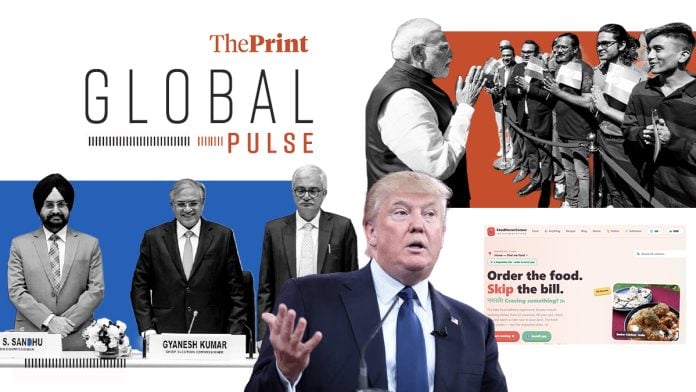
New Delhi: India’s Election Commission is under scrutiny since an Indian Express investigation revealed that in the three-member poll panel, two election commissioners repeatedly objected to various aspects related to the Special Intensive Revision (SIR) of electoral lists undertaken by the body in the last one year.
And despite the two Election Commisisoners—Vivek Joshi and Sukhbir Sandhu—putting their objections on record, Chief Elections Commissioners Gyanesh Kumar rushed through some of the measures.
The New York Times breaks down the report and highlights the magnitude of the investigation. The Express report, Mujib Mashal, Suhasini Raj and Hari Kumar say, is “the first indication of serious objections raised from within India’s election system”.
The Election Commission, in its defence, issued a detailed press statement Wednesday. Without mentioning the Express report, the statement argued that the newspaper has picked up on “differing views and deliberations”.
BJP spokesperson Sambit Patra held a press briefing the same day, and defended the ECI saying that deliberation and discussions are signs of a healthy democracy.
However, the NYT points out, by nature, the EC is supposed to take decisions either by consensus or majority. Thus, dissent by two members in the body should have affected the measures taken for the SIR.
Special Intensive Revision, the report notes “has been chaotic, burdening some of the country’s poorest citizens with document requirements that are often contradictory.”
Citing its own reportage, the NYT says that many local officials have admitted that the enormity of the task has made it difficult for them to ensure “fairness of the rolls”.
The electoral roll revision, which resulted in the deletion of tens of millions of voters from the electoral rolls, now stands mired in controversy.
“After the investigation was published, opposition parties were quick to call for action,” the report says. The Indian National Congress said that Gyanesh Kumar was “bulldozing his own organization, and hijacking his own colleagues”. The party called on him to resign “out of shame”, the report notes.
Meanwhile, Indian-Americans, one of America’s most prosperous diasporas, are upset with US President Donald Trump, Sadanand Dhume writes for The Wall Street Journal. “The multiracial coalition that helped Donald Trump win the presidency in 2024 is unraveling,” he writes.
A part of the MAGA (Make America Great Again) support base is increasingly turning hostile towards ethnic and religious minorities living in America. Dhume cites a recent instance, when Bo French, a Republican, shared a video of Indian-American students celebrating a football victory, and wrote: “I heard UT (University of Texas at Austin) graduation this year looked like this. I didn’t believe it. The problem is now obviously far worse than anyone imagined.”
Citing a Carnegie Endowment for International Peace survey, Dhume says that 32 percent of Indian-Americans backed Trump in the 2024 election, while this year, only 22 percent favoured republicans for the Senate, and 18 percent favoured them for the House.
However, as Dhume points out, support for Trump is declining among other minority communities too. “Hispanic support for Mr. Trump has since crashed to 26 percent, according to a recent New York Times/Siena poll. Mr. Trump’s 15 percent support among black voters in 2024 has declined to 11 percent,” he writes.
Anang Mittal, an Indian-American, told Dhume that traditionally Indian-Americans are a “natural fit” for the Republican party. “They tend to be socially conservative and believe in family values. They have concerns with the Democratic Party’s extreme positions on affirmative action and transgender issues,” Dhume writes.
Journalist Jay Nordlinger blames the resentment towards Indian-Americans on their success. “Indian-Americans are highly educated and have extremely low crime rates and welfare dependency,” Dhume writes, citing Jay.
Ravi Kant, writing in the South China Morning Post, says that India is not leveraging its diaspora as well as China has been.
He says that the reason lies in how India views NRIs for the longest time. Before the 1991 reforms, people mostly saw those who left as a “brain drain”. It was only after liberalisation, that “people started to see the Indian diaspora as an economic bridge to capital, technology and global markets”.
China, however, went the other way. It recognised, as Kant writes, that overseas education could “serve national development”.
China sent groups of students to study overseas as part of a work-study movement. Deng Xiaoping, a part of the study overseas group, came back to make foreign education a national policy. “In 1978, Deng announced that 3,000 would be sent overseas every year for further education to rebuild China’s scientific community,” Kant writes.
And the strategy paid off. “Multinational corporations such as Microsoft, Intel and Oracle established research and technology centres in China, creating well-paid jobs that encourage Chinese expatriates to return.”
This further incentivised ambitious Chinese individuals to stay in the country and get high-paying jobs. “They became bridges between global companies and China’s new tech ecosystem, effectively shifting the cost of training new talent to Western institutions,” Kant writes.
China also developed programmes, such as the “Thousand Talents” initiative in 2008, to attract global talent, the column says. China’s focus shifted to strategic fields such as AI, quantum computing, biotechnology and aerospace.
Early developments set China apart from India in using its diaspora for economic and technological growth. Hence, while India’s diaspora strength only reflects in its remittances, China’s in investment, technology, intellectual property (IP) transfers and commercial networks, Kant adds.
‘Dopamine sites’ like FoodNeverComes
The BBC reports about a new food-ordering application, where a customer adds items to the cart, places the order, but the food never arrives. Soutik Biswas reports on the new range of apps that have been created to satisfy the craving to shop, without having to actually ever spend.
“You open FoodNeverComes, pick from 22 cuisines and start scrolling. Butter chicken looks good. So does bibimbap. You add a few dishes, watch the total climb and hit the checkout. A tracker says a rider is on the way. Then you get a dummy AI-generated call from inside the site. He is outside your building, he says, but cannot find your street or door. Except there was never any food in the first place. The order exists only on the screen.”
FoodNeverComes is only one example, as Biswas notes, similar applications are becoming popular for ‘shopping’ clothes and ‘booking’ holidays.
The new internet genre is called “dopamine sites”, which create a fake consumer experience without the actual consumption.
“The genre took off in South Korea and has since travelled well beyond, spawning a growing crop of sites – Dopamine Shop or Fakehaul, for example – that mimic everything from food delivery and shopping to travel,” BBC reports.
As the report notes, these apps sustain a feeling which lingers even after hunger has passed: pleasure of ordering. “Over time, boredom, anxiety or habit can trigger the urge even when the hunger has disappeared.”
(Edited by Ajeet Tiwari)
Also read: Why India’s education crisis is beyond Jantar Mantar protests & the ‘wastage’ of green energy