



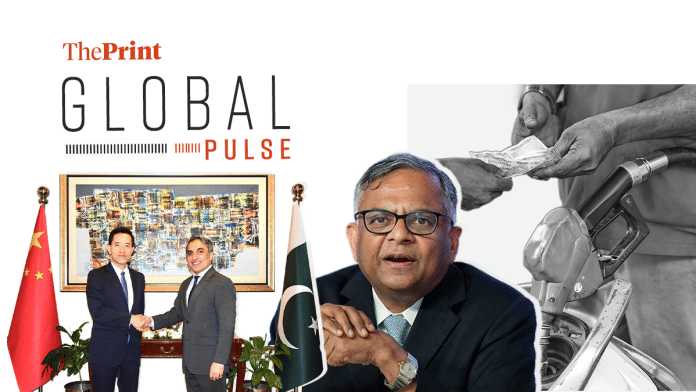
New Delhi: Even as N. Chandrasekaran accepted the chairmanship of Tata Sons for five more years, the group’s 65-year-old scion fought tooth and nail to oppose Chandra’s reappointment, and the group’s much-delayed public listing.
Noel Tata, the Financial Times notes, had long resisted public listing because he believed it would “irrevocably change the character of the group”.
“He told people before the meeting that he expected board members to make a fresh push to keep the chair, N Chandrasekaran, universally known as Chandra,” journalists Krishn Kaushik, Michael Stott, Andres Schipani, and Chris Kay write in the report.
The reason, the report notes, is that Chandra supports public listing of the group, as part of a push for more transparency. However, last month, he resigned after failing to win Noel’s trust.
In Saturday’s boardroom meeting, Noel was confident that he would convince the board to go his way. As the report says, he prepared written statements and an opinion piece from a former Chief Justice of India backing his stand that Chandra should not get an extension.
“The board ignored him. The meeting ended with a statement saying that Chandra had been reappointed for five years and Tata Sons would begin steps to comply with the central bank’s listing directive,” the report says.
Tata Trusts, where Noel is chair, criticised the board’s decision and said it stands nullified as two nominees were split.
Meanwhile, India is facing renewed geopolitical pressures from all sides. Much to New Delhi’s irritation, Pakistan and China signed a border pact that formalised a boundary which India claims is part of the disputed area. And, the US has passed a law that gives President Donald Trump the powers to impose 100 percent tariffs on the countries buying oil from Russia.
“The two countries signed the Pakistan-China Boundary Joint Commission, an agreement which Pakistan described as a ‘significant milestone’ that would deepen cooperation on border management, trade and connectivity between India’s regional rivals,” BBC News’ India correspondent Soutik Biswas reports.
India has responded sharply, rejecting the move and adding that the pact has no legal basis or recognition for a territory it claims as its own.
Biswas says that the pact has come at a particularly sensitive moment. “India and China are seeking to stabilise their relationship after years of military tensions along the Line of Actual Control (LAC), the disputed line separating their forces along much of their Himalayan frontier. At the same time, Beijing and Islamabad are deepening cooperation along a neighbouring stretch of the frontier that India also claims,” BBC reports.
The pact concerns the Pakistan-China frontier, including the Shaksgam Valley, a roughly 5,180 sq km tract that Pakistan ceded to China in 1963, but which India claims as part of its territory in Ladakh.
“Pakistan has no locus standi to enter into arrangements concerning Indian territory under its illegal and forcible occupation,” the Indian external affairs ministry said.
Pakistan, on the other hand, said Jammu and Kashmir remains a disputed territory, arguing that India, therefore, has no standing to challenge its 1963 boundary agreement with China.
Jabin T Jacob, professor at the Department of International Relations and Governance Studies at Delhi’s Shiv Nadar University, sees this as part of a broader effort by China to “demarcate its boundaries and a desire to institutionalise exchanges and movement along a frontier at a time when Pakistan’s other borders have experienced conflict and instability”.
Alex Travelli of The New York Times looks at the fine print of the law that empowers Trump to impose 100 percent punitive tariffs on Russia’s trade partners.
“A new sanctions law giving President Trump broad authority to impose steep tariffs on countries that buy Russian oil adds a new layer of uncertainty to India’s already fraught trade relationship with the United States,” he writes.
While the official reason for the tariffs is to choke Russia’s funding of its war against Ukraine, Travelli argues that the law gives Trump considerable power over when and how to impose the tariffs, “and it’s not clear when—or even whether—he would impose tariffs that would raise the cost of American imports of Indian goods.”
The report says that the timing of the law puts Prime Minister Narendra Modi in a “tight spot”. India imports more than 90 percent of the crude oil it consumes, and its reliance on Russia has climbed again as the war in Iran disrupted supplies from West Asia.
As the report notes, citing Kpler data, Russian crude accounted for nearly half of India’s summer time import this year. The law is only the latest in a series of measures that have demanded India to adjust its Russian crude purchases.
Brazilian President Luiz Inácio Lula da Silva, European Council President António Costa, Kenyan President William Ruto, and Canadian Prime Minister Mark Carney write in Financial Times, arguing why global cooperation and multilateralism are needed now more than ever.
“As world leaders head to the UN General Assembly in New York this week, we confront a paradox. The global community is more interdependent than ever, even as it becomes more fragmented and polarised,” they write in a column.
They argue that even as economies get deeply intertwined with technological cooperation taking precedence, geopolitics is moving in the opposite direction. Citing some figures, the column says that 2025 saw 65 state-based armed conflicts across 35 countries, the highest number recorded since 1946, while global military spending rose to a record $ 2.9 trillion.
“The language of spheres of influence and power politics is back. Economic ties are increasingly used as instruments of pressure and coercion while inequality is on the rise, both within and among countries,” it adds.
Thus, has the multilateral system failed? “A multilateral system that fails to reflect the realities of today will not survive the test of time. But the need for multilateral cooperation is very much alive,” the world leaders note.
The authors of the column are coming together for a new initiative called, ‘Partners for Multilateralism (P4M)’.
“P4M is not about creating another exclusive bloc or another international bureaucracy. Its purpose is the opposite: to create a flexible, open framework for countries from different regions and political traditions that are willing to work across divides, to build coalitions for reform and to translate shared principles into practical action,” the column asserts.
(Edited by Tony Rai)