





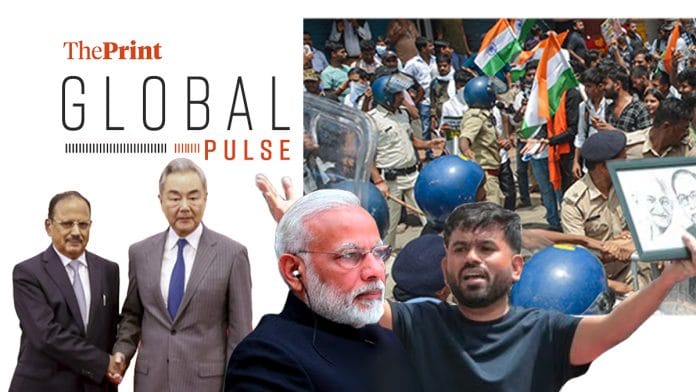

New Delhi: Following the conclusion of border talks between National Security Adviser Ajit Doval and Chinese representative Wang Yi, Chinese media is writing about the best path forward as it seems optimistic about India-China ties.
Chinese daily Global Times analyses the 25th round of border talks between the two countries and how it can contribute to strengthening bilateral relations. The report admits that border talks have gone beyond their own scope to encompass the larger bilateral ties.
Citing Qian Feng, director at Tsinghua University’s National Strategy Institute, the report highlights that the regular talks have become a platform for the two sides to exchange views on regional and international issues, “helping enhance communication and strategic mutual trust”.
On the question of how successful the talks were in resolving the border issue, Qian told Global Times that the boundary question between India and China is a complex one, and cannot be resolved in just a few rounds of talks.
“As long as mechanisms such as the talks between the special representatives continue to function, it shows that both sides are willing to manage and resolve differences through consultation,” he explained.
In India, it has been a summer of protests, The New York Times (NYT) reports. Alex Travelli writing for the NYT reports on what he calls “intense disillusionment” that the youths of the country are feeling.
“India’s long, hot summer of youth unrest shows no sign of cooling off, with protesters undeterred by monsoon rains or police crackdowns,” he writes.
Travelli refers to three separate incidents of protests and clashes with police, excluding the Jantar Mantar protest led by the Cockroach Janta Party (CJP). “The police trained water cannons on crowds in the city of Patna on Tuesday, 600 miles east of New Delhi, the capital, as protesters tried to storm the office of the chief minister, the top elected official in the state,” the report says.
The protests were condemning alleged irregularities in civil-service entrance exams and recruitment exams. Similar protests also took place in the neighboring state of Jharkhand over the last few weeks. And just last week, CJP announced protests in Delhi alleging that the government is not delivering on the promises made during the July protests.
“State and national authorities are simultaneously promising concessions and cracking down. Protests that peaked in New Delhi last month taking aim at Prime Minister Narendra Modi have spread to other states, including some governed by India’s other parties,” Travelli notes.
The CJP has announced a march on 5 September from India Gate to the Delhi Police headquarters, and Travelli reports that the police are at the centre of the call for another march. One of the agreements between the government and the representatives of the movement was prevention of any sort of prosecution of the protesters.
However, the police have said that the protest was hijacked by “anti-social elements”, and cases have been filed in various states against the protesters. “The C.J.P. has asked the Supreme Court to consolidate a list. The government has refused to provide any written guarantee, arguing that it cannot interfere with charges already being considered by the courts,” the report says.
Ahead of the much-anticipated 5 September march, a BBC podcast looks at how the CJP movement changed India’s politics. The protest, Future of India Foundation executive director Ruchi Gupta says, has successfully put the grievance of India’s youth on the political agenda. While the issues of unemployment and a lack of better opportunities have existed for a long time, Gupta says, they were absent from the main political narrative.
Sadanand Dhume, senior fellow at the Council on Foreign Relations, told BBC that the CJP movement has put Prime Minister Narendra Modi in unfamiliar territory. “He [Modi] is an extremely successful politician, he is not used to persistent criticism from elements of his own base.”
Dhume added that the Modi government is witnessing an anti-incumbency wave.
On the question of what set the CJP protest apart from other large protests that have taken place since Modi came to power in 2014, Rahul Verma, fellow at Centre for Policy Research, tells BBC that the government had a counter narrative for most of the earlier protests.
They were either based on policy differences or ideological differences. “This was the first protest happening on the grounds of administrative failure,” he said.
(Edited by Tony Rai)
Also Read: What Chinese media is saying about Indian NSA Ajit Doval’s Beijing visit & the boundary question