





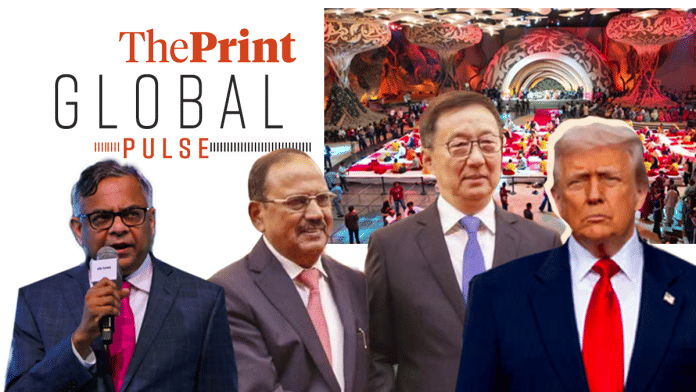

New Delhi: NSA Ajit Doval’s visit to Beijing for the 25th round of border talks with Chinese representative Wang Yi has elicited a positive response in the Chinese media, with experts saying regular talks signal “stability and improvement” in bilateral relations. However, Global Times strikes a note of caution.
The National Security Advisor held talks with Chinese Foreign Minister Wang Yi on Tuesday on the India-China boundary question and ways to improve bilateral relations.
A report in the paper quotes experts as saying that the successive rounds of talks on the China-India boundary question—the 24th round was held in New Delhi last August—signal that the two sides are advancing boundary negotiations steadily.
However, the Chinese newspaper says that despite positive momentum in the ties between the two countries, India “has still taken provocative moves along the border”. The report refers to the Indian government’s 7 August announcement of “standard names” for 27 locations in Arunachal Pradesh.
Responding to the “issue” on 10 August, Chinese spokesperson Guo Jiakun said that the “Zangnan region” is Chinese territory and that China does not recognise the “so-called Arunachal Pradesh” established by India.
Asked about Arunachal Pradesh border issues with China, MEA official spokesperson Randhir Jaiswal told a press conference on 11 August, “We have also stated that the state of border affairs will reflect on the state of our larger bilateral ties. This was also reiterated at the 36th WMCC (Working Mechanism for Consultation and Coordination on India-China Border Affairs) meeting on the India-China border affairs which was held on the 6th (August).”
US President Donald Trump has threatened a fresh slew of punitive economic attacks against those doing business with Iran. Will the new economic measures impact India? The New York Times takes a look at how Trump’s measures could possibly impact China, India, and other countries.
According to the US-China Economic and Security Review Commission, China is Iran’s largest trading partner and its primary consumer of oil, reports Leo Sands of the NYT.
While China’s trade with Iran last year was estimated at 10 billion dollars excluding oil imports, experts say that it is only a drop in the ocean for China’s economy, and China would remain largely unaffected by the US’s economic measures to isolate Iran.
India, on the other hand, used to be one of the most important trade partners of Iran with the total value going up to 17 billion dollars in 2018-19. However, in 2019, under mounting pressure from the Trump administration, India stopped buying Iranian oil altogether with trade share plummeting to 1.63 billion dollars in 2025-26.
It was only when Trump gave a 60-day waiver to allow countries like India to purchase Iranian oil to alleviate the economic pressure caused by energy crunch, that India finally bought Iranian oil for the first time in almost seven years.
The challenges in the Tata Sons group continue after Chairman N Chandrasekaran resigned this month without a successor. Nikhil Inamdar of the BBC reports on what lies ahead for one of India’s largest conglomerates with several ventures bleeding money to stay alive.
Inamdar writes that finding a successor to Chandrasekaran would be “no easy task” for the country’s “most revered” conglomerate “whose sprawling $300bn empire spans Jaguar Land Rover and Air India as well as manufacturing iPhones for Apple.”
“Chandrasekaran resigned amid a deadlock over his reappointment and a widening rift with Tata Trusts – the charity arm which owns controlling shares of the unlisted commercial holding company,” he adds.
The disagreements are reportedly focused on a potential public listing of Tata Sons and the allocation of capital to the group’s new unlisted businesses, including semiconductors, e-commerce and aviation, which are all currently loss-making, says the report.
The group is also in the middle of one of its largest investment cycles with tens of billions of dollars being poured into all kinds of ventures from India’s first chip fabrication plant to manufacturing EV batteries.
“It is an incredibly difficult role not just for the individual who will get it but also for the selection committee to find someone. It requires a multitude of skillsets and experience from managing the Tata Trusts to the Tata Sons board, understanding various new businesses and being able to also have strong relationships with regulators and the government,” Hetal Dalal of the Institutional Investor Advisor Services told the BBC.
Challenges abound as Tata Consultancy Services, the group’s golden goose, is no longer generating revenue at the pace it once did, amid the AI boom.
The Economist, in its Ashoka column for India, argues for Hyderabad’s model for building skyscrapers, and how it could set an example for other Indian cities. The column notes that while Hyderabad is not famous for its skyscrapers, it has the most number of high-rises after Mumbai.
“How did the country’s sixth-most populous city build its second-largest concentration of tall buildings?” the column asks. “Through practical policy changes.”
A general floor space index (FSI) — the ratio of permissible built-up area to land area — is around 2, and rarely exceeds 4. For context, in Singapore, the FSI is 25, meaning that for every 25 sq feet of area, a developer can build up to 25 square feet of tower. Hyderabad got rid of the arbitrary cap but did not abandon all rules. “Regulations concerning minimum street widths and required setbacks still apply. Aviation authorities impose restrictions around air-traffic funnels,” the column says.
Markets decide the rest, adds the column. Construction costs increase with height, so a builder’s decision on how much to pay for land and how tall to build depends on whether buyers are willing to pay enough for flats to keep the project profitable. That, in turn, has helped prevent a housing bubble, says the column.
“The lesson for other Indian cities is not “abolish FSI”—or not just that, at any rate. It is that civic administrators should think about what purpose their cherished rules serve, and whether better designed policies can achieve those goals.”
“Gold-loans are having a moment,” says Veena Venugopal, writing in India Business Briefing newsletter for the Financial Times. And India’s biggest business houses are joining in the boom. The Aditya Birla Group recently announced that it was setting up a dedicated gold-loan franchise across 1,000 branches.
Venugopal says that the sector’s prospects are promising. According to the Reserve Bank of India, gold-backed lending has grown at a compound annual rate of more than 42 percent since March 2024. The segment recorded nearly 70 percent year-on-year growth in both May and June.
There are several factors that explain this surge in loans against gold. “First, Indian households are the world’s largest holders of gold, with an estimated 25,000 tonnes lying in homes across the country, much of it in the form of jewellery,” she writes.
Second, gold-backed loans are considered relatively low-risk because lenders hold the collateral and can liquidate it relatively easily. By contrast, recovering and selling property pledged as collateral can involve legal disputes, regulatory hurdles and lengthy delays, the column adds.
Suhasini Raj and Francesca Regalado of The New York Times report on the mass wedding “scam” that took place in Madhya Pradesh in May this year.
Abhishek Varma had a nagging feeling that something was amiss on his wedding day. His parents, eager to get him married, had been introduced to a man from a nearby village who claimed to be a matchmaker. He told them they simply had to choose an orphaned woman from a photo album and pay about 200 dollars to participate in a mass wedding, the report notes.
When Varma reached the wedding venue, he waited with 40 other grooms for getting married, but the brides never came. Raj and Regalado highlight that the Madhya Pradesh incident was an extreme example of India’s wedding “scams”.
India’s marriage market attracts scammers because of the huge sums families spend on weddings, often saving for years to pay for a daughter’s clothes, jewellery and dowry, the traditional yet illegal transfer of cash or assets to the groom.
In late July, the report notes that the police charged the man, Dinesh Bairagi, 45, and four accomplices, including his brother, Mukesh Bairagi, 40. If convicted, they could face a punishment of up to three years in prison and a fine.
Citing the police, the report says that the Bairagis made the equivalent of around 4000 dollars, scamming each family for anywhere between Rs 10,000 to 25,000.
(Edited by Ajeet Tiwari)
Also read: India-China manufacturing gap, Reliance & Rolls-Royce collab—what’s making to global headlines