





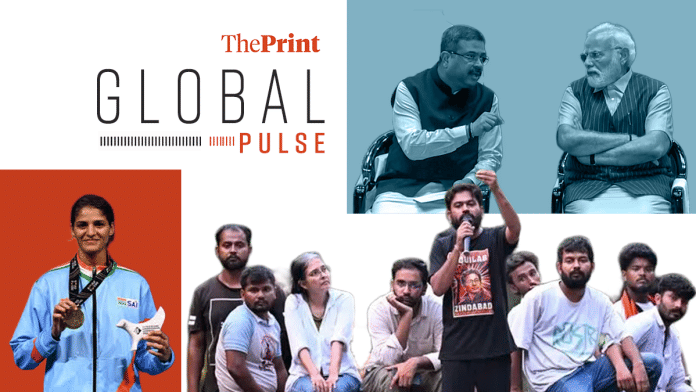


New Delhi: After an eventful weekend, global media is analysing what Dharmendra Pradhan’s resignation means for Prime Minister Narendra Modi and his government, and how Cockroach Janta Party (CJP) founder Abhijeet Dipke became an accidental hero. The BBC also profiles world champion Indian boxer Jaismine Lamboria, who is eyeing Commonwealth gold.
“For the first time in his long political career, Indian Prime Minister Narendra Modi’s aura of political invincibility appears to have been punctured,” Michael Stott writes for the Financial Times.
The protests that lasted for two months over the NEET (National Eligibility cum Entrance Test) paper leak forced the government into a “humiliating climbdown” with Union Education Minister Dharmendra Pradhan’s resignation, according to FT.
“Long accustomed to getting his own way, Modi had to swallow the spectacle of two of his ministers sitting stony-faced as envoys from the Cockroach Janta Party (CJP), which led the protests, announced to waiting media that the government had agreed to meet all their demands,” the report says.
Acknowledging Dipke’s role, the CJP social media handle said: “Bro created a movement out of literally nothing.” This was after Pradhan announced his resignation Saturday.
Stott citing analysts, reports that more worryingly for Modi, the movement has spread beyond the NEET paper leak issue. It has come to encompass “broader frustrations”.
“These include rising joblessness among graduates and a lack of quality well-paid jobs for India’s 370mn youth population, the world’s largest,” he writes.
India has recorded annual economic growth of over 6 percent in recent years, placing it among the world’s fastest-growing major economies. But, as Stott writes, with more young people entering the workforce and expectations rising, partly fuelled by Modi’s goal of making India a developed nation by 2047, the economy will need to grow even faster to meet voters’ aspirations.
Showkat Nanda and Anupreeta Das of The New York Times (NYT) take a look at Abhijeet Dipke and how he brought the movement to life. Following Pradhan’s resignation, as the people cheered and celebrated, Dipke cemented his status as a “folk hero”.
“He had taken on the government of Prime Minister Narendra Modi and scored a victory,” they write.
Nanda and Das write that barely two months ago, Dipke was just another international student from India, “with a Master’s degree in public relations from Boston University, squeezing in workouts in between applying for jobs and playing FIFA soccer on his PlayStation.”
After Chief Justice of India (CJI) Surya Kant called India’s youth “cockroaches”, Dipke took to X and wrote: “What if all cockroaches came together?” The NYT notes that Dipke’s timing was “impeccable”. Just two weeks earlier, the National Testing Agency (NTA) had cancelled the NEET-UG exam after questions were leaked before the test.
“Such leaks are almost endemic to India’s education system and regularly prompt fury and frustration. To bring lasting change, though, Mr. Dipke and others spearheading the Cockroach movement would have to figure out how to alchemize the energy of the nascent movement,” the report says.
As youth protests spread across India, demonstrations against the issue, and the Modi government at large, also erupted in cities around the world, Sarah Chatta reports in another article for NYT.
“Aarsh Chauhan doesn’t usually go to protests. An Indian citizen studying finance at Baruch College, he describes himself as apolitical,” the report says. However, as visuals of police crackdown spread like wildfire on social media, Chauhan was moved to do something. He joined the protest, not in New Delhi, but New York.
Over 500 people gathered at the statue of Mahatma Gandhi in Union Square, Manhattan, on Friday, chanting ‘we will take our freedom’ in Hindi. Protests also erupted in Los Angeles, London, Prague, Berlin and Vancouver, British Columbia.
“Directed at India’s prime minister, Narendra Modi, and at the country’s education minister, the diaspora protests focused on issues in the Indian education system and the lack of job opportunities,” Sarah writes.
The protests were led by a group called Hindus for Human Rights in America and Australia, the report says. “In the past week, the global Indian diaspora spontaneously organized diverse solidarity rallies, large and small, all over the world,” Sunita Viswanath, group’s executive director told the NYT.
Annesha Ghosh of the BBC profiles Jaismine Lamboria, Indian Army’s first woman boxer who is now chasing a Commonwealth gold. The reigning 57 kg world champion, who loves throwing punches for a living, finds her inspiration in former India cricket skipper M.S. Dhoni. “He is known as ‘Captain Cool’ for a reason, and I want to be calm like him,” she told the BBC.
The 24-year-old is among India’s leading contenders for boxing gold at the Glasgow Commonwealth Games, hoping to go one better than the bronze medal she won at Birmingham 2022, the report notes.
The report highlights that the Indian Army has provided the “wider institutional framework around much of her development.”
Lamboria’s bronze-medal performance at the 2022 Commonwealth Games marked a historic milestone beyond the ring. She became the first woman boxer to join the Army, enlisting in the Corps of Military Police. She is now honing her skills under the Army’s Mission Olympics Wing.
Lamboria’s goal for the Commonwealth Games is simple: “I aim to change the colour of that medal to gold,” she told the BBC.
(Edited by Tony Rai)
Also Read: Global media’s Delhi bulletin: CJP protest a ‘Gen Z affair’, lays bare ‘limits of propaganda’