





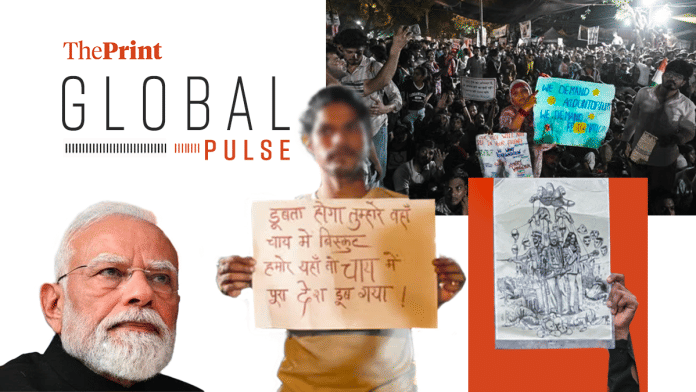


New Delhi: The youth-led protest at Jantar Mantar continues relentlessly despite Prime Minister Narendra Modi’s assurance of “strict actions against paper leaks,” and announcement on setting up fast-track courts for quick justice in such cases.
The global media is now looking at the bigger picture, asking what sets this protest apart from those that have taken place during Modi’s 12-year tenure. Abhijeet Dipke, the founder of the Cockroach Janta Party who is spearheading the agitation, has said the demonstrations will continue until Union Education Minister Dharmendra Pradhan resigns.
The Economist gives the most scathing critique to the Modi-led government’s ‘handling’ of the protest in an article titled: “Narendra Modi’s party discovers the limits of propaganda.”
It says that in the social media age, where the rule of thumb is to grab someone’s attention within the first three seconds, Sonam Wangchuk’s hunger strike at Jantar Mantar barely drew any traction online. Between Wangchuk’s fast-unto-death and Pradhan’s resignation, the column says, death was the likelier outcome.
“Mr Modi has never sacked a minister for incompetence,” it jibes.
However, the Indian government itself gave the protest the fodder it needed. “On the 21st day of the hunger strike, the government provided the spectacle Mr Wangchuk had failed to produce. Plainclothes police stormed the protest site and carted him off to hospital, supposedly for his own good. They carried white sheets to veil the moment of abduction,” it adds.
As The Economist writes, the white sheets were enough. The videos of the incident jumped from Instagram to Facebook to Reddit to X.
The column says that the Modi government tried to control the narrative, but the “smartphone generation was not to be thwarted”.
Another challenge, the column says, the government faced in shaping the narrative was an absence of a particular community to frame. “It is easy enough to frame protesters as Sikh separatists, Muslim terrorists, leftist agitators or Pakistani infiltrators. But they are not used to seeing their own sons and daughters—Hindu, middle-class, educated—treated the same way,” the column adds.
Soutik Biswas of the BBC writes that the CJP protest became a movement that Modi didn’t see coming. He asks if this is simply another student protest, or the beginning of “something larger”. The report highlights that what sets this protest apart is not sheer scale, but the overall breadth and depth of grievance.
Citing other large-scale protests that the country has witnessed since Modi became PM in 2014 (farmers’ protest, anti-CAA protests), Biswas writes this protest is “not fundamentally about ideology”.
“Instead, it questions whether the State can still guarantee fairness in the examination system that millions of young Indians see as their principal route to social mobility,” the report adds.
Rahul Verma, a fellow at the Centre for Policy Research, told the BBC that the movement points to administrative failure. It asks, in clear words, whether the BJP has the ability to govern. Hence, many of the protesters are not BJP’s natural opponents, he added.
The grievance is about governance rather than ideology, Verma told the BBC, hence the BJP cannot easily rally its supporters or use political counter-narratives that helped it confront earlier protest movements.
The New York Times explains how the Modi government was able to handle public anger over rising fuel prices during the US-Iran war, but was “caught off guard” by the youth protest.
“Narendra Modi, the powerful and acutely image-conscious prime minister of India, is suddenly facing a political problem he had not anticipated on entering his 13th year in office,” Alex Travelli writes.
The report says that Modi has had “his eyes trained on economic anxieties much of this year as the US-Iran war caused energy shortages back home”.
“But it was another sort of economic pressure that has now caught up with him and helped drive thousands of students to protest in the capital: The crumbling and sometimes crooked machinery of India’s underfunded education system, along with a painful lack of jobs for the millions of graduates it produces.” Even as Modi posted on social media that nothing is more important than the “welfare and future of our youth”, protesters found the response to be both “late and lame”, the report says.
As protest continues in the National Capital, smaller protests have emerged in Mumbai, Bengaluru, Ahmedabad, Patna and other cities demanding Pradhan’s resignation.
Veena Venugopal, writes about the protest in Financial Times.
“For four straight days, despite Delhi police using batons and tear gas each evening, the protest has only grown stronger,” she writes.
Writing the India Business Briefing newsletter in FT, she adds: “It is an unmistakably Gen Z affair: the signs are mostly memes, some protesters are dressed as superheroes, and there’s an Instagram reel for everything.”
Venugopal makes another important observation: since Monday’s police crackdown on protesters, the chants have started targeting Modi directly.
“As far as I can recall, this is the first time a large cross-section of Indians has criticised the prime minister by name. Many of the protesting students come from the BJP’s core voter base — Hindu, middle-class households — some encouraged by their parents to protest, others defying their families to be there.”
The newsletter highlights that there are only three ways de-escalation could happen now: first, the education minister resigns; second, police uses brutal force to crush any dissent; third, “the government strikes a compromise, though this will be complicated by the fact that the students are not a unified political entity and have no clear leader who can bring the movement under one banner.”
(Edited by Ajeet Tiwari)
Also Read: Govt has lost ‘first round’—global media on CJP stir, India’s ‘pressure-cooker’ education system