





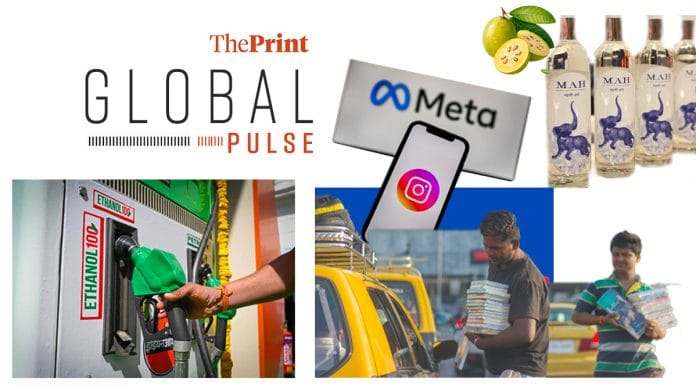


New Delhi: The Indian government’s success in increasing ethanol blending with petrol to 20 percent is not boding well with consumers.
Veena Venugopa writes in Financial Times that ethanol blending has left many consumers furious, and “seems to be the one issue that even longtime supporters of the ruling Bharatiya Janata Party are having trouble getting around”.
After achieving the target of 10 percent in 2022, the policy has now accomplished its goal of E20, five years ahead of schedule. Venugopal lists several issues driving the outrage. “Mileage has always been an important consideration for Indians and, for decades, vehicles have been marketed predominantly on their fuel efficiency. Since ethanol has a lower calorific value, it brings the mileage down,” she writes.
Some consumers are now reporting a reduction of 6-10 percent in how far they can drive on one tank fuel, FT notes.
Apart from mileage, another big concern for Indian consumers is the issue of compatibility between blended fuel and their vehicles. “Ethanol in fuel can be corrosive and lead to frequent breakdowns and higher repair and replacement costs,” Venugopal writes.
“In the past few weeks, public outrage has built up substantially, with real and fake social media videos showing expensive cars breaking down, allegedly on account of fuel quality. On Saturday, three ministries jointly convened a press briefing along with heads of automobile manufacturers to allay some of these fears. This had limited success,” notes the report. Consumers, it adds, have alleged the government pushed the policy in a hurry without doing its research.
As ethanol blending enrages Indian consumers, another kind of alcohol is empowering indigenous women of India. Mahua, an alcohol sourced and produced locally, is being shipped to the UK, and the distillery manufacturing the variety is doing well, reports Alice Lascelles for Financial Times.
“The Indian spirit mahua is one of the only alcoholic beverages distilled exclusively from flowers. Also known as mahuli or mahura, the drink is made from the tassel-like flowers of the mahua tree. The liquor has been a speciality of Indigenous communities across central India for hundreds of years,” the report says.
Now, a new generation of distillers, as the report notes, is giving global spotlight to the drink. Desmond Nazareth has launched his own recipe, DesmondJi mahua, in the UK through Indian liquor specialist Maharaja Drinks.
Lascelles describes what happened when Nazareth went for the first time to source the flowers. “Local communities were initially wary when Nazareth came to source mahua flowers, the collection of which was also restricted under colonial rule,” she writes. They thought that Nazareth and his team were excise officers who had come to put them in jail.
The report also details the role played by women in the Mahua economy. “From the collection of flowers to the drying, selling, buying and distilling. They consume it too. The whole chain is sustained by women,” Nazareth told FT.
Abhishek Dey of the BBC reports on the Indian government issuing orders to Meta to immediately remove content that promotes child abuse and adult pornography on Instagram. The directive comes after an investigation report by the BBC revealed that Indian users were seeing adverts promoting sexual and child abuse on Instagram despite the social media app’s policies barring such content.
The adverts contained links to Telegram channels where the material was on sale.
“The government has also sought an explanation within a week on how advertisements containing such material were allowed on the platform, the official said,” Dey writes.
Both Meta and Telegram have given preliminary comments on the issue. “Meta has said it has a zero-tolerance policy on child sexual abuse material and is continuing to strengthen its detection and defences. Telegram said it had removed more than 274,000 groups and channels related to child sexual abuse material in 2026.”
A senior IT ministry official also told the BBC that the government has issued a “stern” notice to Meta for running such adverts on its platform.
The Economist takes a look at India’s reading list, and concludes that Indians are on a journey of self-improvement, self-discovery, and self-promotion.
“India is a rare country where hawkers still peddle pirated books at traffic lights. Congestion is often terrible, it is true, but it is not novel-length bad. The black-market trade says several things about the place: that there are not enough bookshops; that Indians are keen readers; and that copyright enforcement is somewhat lax,” the column notes.
The books, all in English, tell something about India’s relationship with the language, writes The Economist. For a country as linguistically diverse as India, sales of English books represent the country’s hopes and dreams, it adds.
The column goes on to highlight that bookshop displays and bestseller-lists give away the Indian reader’s chief concern—self-improvement. “Half of all books sold are non-fiction, with fiction and children’s books roughly equal. That is in contrast to other big English-language markets, where fiction has a clear lead,” it notes.
The column was referring to the thousands of copies of ‘Psychology of Money’ and ‘Atomic Habits’ that are on display in book stalls. “The desire for personal growth is not new. ‘How to Win Friends and Influence People’ has been a regular on Indian bookshelves for decades. But it has recently been Indianised,” it adds.
Books also reveal that Indians are on a journey of self-discovery. “Histories of India, often written by foreigners, have always sold well. But now Indians are not just writing their own stories, as Manu Pillai does in his mammoth Gods, Guns and Missionaries.” They are also interrogating who gets to tell these stories.
With influencers entering their writer era, a symbiotic relationship between books and social media has been established, says the column, adding that aesthetic pages send users to books, books’ authors bring readers back to social media. “Books reveal the Indian reader—both creator and consumer—to be versed in the art of self-promotion.”
(Edited by Amrtansh Arora)
Also Read: ‘Limits’ of India-Japan ties & Modi’s overseas honours spree, ‘sometimes as 1st & only recipient’