





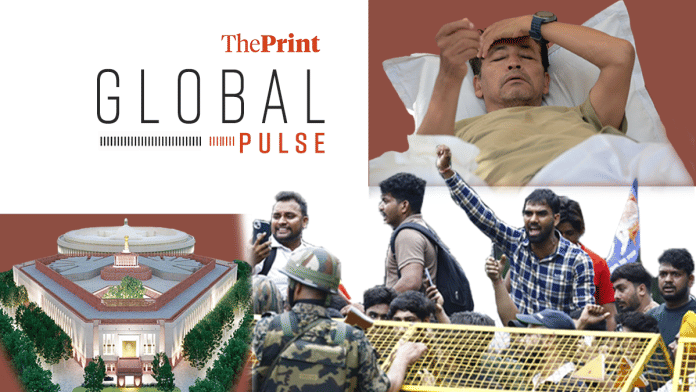


New Delhi: The protest at Jantar Mantar, New Delhi, which drew tens of thousands of people from across India, featured prominently Monday in global headlines about India. The New York Times (NYT) writes that chaotic scenes played out on the streets of New Delhi as police and security forces used tear gas and batons to disperse the protesters.
The protest demanding Education Minister Dharmendra Pradhan’s resignation over the undergraduate medical exam paper leak drew massive response on Monday, with demonstrators marching towards Parliament.
“A smiling Mr. Modi, who arrived to open a session of the Parliament, tried to project an image of calm,” Mujib Mashal and Pragati K.B. of NYT report.
They write that Prime Minister Narendra Modi did not address the demands of the protesters even as crowds spilled onto the roads leading to Parliament building, where he stood.
Citing some figures based on Indian media reports, the newspaper notes that following police crackdown, at least 100 people were taken to two hospitals in Delhi, and over 60 protesters were arrested.
The report spotlights the government’s standard response to such protests. It says, “Mr. Modi’s response has so far remained consistent with his decade-old position that his ministers are not answerable to public pressure.”
However, this time, the size and force of the protest may indicate that the National Democratic Alliance (NDA) government has “the raw anger among young people in India”, especially in the aftermath of recent student movements in Nepal and Bangladesh.
Hence, Modi’s image as a “strongman may also be showing cracks”, the report says.
Also reporting on the protest, the BBC writes that the movement has “broadened into one of the most visible expressions of public dissent against Prime Minister Narendra Modi in recent years”.
And the dissent grew sharper after activist Sonam Wangchuk, who had been on a 20-day hunger strike as part of the protest, was forcibly moved to Safdarjung Hospital, report Geeta Pandey, Zoya Mateen and Azadeh Moshiri of the BBC.
“Although police had made clear protesters would not be given permission to march to parliament, tens of thousands of students, parents, teachers and professionals gathered from early morning at Jantar Mantar, a 300-year-old observatory in central Delhi, and remained there despite heavy rain,” they write.
The Cockroach Janta Party led the march to Parliament after holding its first protest on 6 June, when its founder, Abhijeet Dipke, arrived in Delhi just weeks after launching the CJP’s online satirical account.
How did Wangchuk become part of the movement?
Another report by BBC correspondent Simon Fraser sheds light on Wangchuk’s life and work. “Popularly known as ‘Sonam sir’, Wangchuk is one of best-known public figures in the disputed Indian-administered territory of Ladakh and a well-known name in India,” the report says.
His work on education has won him much recognition, including the Ramon Magsaysay award in 2018. Wangchuk is not unfamiliar with fasting as a legitimate means of protest. “Last year he held two hunger strikes, lasting several weeks, to highlight the fragile ecology of his hometown – an icy cold desert in the Himalayas, which is at the centre of border disputes between India and China,” the report notes.
Wangchuk’s hunger strike was a response to fast tracked infrastructure development in the Union Territory, the report notes. The Centre has approved several highway, power and military infrastructure projects in Ladakh, which Wangchuk says could damage the region, particularly as they were sanctioned without consulting local representatives.
As the report highlights, his own experiences with the education system shaped his contributions to it.
“In the 1980s, his experiences led him to question the education system in Ladakh, which he said did not address local needs. He protested against the use of textbooks in English and Urdu in a region where most people spoke the Ladakhi language,” the BBC notes.
Most of the textbooks came from Delhi, hence they would have examples that Ladakhi people were not familiar with, resulting in a significant gap between curricula and learning. Wangchuk identified this early on.
“Since then, he has worked with local authorities and communities to ensure that the education system addresses the unique needs of children in Ladakh,” the report says.
Following police crackdown and a dialogue between CJP representatives and Health Minister J.P. Nadda on Monday, the protesters have regrouped at Jantar Mantar, pledging to continue the sit-in till the demands are met. Meanwhile, Wangchuk is reportedly continuing his hunger strike from the hospital.
On Tuesday, Parliament is back to business after remaining adjourned on Monday. Veena Venugopal writes in the Financial Times about what is expected of the 19-sitting Monsoon Session.
There are quite a few bills on table, and the “most significant”, according to Venugopal, among them is the Prevention of Insults to National Honour (Amendment) Bill, 2026, which seeks to make any “insult” against India’s national song a “criminal offence”.
“A seemingly comical waste of parliament’s time, but one that could become a powerful weapon for the police, if implemented,” Venugopal writes.
She also points to the buzz around whether the government would reintroduce the Delimitation Bill after attempts to push it in the last session failed.
“In this season of dissent, also expected to come up is the Foreign Contribution (Regulation) Act amendment, which governs how individuals, associations and companies in India receive and use foreign donations — ostensibly to stop funds from reaching activities ‘detrimental to the national interest’,” she writes.
The Opposition parties have also said that they would raise the issue of the Ram Temple donation theft in Parliament.
However, a big question hangs in the air: Wangchuk has demanded a discussion on India’s education system in Parliament as one of his conditions for ending his fast. Will that be a talking point in this session?
“The government will probably pull some rabbits from its hat especially in the last few sittings, but the events of this week will set the tone. If the student protests escalate, it will become the single biggest issue dominating the session,” Venugopal writes.
(Edited by Tony Rai)
Also Read: Affirmative action vs merit—global media has a take on Indian, Chinese systems & growth output