



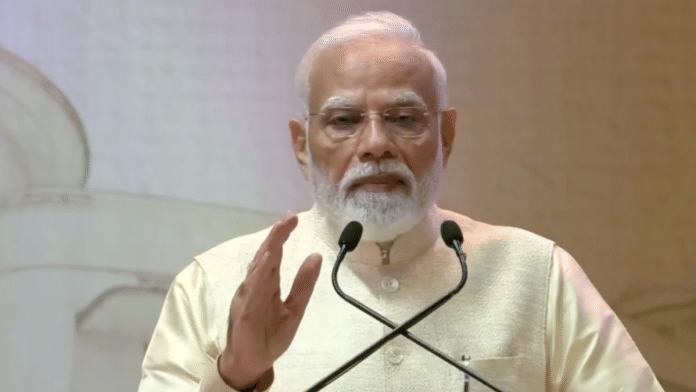
New Delhi: Prime Minister Narendra Modi gave a speech at the Union Public Service Commission’s centenary celebrations at Bharat Mandapam, where he encouraged the country’s youth to enter public services.
“We must bring such youth into the Public Services who are attracted not by public office, but by public service. Therefore, it is essential that the recruitment examination does not just test what the candidate knows. But I also see why youth wants to come into Civil Services,” said PM Modi.
The role of the UPSC, he said, goes beyond recruitment, as the people selected through the commission will eventually shape the country’s governance.
“The UPSC is the vehicle for the kind of governance the country needs for a developed India. The youth we are recruiting today will play a role in building a developed India. Keeping this in mind, we must always keep two criteria in mind.”
He identified these two criteria as “nation first” and “citizens first”. He said that evaluating candidates on the basis of these values would make it easier to achieve national goals.
Criteria for UPSC
Putting citizens at the centre of governance, Modi invoked the idea of “Nagrik Devo Bhava” and described it as a departure from the older understanding of the government’s role.
“It was once believed that the government was our parents, but today our mantra is ‘Nagrik Devo Bhava.’ The citizens of the country are no less than gods for us. Serving citizens is paramount for us. Therefore, 21st-century India is moving forward with a new work culture. Its core principles are pro-people, pro-active, and good governance.”
Explaining what these three principles mean in practice, he said:
“‘Pro-people’ means working with the interests of citizens is paramount. Pro-active means anticipating a problem and preparing a solution instead of rushing into action when it arises. Good governance means avoiding government pressure, pressure, or unnecessary influence.”
These principles, he said, should also determine the qualities expected from those entering public service.
“Based on pro-people, pro-active, and good governance, we must provide the country with professionals who have the compassion to understand the plight of the poor, who work with youthful enthusiasm, who find innovative solutions to difficult problems, who understand the country’s needs, who ensure law enforcement, and who can also assess whether people’s lives are becoming easier.”
The centenary celebrations also became an occasion to reflect on the institution’s legacy and the faith that generations of aspirants have placed in it.
“Today, along with the celebration of UPSC’s 100 years, is also a celebration of a legacy. This celebration is of that aspiration, which millions of youth live every year. This celebration is of that faith, which every Indian has in this institution. Today’s 21st-century India is moving forward with a new work culture. Its fundamental principle is… Pro-People, Pro-Active, Good Governance,” said PM Modi.
(Edited by Aakriti Handa)