





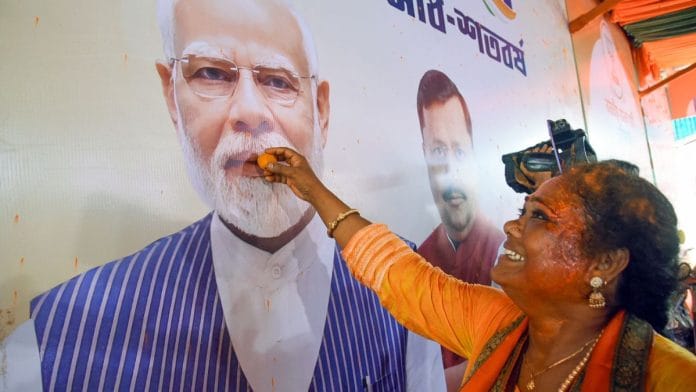


New Delhi: As the BJP gained a decisive mandate in its favour in West Bengal, Bengali intellectuals were busy interpreting the “historic mandate.” Analysts attribute the TMC’s decline to strong anti-incumbency sentiment and widespread voter disengagement.
Much of the commentary describes the long-term consequences of ‘Mamatanomics.’ The model promised industrial revival after the Left era, but critics argue it instead created structural dependence on welfare schemes.
Some commentators see the result as a sign of democratic renewal. Others see it as a test for democracy.
Industrialist Harsh Goenka, chairman of RPG Enterprises, welcomed the result by saying that “Bengal’s business community is delighted,” calling the BJP victory a “turning point” that could bring a jobs and investment boom after years when companies worried about contract sanctity and mixed signals on industrial policy.
Outside Bengal, analysts are already treating the outcome as a turning point for the whole country. In an editorial video released just before counting day, Sujit Nair, managing editor at HW News, said that a BJP win in West Bengal would not be “just a state win” but a “milestone” for the Modi–Shah leadership, comparable in symbolic weight to 2014. He argued that such a result would remove one of India’s strongest Opposition leaders from the front line and reverse the psychological setback of the 2024 Lok Sabha verdict.
Also read: BJP Bengal win dissolves the old Bhadralok order. It kept Dalits and their issues out
What do the results mean for democracy?
From a critical perspective, journalist and public thinker Paranjoy Guha Thakurta sees the Bengal result as a test of whether democracy in India still has a real future. In a statement shared by Yogendra Yadav and circulating widely on X, he calls this election a “litmus test of whether we have fallen below the minimum threshold of electoral integrity,” saying that all the credible information available to him points to a comfortable TMC lead even after the damage inflicted by the SIR‑linked deletions.
He says if the Election Commission “manages to conjure a victory for BJP,” it would be “electoral fraud” and the opposition may question if there is “any point of contesting any more elections under these circumstances.”
Independent commentator Tanmoy compared the current election system to a “casino” where “the system” always wins. In a thread, he said the Opposition celebrates small wins, then returns “like desperate addicts to the rigged table,” instead of exposing rigging or stepping aside for people’s movements.
While Guha Thakurta and Tanmoy questioned the fairness of the system, economist Aunindyo Chakravarty offered a more cautious view. He said the BJP and TMC together have about the same vote share as five years ago. He also noted that the BJP seems to be gaining Hindu votes from Congress and the Left, while Congress and the Left are winning back many Muslim votes from Mamata Banerjee. He added that only detailed surveys can confirm if this pattern is accurate.
Avik Saha, a Kolkata-based lawyer and Jai Kisan Andolan leader, has strongly criticised SIR, posting about deletions and “vote theft.” He said the 2026 West Bengal election may be remembered for weakening the right to vote and attacking the “foundational pillars of democracy.”
(Edited by Theres Sudeep)
So-called intellectuals have reasons to feel worried. The quid pro quo is on the brink of extinction
Yogendra Yadav’s track record is a graveyard of failed predictions. Yet media outlets keep shoving mikes in his face for his hallucinatory soundbites and demented prognostications. What makes this man an ‘intellectual’?
I am a Bangali intellectual. BJP cheated. Democracy has died. Time to leave India. Tata, bye-bye.
The so called intellectuals were mum when political violence waa unleashed upon common people merely because they voted for an opposition party in 2021. Where were these intellectuals when panchayat elections were marred by uncontested elections along with visuals of ballots floating in the ponds of Bengal ? Where was this Mr. who feels the game is rigged now ? Women were subjected to sexual abuse and even dogs were killed alongwith his owner merely because they voted for opposition party. Such intellectual gymnastics now using words to show fake concern for democracy is both abhorrent and pukeworthy now. Is intellectual dishonesty the first trait to be tagged as an intellectual in Bengal now ? Do not demean the word “intellectual” using them for people who only wished the status quo continued in Bengal and were blind and deaf to the atrocities committed by TMC . Enough is enough.
On a lighter note, when was an Indian industrialist not “ delighted “ over such a political development.