



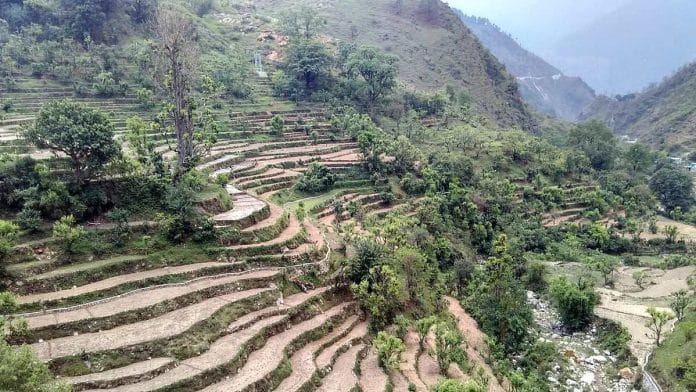

New Delhi: In his fields in Pauri Garhwal, farmer Gopal Dutt can no longer rely on the seasons. Rain that was once predictable now arrives too early, too late, or not at all. When it does come, it often damages crops instead of sustaining them. Dutt, who grows wheat and masoor during the winter months, is now increasingly uncertain about both sowing and harvest.
“Earlier, we would get eight months to a year’s worth of food grains from our fields. In the last few years, that has dropped to barely a month or two. When we plant, the rain either doesn’t come at all, or it comes at the wrong time and damages the crops,” he told ThePrint over a telephonic conversation.
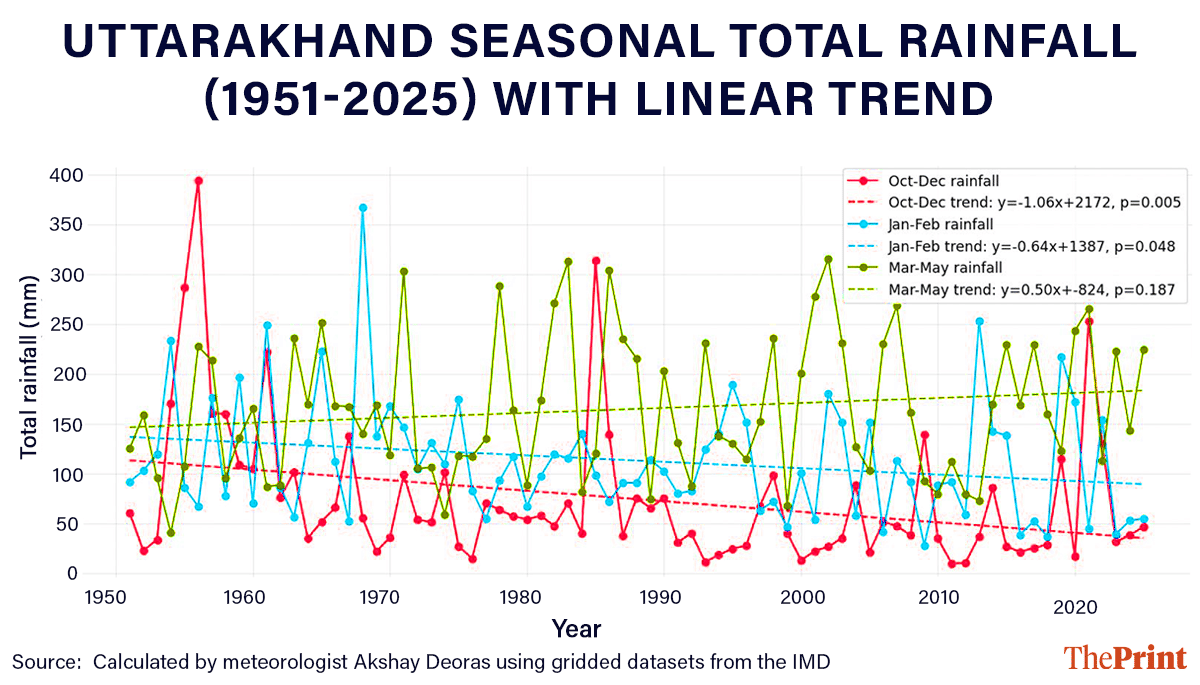
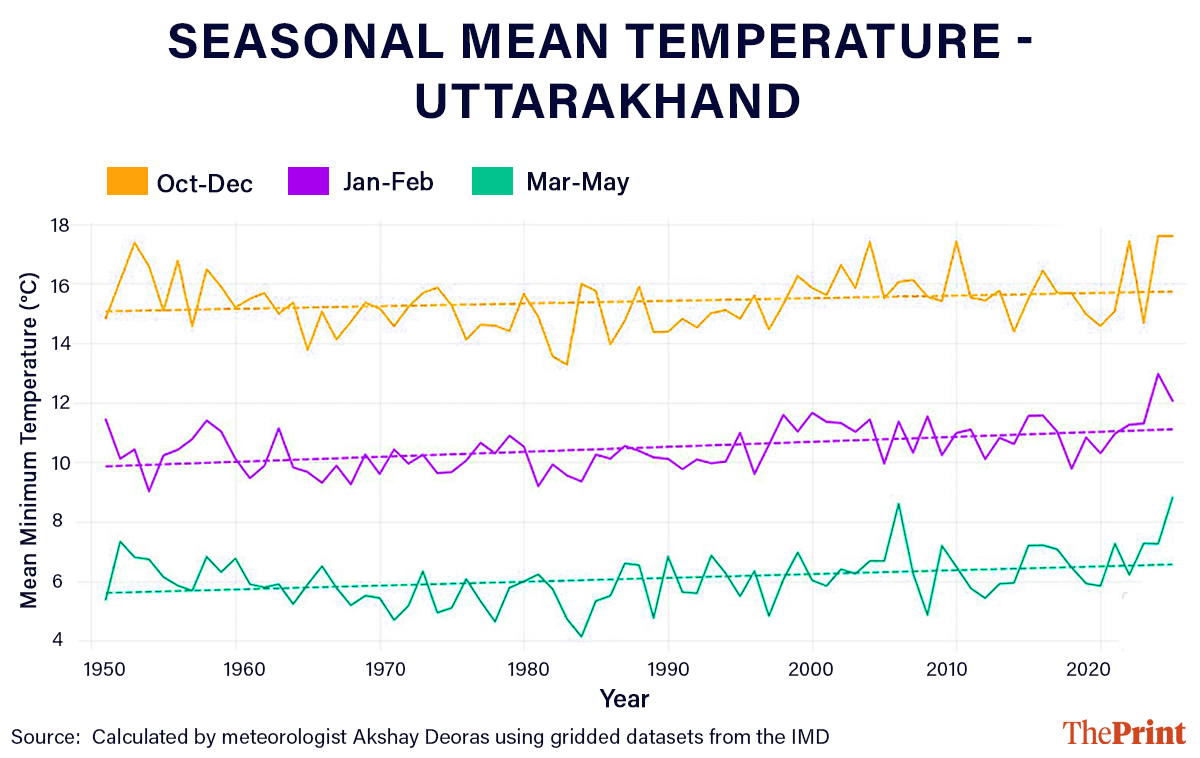
India Meteorological Department (IMD) data between 1951 and 2025 shows two clear trends across the state: declining early winter rainfall and rising minimum temperatures.
Rainfall between October and December has been decreasing at a rate of roughly 10 mm per decade. While a similar decline can be observed in nearby Himachal Pradesh and Jammu and Kashmir, what is more concerning for Uttarakhand is that rainfall has also been decreasing in January and February at about 6 mm per decade. The state faces a precipitation shortfall throughout winter.
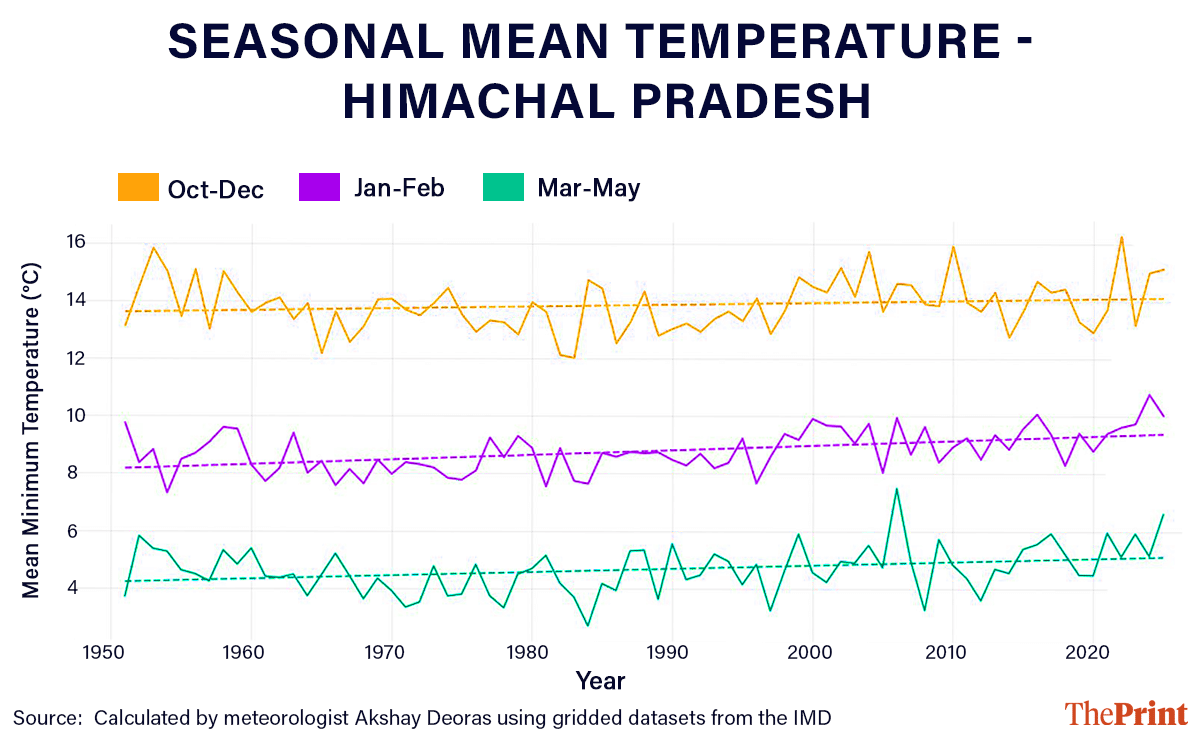
At the same time, minimum temperatures during the winter months are rising across the western Himalayan region.
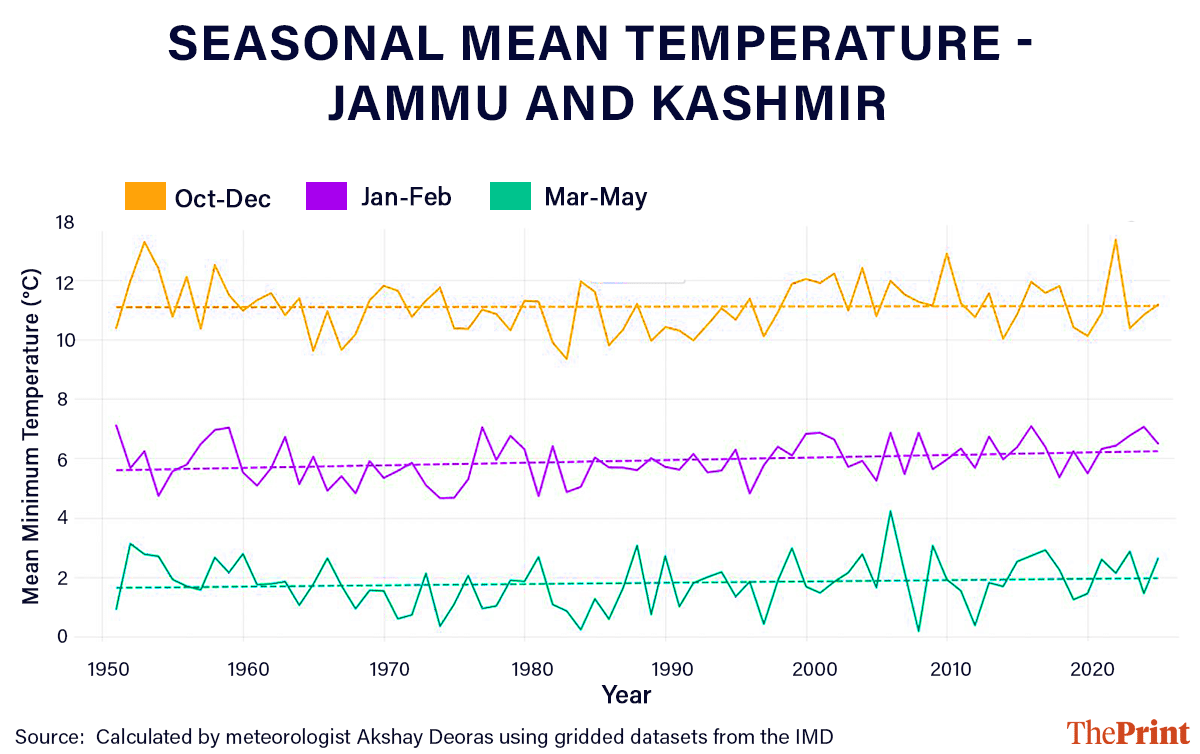
In Uttarakhand, minimum temperatures have increased by roughly 0.1–0.2°C per decade. Himachal Pradesh shows a comparable rise, with minimum temperatures increasing by around 0.2°C per decade during October to December and about 0.1°C per decade in January to February. Jammu and Kashmir also shows a statistically significant rise in early winter minimum temperatures of roughly 0.1°C per decade.
Taken together, these shifts point to a change in baseline seasonal conditions in the western Himalayan region. Rainfall is becoming less reliable, and winters are becoming warmer.
Extreme temperatures, floods, and droughts are often used as markers of climate change. But in Uttarakhand and across the western Himalayas, these slower changes in seasonal patterns have begun to take a toll.
“This is not just a short-term fluctuation—the data points to a longer-term shift in the winter climate, with the core winter season becoming drier,” said Akshay Deoras, Research Scientist at the National Centre for Atmospheric Science, University of Reading. “Winter precipitation is critical for both agriculture and tourism in the region. Reduced snowfall and rainfall can affect crops like apples that depend on winter chill, and also impact livelihoods linked to winter tourism, making these changes economically significant.”
Worrying numbers
In Uttarakhand, October rainfall has varied sharply over the last five years: It fell from 232.8 mm in 2021 to 6.4 mm in 2024, before rising again to 46.1 mm in 2025, pointing to large year-to-year swings. Over this period, the total monthly average rainfall in the state was around 87 mm, showing the degree of variability.
In Himachal Pradesh, December rainfall showed the widest variation, ranging from 0.17 mm in 2022 to 50.2 mm in 2023. In Jammu and Kashmir, November rainfall fluctuated significantly, from 65.7 mm in 2021 to 3.6 mm in 2024, before increasing again in subsequent years.
While precipitation has become increasingly uneven, minimum temperatures show a steady rise rather than fluctuations.
In Uttarakhand, the minimum temperature for December increased consistently from 6.3°C in 2021 to 8.3°C in 2025, pointing to progressively warmer winter nights. Corresponding increases can be seen in Himachal Pradesh, where the minimum temperature went from 4.8°C in 2021 to 6.9°C in 2025. In Jammu and Kashmir, it increased from 1.9°C in 2021 to 4.0°C in 2025.
A 2018 climate vulnerability assessment by the science ministry under the National Mission for Sustaining the Himalayan Ecosystem (NMSHE) describes the Indian Himalayan Region as “highly vulnerable to climate change”, owing to its fragile terrain and faster warming rates. Uttarakhand is already seeing the effects of these shifts.
“Adaptation to climate change has become imperative in the Indian Himalayan Region (IHR). Concerns about the growing impacts of climate change call for immediate response measures to reduce the vulnerabilities in the region,” the report read.
Also read: At Nari Shakti event, student stopped from felicitating minister—she was in a sleeveless kurti
‘Younger people leaving Uttarakhand’
In the hill states of North India, winter rainfall plays a critical role in agriculture. Unlike much of the country, where the monsoon drives cropping cycles, farmers here depend on precipitation brought by western disturbances during winter to support Rabi crops and horticulture. A shortfall or mistiming of this rainfall can directly affect soil moisture, crop growth, and yields.
Bhim Singh Rawat, Associate Coordinator at the South Asia Network on Dams, Rivers and People (SANDRP), recalls that knee-high snow was once a common occurrence in his village in Uttarakhand during winters.
“I haven’t seen anything close to those levels, particularly in the last few years,” he said. “The decline has forced many households to depend more on markets and government rations for food, as local production becomes less reliable.”
According to Rawat, this has contributed to out-migration from Uttarakhand, with younger people leaving villages in search of work as farming becomes less viable.
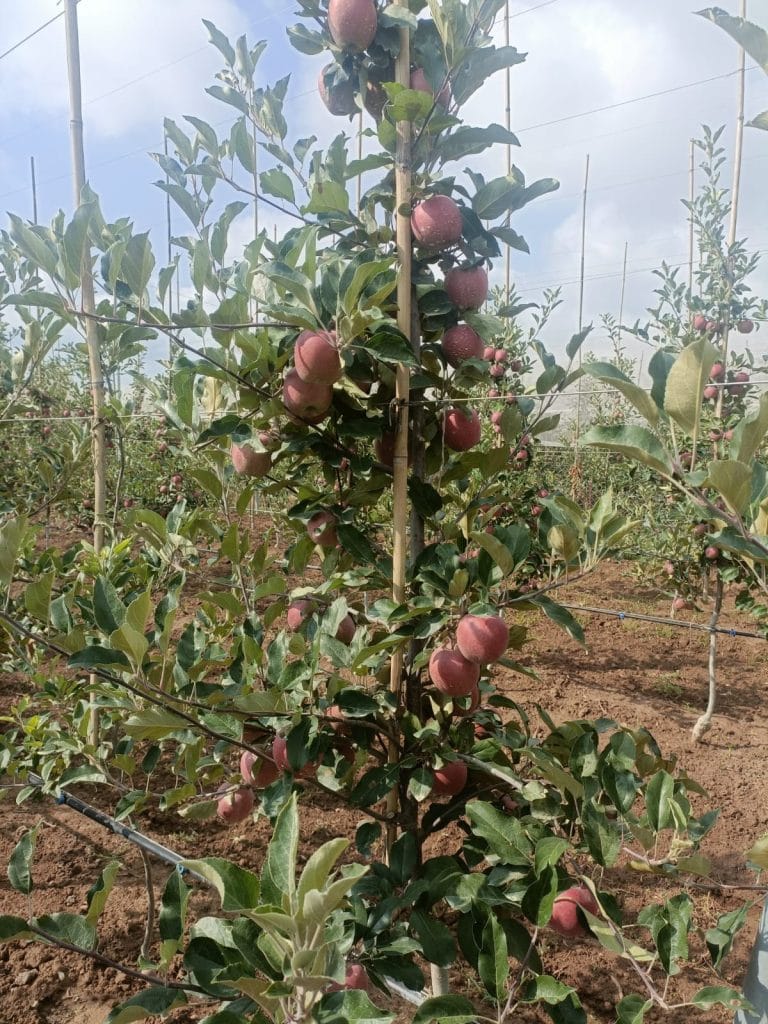
Although Himachal Pradesh and Jammu and Kashmir continue to get scattered rainfall in late winter, the impact of seasonal changes can be felt here, too. In Kashmir’s orchards, warmer winters and untimely rain are affecting apple production.
“There used to be a ‘chilling period’ that ran from 21 December to 31 January. At this time, temperatures would drop to -10 degrees at night. This is a requirement for apple trees. This period would typically be followed by a season of sunny days, during which pollination would happen,” said Dr Danish Altaf, who owns agricultural land in Pulwama.
This year, the chilling period was warmer than usual, and the sunny days have been repeatedly interrupted by rain.
Also read: House panel wants ‘Red Fort model’ replicated across India. Here’s what it looks like
Disrupted weather cycle in Himachal Pradesh
In Himachal Pradesh, farmers are seeing similar shifts. “Winter rains are coming later than expected, often spilling into February and March, and sometimes even into the harvest period,“ said Manshi Asher, researcher and co-founder of Himdhara Collective.
Apples are no longer getting the temperatures they require to flower properly, affecting both yield and quality, while unseasonal rain and hail are damaging crops just when they are ready to be harvested.
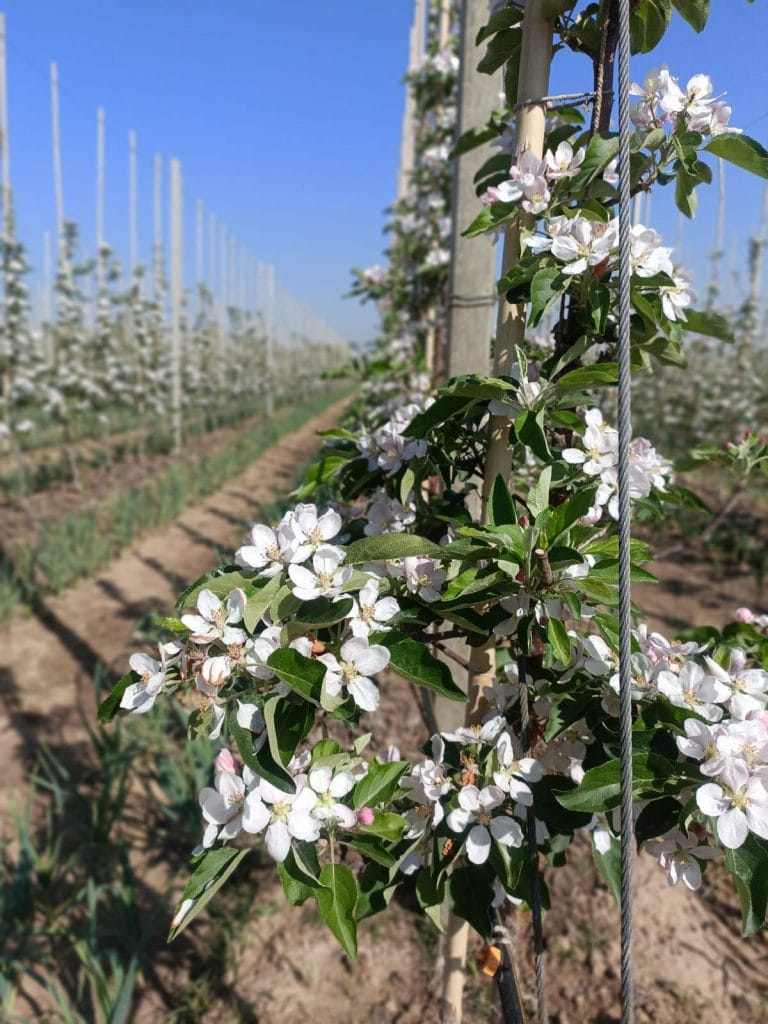
“Erratic weather disrupts the cycle,” she said, adding that while farmers are beginning to recognise this disruption as a pattern, changing cropping cycles is not easy, as existing timelines are deeply ingrained and tied to markets.
At a policy level, India’s response to climate change in the Himalayan region is anchored in programmes such as the NMSHE, which was launched to generate scientific knowledge and guide climate action. But there are gaps in how this knowledge is translated on the ground.
In a recent paper, Asher notes that information on the mission’s activities, including progress reports and state-level funding allocations, is not easily available, with even official data often difficult to access. Studies under such programmes also tend to focus on large-scale hazard assessments, with little connection to the on-ground happenings. As a result, while climate risks are being studied extensively, access to timely, localised information for farmers remains uneven.
According to DS Pai, senior scientist at IMD, India’s gap between data and on-ground support is part of a larger problem.
“The rise in temperatures we are seeing in India is broadly in line with global trends—it is not something unique to the country. And mitigation cannot be done by one country alone. It requires a coordinated global effort. Individual or isolated efforts will not be enough to address the scale of the problem.”
(Edited by Prasanna Bachchhav)
I used to have a cabin in Pauri for about 15 years that I sold off in 2025. Earlier, I could see the Snow Peaks associated with all the four Dhaams (Badrinath, Kedarnath, Gangotri, Yamnotri) from after the monsoons (Sept/Oct) till the start next year in mid/end June.
However, over the last five years, the Snow Peaks and the 150+ km wide Himalayan Snow Peaks started getting hidden from view, 2 weeks earlier, every year…
The above was clearly not due to “early monsoon clouds”…. but Pollution that rose from the hot “valley”, the home to the Alaknanda River, below.
In 2024, I went in mid March and did not see the Himalayan Peaks at all, till I returned to the “plains” to my home in Gurgaon in June that year.
This also happens to be the “Peaks Tourist Period” and the disappointed Tourists would not encourage others to go to Uttarakhand either.
Perhaps, IMD should start measuring these Pollution Effects (AQI, Opacity/Transparency of the Atmosphere, etc… ) too and not just look at the “traditional” Weather Data only, typically comprising Temperature, Rainfall, Humidity etc.. etc…