



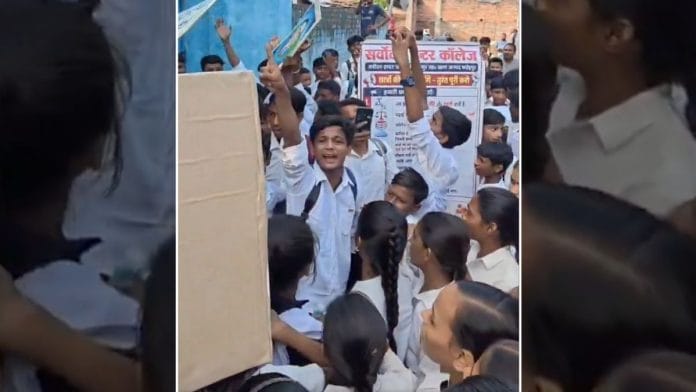
New Delhi: Generation Alpha school children have staged protests across multiple Indian states, demanding basic amenities in government schools. The young students are calling for functional classroom fans, clean drinking water, hygienic toilets, the appointment of teachers to fill vacant positions, and other basic amenities.
Videos of these demonstrations have circulated widely on the internet, with many describing it as a continuation of the Gen Z-led mobilisations over education issues, including the 2026 NEET paper leak scandal that led to the resignation of Union Education Minister Dharmendra Pradhan.
The most prominent demonstration took place in Uttar Pradesh on 28 July at Sarvodaya Inter College, Kishanpur town, Fatehpur district. Nearly 1,500 students from Classes 6 to 12 walked out of their classrooms and staged a sit-in that lasted five to six hours.
Carrying placards and portraits of BR Ambedkar, they marched through the locality raising slogans such as “College ki vyavastha sudharo, bacchon ka bhavishya sanwaro (improve the condition of colleges for a better future)” and “Humari maangey puri karo (fulfil our demands).
The students complained against the lack of electricity or working fans in the classrooms (some of which had allegedly given electric shocks), shortage of desks and benches, unhygienic toilets, irregular and unsafe drinking water, mid-day meals that never matched the prescribed menu, and the complete absence of a library, computer lab or sports facilities.
The school principal, Lal Bahadur Singh, later told the media that the administration had accepted most of the demands. Four fans would be installed in every classroom, electrical wiring would be repaired, desks and benches for the junior classes would arrive within a month, an RO plant and water cooler would be provided, and meals would henceforth follow the official menu.
District education officials also inspected the campus.
A similar protest unfolded at the Jawahar Navodaya Vidyalaya in Pilibhit. Students of Classes 10, 11 and 12 came out of the school and marched on the highway after teachers seized fourteen mobile phones during a routine check. Phones are banned on the residential campus, yet the students demanded tablets, laptops and Wi-Fi so they could prepare for competitive examinations, alleging harassment.
The sub-divisional magistrate (SDM) and a police team, including the Circle Officer, reached the spot, counselled the students and spoke with their parents. After the intervention, the children returned to school, but the teaching remained disrupted on the second day as an inquiry team examined the matter.
Bihar
On 30 July, around 40-50 students of Simuara Middle School in the Gaya district, Bihar, marched nearly four kilometres to the SDM’s office. Students from Classes 6 to 8 sat outside the building and refused to disperse or speak with junior officials at the SDM’s office. They insisted on meeting the SDM.
Their grievances included poor quality mid-day meals in which insects had allegedly been found, a broken hand pump that left them without clean drinking water, dirty toilets, classrooms without fans, broken benches and lack of sports equipment. The SDM, Praveen Kundan, eventually met a group of six students, including three girls, in the presence of teachers.
He ordered a three-member committee to investigate the matter and gave the headmaster a deadline of four to five days to resolve every complaint. Show-cause notices were issued to staff and salaries for the day of the protest were withheld pending explanations. An inquiry into the mid-day meal scheme was also launched.
Also read: Jharkhand’s govt job dream is trapped in an examination system aspirants no longer trust
Rajasthan
Rajasthan’s protests focused on teacher shortages. At the Government Senior Secondary School in Solankiyon Ki Dhani Bankalpura in Barmer district, students locked the gates on 25 July. They again locked the gates on 27 July, but this time the parents joined them.
Nearly two months into the academic session, several classes remained without teachers because sanctioned posts had stayed vacant. The students demanded the immediate posting of first, second and third-grade teachers until permanent appointments could be made.
After nearly two hours of discussion, the district education officer assured them that three teachers would be deployed at once and that subject-specific teachers would follow. The sit-in was then withdrawn.
A similar scene unfolded at a government school in Mengalwa village of Jalore district, where students again locked the gates and sat in protest over severe shortages of teachers. Administrative officials eventually persuaded them to return to class.
Also read: Echoes of Jantar Mantar—Jharkhand students rise against JPSC, JSSC paper leaks
Madhya Pradesh
In Madhya Pradesh, students of the Eklavya Adarsh Aawasiya Vidyalaya, a residential school in Tamia of Chhindwara district, also staged a protest in late July. They sat on the road despite heavy rain, protesting the quality of the mess food.
They alleged that insects had repeatedly been found in dal and vegetables, that the menu never changed, and that sports equipment and health facilities were inadequate. Despite several earlier complaints, they said, nothing had improved.
The principal claimed the agitation was partly the work of the previous mess vendor and that some students were instigating the rest.
Maharashtra
In Dahanu of Palghar district, Maharashtra, schoolchildren highlighted unhygienic washrooms and unsafe surroundings, claiming that water was supplied only when official inspections took place.
Elsewhere, in Beed district, students of Vaidyanath Vidyalaya in Parli boycotted classes over prolonged teacher absenteeism. In Dharashiv, Class 10 students of a Zilla Parishad school began an indefinite sit-in outside the CEO’s office, demanding regular secondary teachers before board examinations. Parents and villagers joined them, arguing that years of vacant posts had left the children unprepared.
Across states, students have locked gates, marched in groups, insisted on speaking to senior officers rather than juniors, and answered questions in unison. The recurring slogan “Hum apna adhikar maangte, nahi kisi se bheekh maangte” has been heard.
In most cases, local officials responded with timelines, committees or immediate promises, and the protests ended without major violence.
(Edited by Saptak Datta)