



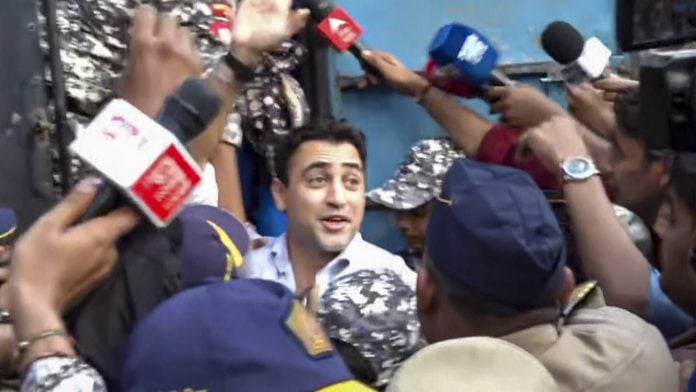
New Delhi: The Bombay High Court Monday listed Bollywood actor-filmmaker Imran Khan’s writ petition for hearing next week. Khan, a US citizen who has lived in India for 42 years, has challenged a Leave India Notice (LIN) issued to him by the Mumbai Foreigners Regional Registration Officer (FRRO) after he was briefly detained in connection with a Mumbai protest against the Election Commission of India.
The notice directed the 44-year-old to leave India by 28 October.
In his plea, Khan argues that the Leave India Notice (LIN) is without jurisdiction, and is unconstitutional as he was not given an opportunity to be heard.
ThePrint explains what the dispute is, which statutes are invoked and what Imran Khan has argued before the high court.
What happened & sections invoked against Imran Khan
According to Khan’s petition, on 10 October, he was near Nana Chowk at around 5 pm when he saw barricades, and turned back as directed.
When approached by reporters, the petition adds, he said: “I don’t have demands. I am here as a citizen, as a person who lives in this city. I am here to see why the freedom of movement is being restricted, why people’s voices are being oppressed and suppressed. That’s why I am here… meri koi aukaat nahi hai ki main logo se kuch demand karu or na hi mein kisi organization ka hissa hu…”
The Mumbai Police apprehended him around 5.20 pm, and he was released at 7 pm. But later that evening, the Gamdevi Police registered an FIR against him under sections relating to disobedience to public servant’s order, wrongful restraint, unlawful assembly and rioting, of the Bharatiya Nyaya Sanhita.
According to the FIR, Imran Khan came to August Kranti Maidan at around 3.30 pm and incited a crowd of 350 to 400 people in violation of a police order.
Khan in his petition argues that this allegation is factually false and contradicted by CCTV footage showing he only arrived after 5 PM, inquired about police barricading, complied immediately when told to leave, and was apprehended while speaking to media persons. The petition stresses that these BNS offences are bailable, carry maximum sentences under two years, and remain under investigation without any chargesheet.
On 14 October, the FRRO issued the LIN under Section 7(2)(c) read with Section 29 of the Immigration and Foreigners Act, 2025 (IFA). The notice states that Khan “contravened the provisions of the Immigration and Foreigners Act, 2025 and the Rules and Orders made thereunder”. The actor contends that the notice does not cite any specific breach.
Section 7(2)(c) empowers the central government to issue orders, directions or instructions stating that a foreigner must leave India. Section 29 says the central government can direct the removal of a foreigner from India under three conditions—contravention or violation of any provision of the IFA, breach of any rule or direction or order made under the Act, and based on an adverse security report.
Khan has argued that he is a registered Overseas Citizen of India (OCI) since 15 December 2006, under Section 7A(1) of the Citizenship Act, 1955, and the petition emphasizes that Sections 7A to 7D form a “complete and self-contained code for Overseas Citizens of India”.
While Section 7B(1) of the Citizenship Act grants lifelong residence rights, Section 7D exhaustively enumerates cancellation grounds, requiring a “reasonable opportunity of being heard”.
Bypassing Section 7D by resorting to general IFA expulsion powers renders the LIN “without jurisdiction and void ab initio”, Khan has said in his petition, arguing that he was not given the opportunity to present his explanation.
Additionally, Section 29 of IFA requires a contravention under Section 20 or an adverse security report. Even if a violation of Section 11 IFA (visiting prohibited places) is alleged, no Gazette notification declaring Nana Chowk as a prohibited place exists, Khan’s plea states.
Furthermore, MHA’s recent notification requires special permits for OCIs only for specific activities like research or journalism, not public presence, Khan has submitted.
Also read: Imranissance is here. Why young adults are falling back in love with Imran Khan
Constitutional wrongs and judicial precedents
Article 14 protects “any person” within India. Khan has challenged the LIN for being “a generic, template-style, non-speaking order”. The action, he said, fails the triple test of proportionality—rational connection, minimal impairment, and balanced effect.
The petition invokes Articles 14 (equality before law) and 21 (life and personal liberty), protecting “any person” in India. Citing E.P. Royappa v. State of Tamil Nadu (1974) and Ajay Hasia v. Khalid Mujib Sehravardi (1981), Khan has argued that arbitrary state action violates Article 14.
Relying on Mohinder Singh Gill v. Chief Election Commissioner (1978), he asserts an administrative order must stand on reasons within it and cannot be supplemented later. The LIN, he says, is a mechanical template misidentifying the IFA as ‘Act XII of 2025’ and ignoring his OCI status.
Expelling a resident without a hearing violates natural justice and fails the proportionality test, he contends.
The LIN was issued in extraordinary haste, within 4-5 days, following public social media demands on X by a political leader who even leaked the unredacted LIN and passport details, Imran Khan has argued in his petition. Alleging malice in law, he points to political pressure and leaked passport details, seeking a writ of certiorari—a legal mechanism that allows higher courts to review decisions made by lower courts or administrative bodies—quashing the LIN and an ad-interim stay on his deportation.
Prior similar cases
Indian courts have ruled on similar cases in the past. Kamil Siedczynski, a Polish student pursuing his Master’s degree at Jadavpur University in Kolkata, was served a Leave India Notice by the FRRO in 2020. The government alleged he had engaged in “anti-government activities” by standing and being photographed at an anti-CAA political rally in the city.
The Calcutta High Court quashed the LIN, ruling that mere peaceful presence or passive participation in a political rally is not a sufficient ground to deport a foreigner. The court noted that unless the State can produce an adverse security report proving the individual constitutes a threat to public order or national security, a blanket expulsion via a LIN is arbitrary and violates the right to a fair procedure.
In March 2025, Sweden-based academic Ashok Swain’s OCI card was cancelled for allegedly making “anti-national” comments and criticising government policies online. The Delhi High Court quashed the cancellation order, ruling that the government failed to provide specific, adequate reasons or concrete evidence justifying its decision.
However, when Raphael Satter, an American cybersecurity journalist, challenged the revocation of his OCI card, which the government cited as a violation for “maliciously creating adverse opinions against Indian institutions”, the High Court did not grant relief. The Ministry of Home Affairs argued that OCI cardholders are foreign nationals who do not possess fundamental political rights under Article 19 of the Constitution.
During subsequent hearings before Justice Sachin Datta, the Delhi High Court pushed back against MHA’s handling of the case. When senior advocate Karuna Nundy (representing Satter) argued that the review process lacked transparency, noting that the state had decided a revision petition a year prior without communicating it to Satter, the judge questioned the government’s paperwork and remarked on the vagueness of the “journalistic activity” claims. The matter remains sub-judice.
(Edited by Gitanjali Das)