





In the 2008 rom-com, Jaane Tu Ya Jaane Na, Jai Singh Rathore has to clear three tests to prove he is a true son of Ranjore. One of which is getting arrested.
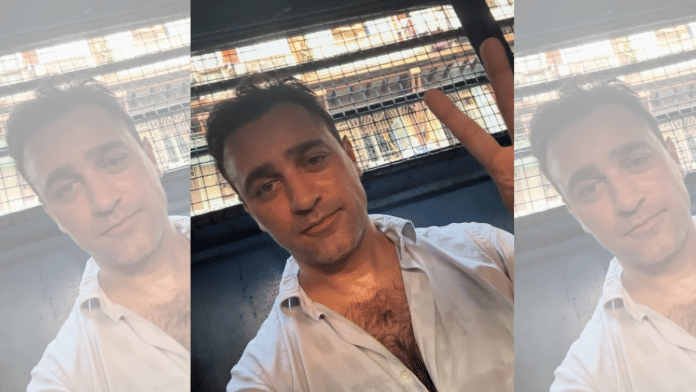
Seventeen years later, Imran Khan, our beloved Jai, found himself in a Mumbai Police van at August Kranti Maidan after being detained during a protest demanding Chief Election Commissioner Gyanesh Kumar’s resignation.
The internet reacted as one would expect when life accidentally imitates a 2008 rom-com. It generated reels and memes. One meme used a still of Naseeruddin Shah and Ratna Pathak to declare that Jai had finally proved he was a real Rathore warrior.
Imran, for his part, posted a photo from inside the van, raising a peace sign.
“Apparently I’m going for a drive,” he captioned it. Very Jai-coded.
Five days after his detention, the Foreigners Regional Registration Office issued Imran, an American citizen with an Overseas Citizen of India (OCI) card, a notice asking him to leave India by 28 October.
While Imran has challenged the notice in the High Court, social media is flooded with reminders of why the actor was once Bollywood’s heartthrob.
His song ‘Dhat Teri Ki’ from the 2013 movie Gori Tere Pyaar mein found an unlikely new use as the soundtrack to his detention videos. Clips of him being taken away by the police were set to ‘Dhunki’, the Katrina Kaif number from their 2011 film, Meri Brother Ki Dulhan. While the song showed Kaif’s character getting escorted by the police, the 2026 version featured Imran being stuffed in a police van.
Then, there were the “three Imran Khans” memes, linking him to a jailed Pakistani politician and a Dutch-Pakistani singer. And, of course, the inevitable: Jai Singh Rathore, finally clearing the third test.
Either way, the Imranissance is here.
But let’s be real, nobody is revisiting these songs and films because they’ve been rediscovered as masterpieces. They’re doing so because the man they loved in them turned out to be, well, the man they loved.
The boy next door
Imran was the original chocolate boy. Soft hair, soft eyes, the best friend you realise you’ve loved all along. Jaane Tu ya Jaane na won him a Filmfare for Best Male Debut and a “next big star” label. Then came the rom-com run of I Hate Luv Storys (2011), Break Ke Baad (2010), Mere Brother Ki Dulhan (2011) and Ek Main Aur Ekk Tu (2012). Kidnap (2008) and Luck (2009) were early attempts at being an action hero, but we don’t talk about those. Delhi Belly (2011) turned out to be his cult classic.
A string of flops then followed Imran, and after Katti Batti’s (2015) failure, Imran vanished from Bollywood. He has said he couldn’t be bothered with what the profession demands, calling the years that followed “hibernation”.
A decade later, he reappeared with a cameo in Happy Patel: Khatarnaak Jasoos (2026) and recently announced a Netflix film, Adhure Hum Adhure Tum, the fate of which remains uncertain.
With his clips circulating again, the crush is back. Except this time, the interest is not being driven by his new romantic comedy, but by the man himself.
Also Read: I walked into Jantar Mantar a nervous student. I walked out a citizen
A crush with a cause
This is not the first time Imran has spoken about public issues.
In 2009, he appeared in the Times of India campaign “Is desh ka kuch nahi ho sakta (Nothing can change this country)”, alongside several other Bollywood A-listers. The ad questioned public apathy toward issues including pollution, criminal politicians and communal violence.
In a recent interview with Main Hoon Yuva, he made the argument that criticising a politician is not criticising the country. Imran said that any authority should be able to justify itself when questioned.
So the shift is not that Imran has suddenly discovered his political voice. It is that he has become more visible in using it. And at a time when celebrity activism often amounts to a story post that disappears in 24 hours, or doesn’t come up at all, his detention during a protest and the following FRRO order have not just attracted attention, but also admiration.
Social media, obviously, did the rest.
The generation that grew up on Jai and Aditi is now old enough to vote. And it has noticed that our beloved ‘Ratz’ turned out to be one of those rare celebrities choosing to speak up.
Jai Singh Rathore would probably have something to say about all this. The internet certainly does. And in an industry that mostly looked away, a Rathore of Ranjore, as tradition demands, did not.
Views are personal.
(Edited by Insha Jalil Waziri)